
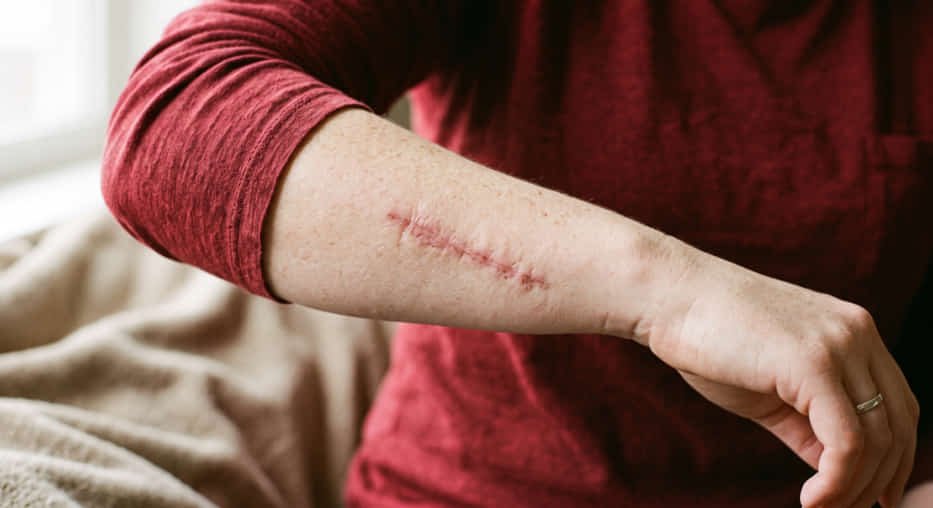
Our skin is remarkably good at repairing itself. A small cut, scrape, or burn can heal within days, often with very little intervention. Yet even after the wound has closed, it may leave behind a scar, a permanent reminder of an injury. Why doesn’t the body simply replace damaged skin with brand-new skin?
The answer lies in how the body balances speed and survival. When your skin is injured, its first priority is not to make the area look perfect again but to protect you from blood loss and infection as quickly as possible.
The healing process begins almost immediately after an injury. Blood vessels constrict to reduce bleeding, and platelets form a clot that seals the wound. At the same time, immune cells rush to the site to destroy invading microbes, remove dead cells, and clean up damaged tissue. This rapid response creates the ideal conditions for repair while reducing the risk of infection.
Once the wound is clean, the body begins rebuilding the damaged tissue. If the injury affects only the outer layer of the skin, known as the epidermis, new skin cells can grow and replace the damaged ones. In many cases, the wound heals completely with little or no visible mark.
However, when the injury extends into the deeper layer called the dermis, the repair process becomes more complicated. The dermis contains blood vessels, nerves, hair follicles, sweat glands, and a network of collagen fibres that give the skin its strength and flexibility. Rebuilding this highly organised structure exactly as it was would take a long time. Instead, the body opts for a faster solution by filling the damaged area with collagen, a tough structural protein that acts like a biological patch.
The collagen in scar tissue is arranged differently from that in healthy skin. Normal skin has collagen fibres woven into a flexible, basket-like pattern, allowing it to stretch and move easily. In contrast, scar tissue contains thicker collagen fibres aligned in the same direction, making it stronger but less flexible. This is why scars often feel firmer than the surrounding skin and may appear paler, darker, or slightly raised. Scar tissue also lacks hair follicles, sweat glands, and some nerve endings, so it behaves differently from normal skin.
Although scars rarely disappear completely, they usually become flatter, softer, and less noticeable over months or even years. During this time, the body gradually remodels the collagen, improving the scar’s appearance. While scars may not restore the skin to its original state, they are a remarkable example of the body’s ability to repair itself quickly, choosing protection and function over perfection.


