
There’s an old saying: “What goes around comes around.” For decades, we have used plastic because it is cheap, lightweight, and convenient. Now, scientists are discovering that tiny pieces of it may be finding their way back to us, in our food, our water, the air we breathe, and even inside our bodies.
Plastic is everywhere. From the water bottle on your desk and the takeaway container from lunch to the synthetic clothes you wear and the packaging around groceries, plastic has become part of everyday life. As these products age, sunlight, heat, and wear slowly break them into tiny fragments called microplastics, which are smaller than 5 millimetres. Even tinier pieces, known as nanoplastics, are so small that they cannot be seen without powerful microscopes.
In recent years, scientists have made a surprising discovery. These tiny plastic particles have been detected in human blood, lungs, liver, placenta, and even brain tissue. This doesn’t mean they are definitely causing disease, but it does show that they can travel much farther through the body than anyone once imagined.
So, how do they get there?
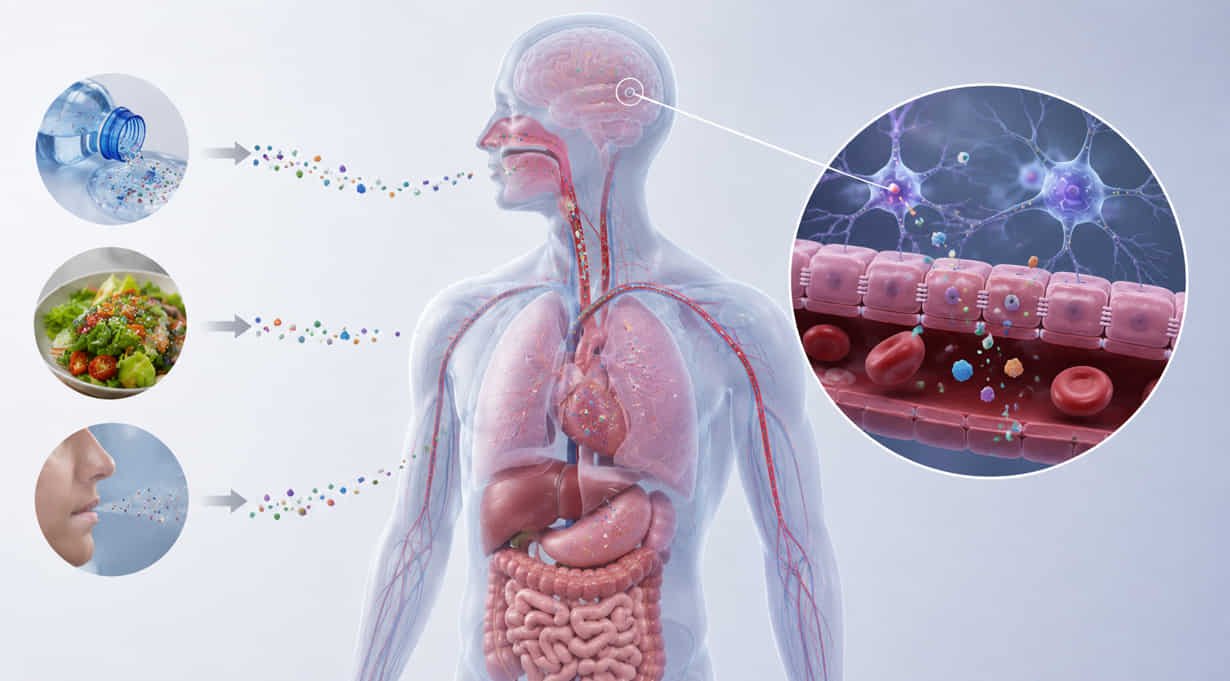
Think about drinking a bottle of water, eating seafood, or simply taking a deep breath while walking along a busy road. Microplastics can enter our bodies through food, drinking water, and the air we inhale. Once inside, some particles pass through the lining of the gut or lungs and enter the bloodstream. The smallest nanoplastics may even cross the blood, brain barrier, a protective shield that normally keeps many harmful substances away from the brain.
Naturally, this raises an important question: Should we be worried?
Scientists are still searching for the answer. Laboratory studies suggest that microplastics may trigger inflammation, the body’s defence response that can become harmful if it continues for too long. They may also promote oxidative stress, a process in which unstable molecules, called free radicals, damage cells faster than the body can repair them. In addition, these tiny particles can act like miniature “taxis,” carrying chemicals such as bisphenol A (BPA), phthalates, environmental pollutants, and even microbes into the body.
Researchers are investigating whether years of exposure could affect the heart, lungs, reproductive system, or brain. However, it’s important to separate possibility from proof. Most of the evidence so far comes from laboratory experiments and animal studies. Scientists have not yet shown that microplastics directly cause these diseases in humans, and long-term studies are still underway.
Can we avoid microplastics completely? Probably not. They have become part of our environment. But we can reduce our exposure. Using glass or stainless-steel containers, especially for hot food and drinks, avoiding heating food in plastic containers, choosing fresh foods over heavily packaged products, limiting single-use plastics, and drinking filtered water when possible are all sensible steps.
The proverb “An ounce of prevention is worth a pound of cure” seems especially relevant here. Microplastics have become part of modern life, and now, part of our bodies. The next challenge for science is not simply discovering where they are, but understanding what they mean for our long-term health. Until clearer human evidence emerges, reducing unnecessary exposure is a practical precaution that costs little but may prove worthwhile.


