
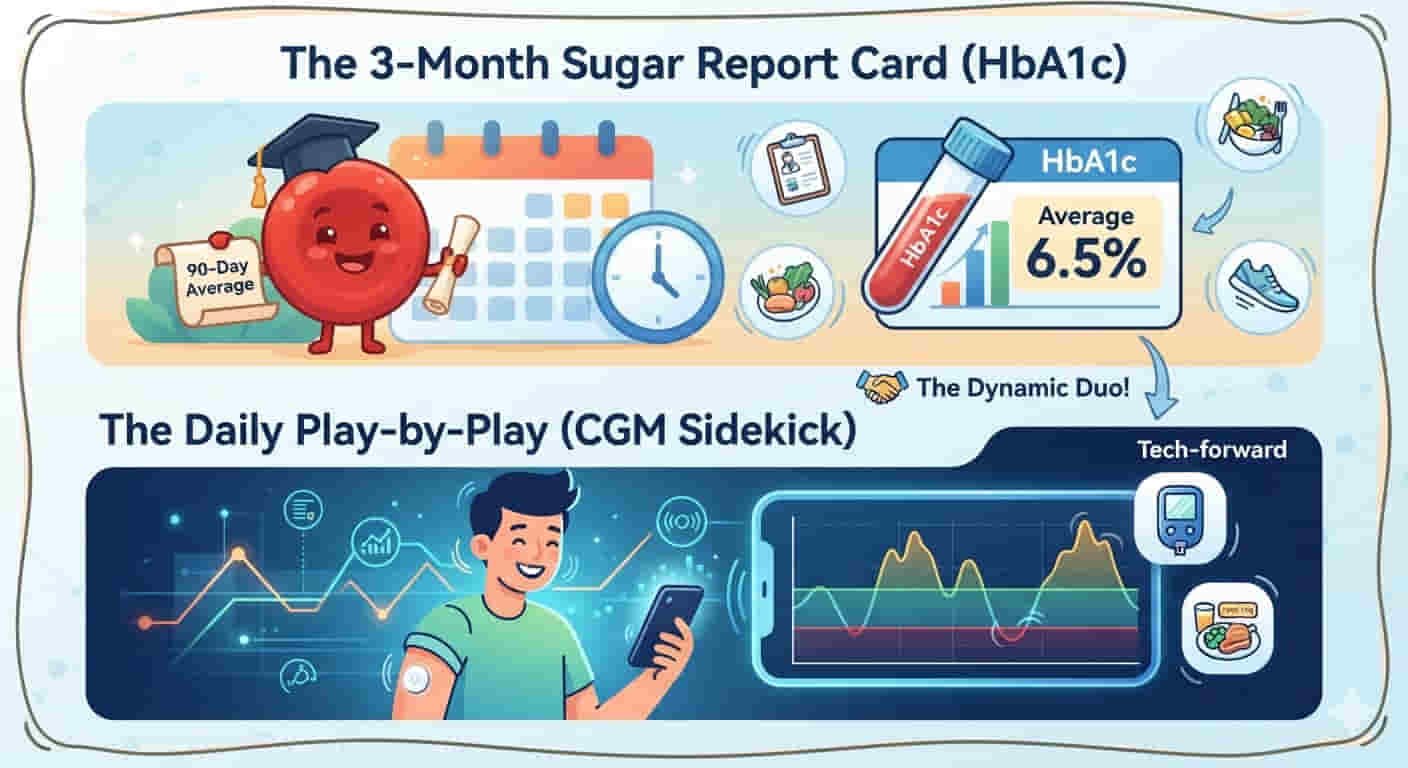
Imagine if your body kept a 90-day diary of your blood sugar, and your doctor could read it with a single blood test. That’s exactly what the HbA1c (Hemoglobin A1c) test does. While a finger-prick test or a glucose monitor tells you what your blood sugar is right now, HbA1c reveals the bigger picture: how well your blood sugar has been controlled over the past two to three months. It works by measuring how much glucose has attached itself to hemoglobin, the oxygen-carrying protein inside red blood cells.
Since these cells live for about 120 days, they carry a lasting record of your average blood sugar levels. The more sugar in your bloodstream over time, the more sticks to hemoglobin, rather like caramel coating an apple. This simple yet powerful test has been the gold standard for diagnosing and monitoring diabetes for decades because it doesn’t fluctuate with what you ate for breakfast or whether you exercised that morning. Instead, it provides an honest “report card” of your long-term metabolic health, helping doctors detect diabetes early, assess treatment success, and reduce the risk of complications affecting the eyes, kidneys, nerves, and heart.
| “The body keeps a silent record of every choice we make. Long before symptoms appear, our blood begins writing a story that science has learned to read.” |
However, as the saying goes, “averages don’t tell the whole story.” Imagine two students who both score 75% on an exam. One consistently scores around 75 on every test, while the other swings wildly between 100 and 50. Their average is the same, but their learning patterns are very different. HbA1c works in much the same way. Two people may both have an HbA1c of 6.5%, yet one enjoys stable blood sugar throughout the day while the other experiences sharp spikes after meals followed by dangerous drops during the night. Because HbA1c only reports the average, these highs and lows can remain hidden.
Certain medical conditions can also make the test less accurate. People with anemia, recent blood loss, pregnancy, kidney disease, or disorders that affect red blood cell lifespan may have HbA1c results that don’t truly reflect their glucose control. In these situations, doctors interpret the result carefully and may recommend additional tests. So, while HbA1c remains an excellent long-term indicator, it is not a complete picture of day-to-day glucose behavior.
This is where modern technology steps in. Continuous Glucose Monitors (CGMs) are transforming diabetes care by measuring glucose levels every few minutes, day and night. Instead of providing a single average, a CGM creates a movie, while HbA1c provides the summary at the end. One of the most valuable CGM measurements is Time in Range (TIR), the percentage of time a person’s glucose stays within the recommended target range.
It reveals how often blood sugar is stable, how frequently it spikes after meals, and whether it falls too low during sleep or exercise. Doctors now increasingly use HbA1c and CGMs together, because the two tests complement rather than compete with each other. HbA1c tells the long-term story, while CGMs reveal the daily chapters. Like checking both your bank balance and your daily spending habits, combining these tools provides the clearest understanding of metabolic health. Even in the era of wearable technology, the trusted HbA1c test continues to earn its place as one of medicine’s most valuable tools, not because it tells the whole story, but because it tells an essential part of it.
Did you know?
- “A single number can never tell the whole story, but it can reveal the direction of the journey. In medicine, looking back is often the first step toward moving forward.”
- “Like the rings of a tree reveal its years, our blood carries the history of our health. The challenge is not just measuring sugar — but understanding the story it tells.”
- “Good health is not built in a day — it is written quietly, one heartbeat and one meal at a time. Sometimes, the most powerful test is the one that tells the story of the past, not just the moment.”
- “Technology may show us every moment, but wisdom comes from seeing the bigger picture. Health is measured not only by today’s numbers, but by yesterday’s patterns.”


