
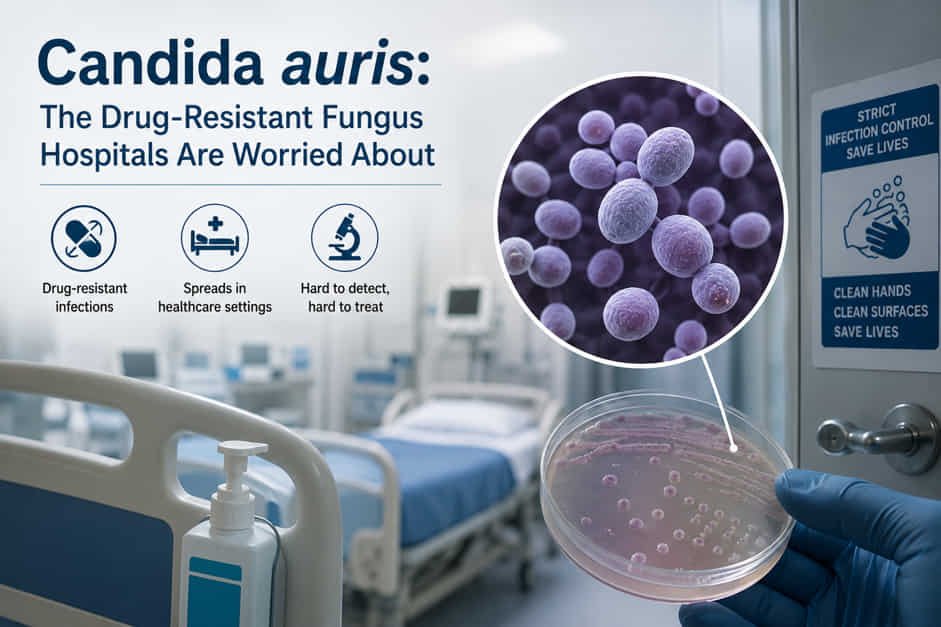
When we think about drug-resistant microbes, bacteria such as the ones responsible for antibiotic resistance usually steal the spotlight. But bacteria aren’t the only microorganisms evolving to evade our medicines. Fungi are joining the race too, and one species has become a growing concern for hospitals worldwide: Candida auris (C. auris). First identified in 2009, this microscopic yeast has spread to healthcare facilities across many countries, earning a place on the World Health Organization’s list of priority fungal pathogens. Unlike the harmless yeast used to bake bread, C. auris can cause life-threatening infections in vulnerable patients.
What makes it particularly worrying isn’t just its ability to cause disease, it’s its remarkable talent for surviving in hospitals, resisting multiple antifungal drugs, and spreading silently from one patient to another. In many ways, it’s like an uninvited guest that refuses to leave and knows exactly how to avoid being caught.
C. auris often begins its journey quietly. It can live on a person’s skin without causing any illness, a state known as colonisation. Many people carrying the fungus don’t even know it’s there. Trouble begins when it enters the bloodstream, surgical wounds, or internal organs, where it can cause serious infections. Patients at greatest risk include those in intensive care units, people with weakened immune systems, premature babies, and individuals using medical devices such as ventilators, central venous catheters, or urinary catheters.
| “The greatest threats are not always the loudest. Sometimes, the most dangerous enemies are the ones we cannot see—and the ones that learn to outsmart our medicines.” |
One reason doctors are concerned is that many strains of C. auris are resistant to one or more major classes of antifungal medicines, and some are resistant to nearly all available treatments. This leaves physicians with far fewer options than they have for treating most fungal infections, making rapid diagnosis and appropriate therapy critically important.
The fungus is also unusually skilled at surviving in healthcare environments. While many microbes disappear after routine cleaning, C. auris can persist for weeks on bed rails, door handles, medical equipment, mattresses, and other hospital surfaces. A patient carrying the fungus may unknowingly contaminate these objects, allowing it to spread to others through healthcare workers’ hands or shared equipment if strict infection-control measures aren’t followed. To make matters worse, C. auris can sometimes be mistaken for other yeast species in routine laboratory tests, delaying both treatment and outbreak control.
It’s a reminder that “a stitch in time saves nine”, the earlier hospitals identify the fungus, the easier it is to prevent larger outbreaks. Today, many hospitals use advanced laboratory techniques and enhanced surveillance programs specifically designed to detect C. auris quickly and accurately.
The reassuring news is that healthy people going about their daily lives are at very low risk of developing serious C. auris infections. The fungus is primarily a threat in hospitals and long-term care facilities, where patients are already medically fragile. Preventing its spread depends on simple but powerful measures: careful hand hygiene, proper use of personal protective equipment, thorough environmental cleaning with effective disinfectants, rapid laboratory identification, and strict infection-control practices.
The rise of Candida auris also highlights a broader lesson. Drug resistance is not just a bacterial problem, fungi are evolving too. As microbes continue to adapt, medicine must do the same by developing new antifungal drugs, faster diagnostic tests, and stronger infection-prevention strategies. After all, in the ongoing battle against infectious diseases, staying one step ahead is always better than trying to catch up.


