
Most people think of bats as creatures that bring only fear. But what if these night fliers are actually carrying a secret that could help save human lives? As the saying goes, “Do not judge a book by its cover.” Bats may look mysterious, yet they could be nature’s hidden medicine chest. “Nature often hides its greatest treasures in unexpected places,” as many scientists like to say. Like quiet librarians guarding valuable books, bats may be protecting important lessons about health that we are only beginning to read.
Bats are mammals, just like humans, but they have an amazing ability. They can carry viruses linked to diseases such as COVID-19, Ebola, Nipah, and Marburg without becoming seriously sick. While these viruses can cause severe illness in people and many other animals, bats often stay healthy. This makes scientists ask an important question, “What makes bats so different?” The answer seems to lie in their immune system, the body’s natural defence army that fights harmful germs.
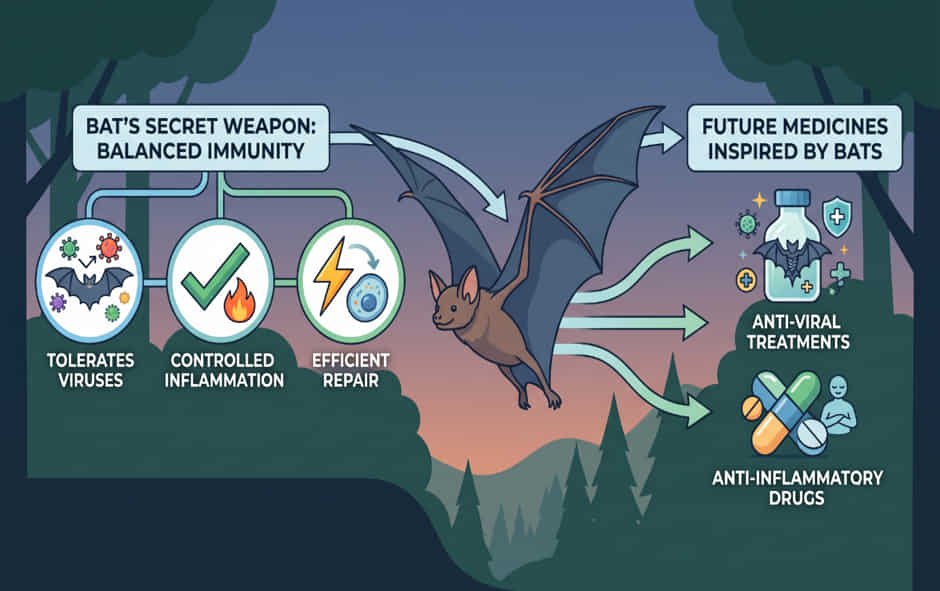
Our immune system is like a security guard. When a virus enters the body, it raises the alarm and sends immune cells to fight the invader. But sometimes the guard becomes too aggressive. Instead of protecting the building, it starts breaking the furniture. This overreaction, called inflammation, can damage healthy tissues and make a disease even worse. Bats appear to have found a better balance. Their immune system attacks viruses quickly but avoids causing too much inflammation, allowing them to live peacefully with many viruses.
Scientists believe this special ability may have evolved because of flight. Flying is one of the hardest jobs in the animal kingdom. Every flight is like running a marathon in the sky. It produces stress inside the body and can damage cells. Over millions of years, bats seem to have developed powerful ways to repair this damage and keep inflammation under control. These same adaptations may also help them tolerate viruses that would make many other mammals seriously ill.
The COVID-19 pandemic brought bats into the global spotlight because viruses related to SARS-CoV-2 have been found in several bat species. However, this does not mean bats are directly responsible for infecting people. Direct transmission from bats to humans is uncommon. Scientists say that human activities such as wildlife trade, cutting forests, and disturbing natural habitats open the door for viruses to move between animals and humans. In many cases, people unknowingly build the bridge that viruses later cross.
Researchers are now looking closely at bat biology, hoping to turn nature’s lessons into better medicines. If scientists can understand how bats control viruses without harming their own bodies, they may discover new ways to treat infectious diseases and conditions caused by excessive inflammation. This work involves fields such as immunology, virology, genetics, and evolutionary biology, each adding another piece to the puzzle.
So, the next time a bat silently flies across the evening sky, think twice before calling it a villain. It may be a tiny teacher wearing a dark cloak, carrying answers that medicine has searched for over many years. Sometimes the smallest wings carry the biggest hopes, reminding us that nature still has many stories left to tell.


