
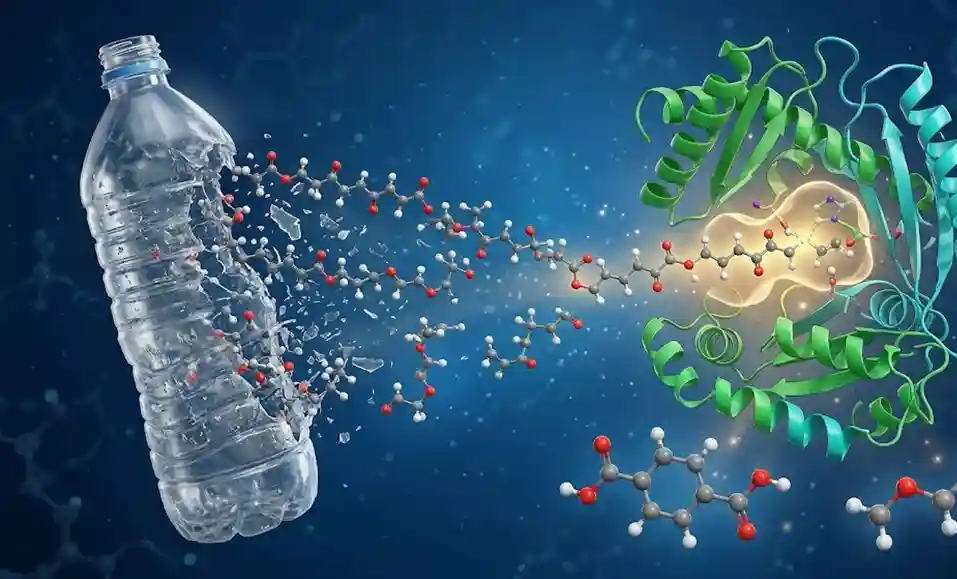
Plastic is everywhere, but once it is thrown away, it often becomes a stubborn guest that refuses to leave. Every year, millions of tonnes of plastic pile up in landfills and oceans, silently choking nature. Even recycled plastic usually gets a second life as lower quality products like flower pots or park benches, before finally becoming waste. It is like passing an old book from one person to another until its pages fall apart. But scientists now believe they have found a smarter solution. “Why throw plastic away when we can give it a fresh beginning?” they ask. As the proverb says, “Where there is a will, there is a way.” These tiny biological helpers, called super enzymes, may become the superheroes of the recycling world.
Enzymes are natural proteins that work like skilled factory workers inside every living organism. They speed up chemical reactions, helping us digest food and keeping our bodies running smoothly. Now scientists are training these tiny workers for a new mission, fighting plastic pollution. Researchers at the University of Manchester studied polycarbonate, a strong plastic used in safety glasses, electronic gadgets, and machine parts. This plastic is as tough as a locked treasure chest because it is made to last for many years. Using a method called directed evolution, scientists repeatedly improved an enzyme until it learned to break this hard plastic into its original chemical building blocks. It is much like sharpening a key until it perfectly opens a stubborn lock. One small change after another made a big difference.
The journey, however, is not without hurdles. Before enzymes can break plastic, the material must be heated to nearly 70°C. Sadly, most enzymes behave like an ice cream under the summer sun, losing their shape and becoming inactive. To solve this problem, scientists looked towards extremophiles, tiny microorganisms that happily live in boiling hot springs and deep sea hydrothermal vents. Their heat resistant proteins became teachers for designing stronger enzymes. Artificial intelligence then entered the story like a brilliant coach, predicting which changes would make these enzymes faster, stronger, and more stable. This perfect partnership between biology and AI shows that two heads are indeed better than one.
The impact of this discovery could reach far beyond plastic bottles. Similar super enzymes may one day recycle synthetic clothes, electronic waste, and even waste produced during future space missions. Instead of treating plastic as useless rubbish, we may soon see it as a valuable resource waiting for another chance. This is the heart of a circular economy, where materials travel in circles instead of ending in landfills. As a famous saying reminds us, “Nature does not waste anything.” By learning from nature’s own chemical workers, scientists are opening the door to a cleaner planet where yesterday’s waste becomes tomorrow’s wealth.


