
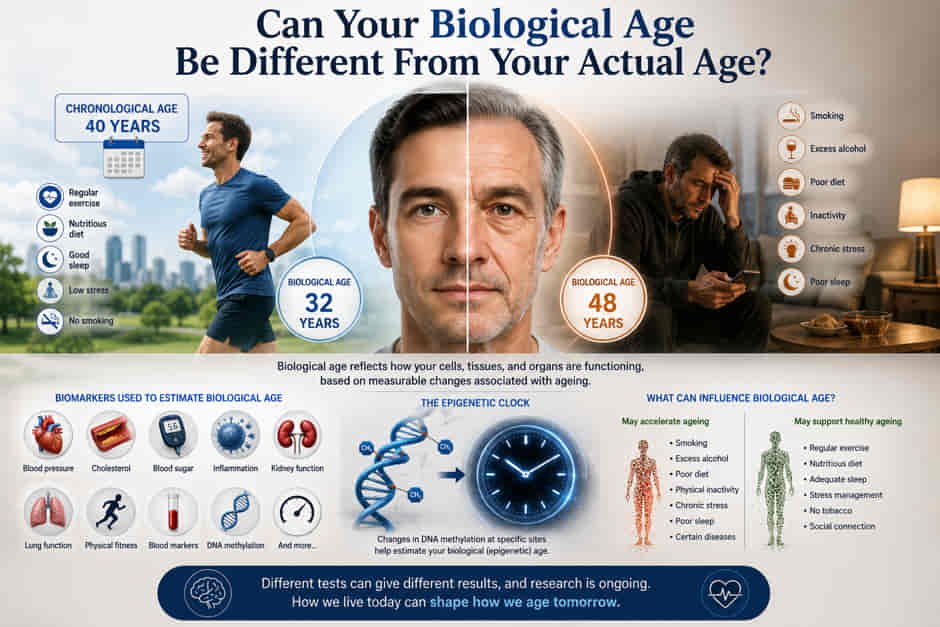
“Age is just a number,” people often say. Science agrees, but only partly. Imagine two friends who are both 40 years old. One climbs stairs like a teenager, while the other feels tired after a short walk. They share the same birthday count, yet their bodies seem to tell different stories. Your birth certificate counts the years, but your body writes its own report card. Like two identical-looking cars that have travelled different roads, one may run like new while the other may already be asking for repairs.
We usually calculate age by subtracting our birth year from the current year. This is called chronological age. It never changes direction, the calendar only moves forward. But scientists also talk about biological age, which reflects how healthy and “young” your body’s cells, tissues, and organs are. Think of your body as a large orchestra. If every instrument plays in harmony, the music sounds fresh. If several instruments fall out of tune, the performance begins to show its age.
Biological age is measured using clues inside the body, called biomarkers. These include blood pressure, blood sugar, cholesterol, inflammation, kidney function, lung function, physical fitness, and even tiny changes inside DNA. One of the most exciting tools is known as the epigenetic clock. It does not count birthdays. Instead, it reads small chemical marks on DNA, rather like a librarian reading notes written in the margins of a book to understand how often it has been used.
This process is based on epigenetics, the study of chemical changes that control how genes work without changing the DNA itself. One important change is called DNA methylation. As we grow older, these chemical marks change in predictable ways. Scientists use advanced computer models to study these patterns and estimate a person’s biological age. It is almost as if the DNA whispers, “Here is how much wear and tear I have experienced.”
Many factors influence biological ageing. Our genes play a role, but they are only part of the story. Daily habits also leave their fingerprints on the body. Smoking, too much alcohol, poor sleep, unhealthy food, lack of exercise, long-term stress, and certain illnesses may speed up biological ageing. They quietly add extra miles to the body’s engine. On the other hand, regular exercise, balanced meals, good sleep, and staying away from tobacco help the body stay healthier for longer. As the old saying goes, “A stitch in time saves nine.” Small healthy choices today may prevent bigger health problems tomorrow.
Still, biological age is not a magic prediction of your future. Different biological clocks measure different features of ageing, so two tests may give different answers for the same person. Scientists are still studying which methods best predict future health, disease risk, and lifespan. In simple words, these tests are useful guides, not fortune tellers. They can point towards the road ahead, but they cannot see every bend.
Researchers are also exploring whether biological ageing can be slowed or even partly reversed. Some studies have shown that healthy lifestyle changes may improve certain ageing markers. However, this does not mean people can simply rewind time or become twenty again. The body’s clock is clever, but it is not a movie that can be played backwards. Claims of miracle anti-ageing treatments should be taken with caution because extraordinary promises often hide ordinary truths.
So, can your biological age be different from your actual age? The answer is yes, at least in many cases. Your chronological age is fixed by the calendar, but your biological age reflects how well your body has travelled through life. One counts birthdays, the other counts the journey. As scientists continue to unlock the secrets of ageing, biological age may help doctors detect health risks earlier and guide people towards healthier lives.
Your birthday tells the world how long you have lived. Your biology quietly tells the story of how well you have lived. As the proverb says, “Health is wealth,” and your body’s silent clock may be keeping the most important time of all.


