
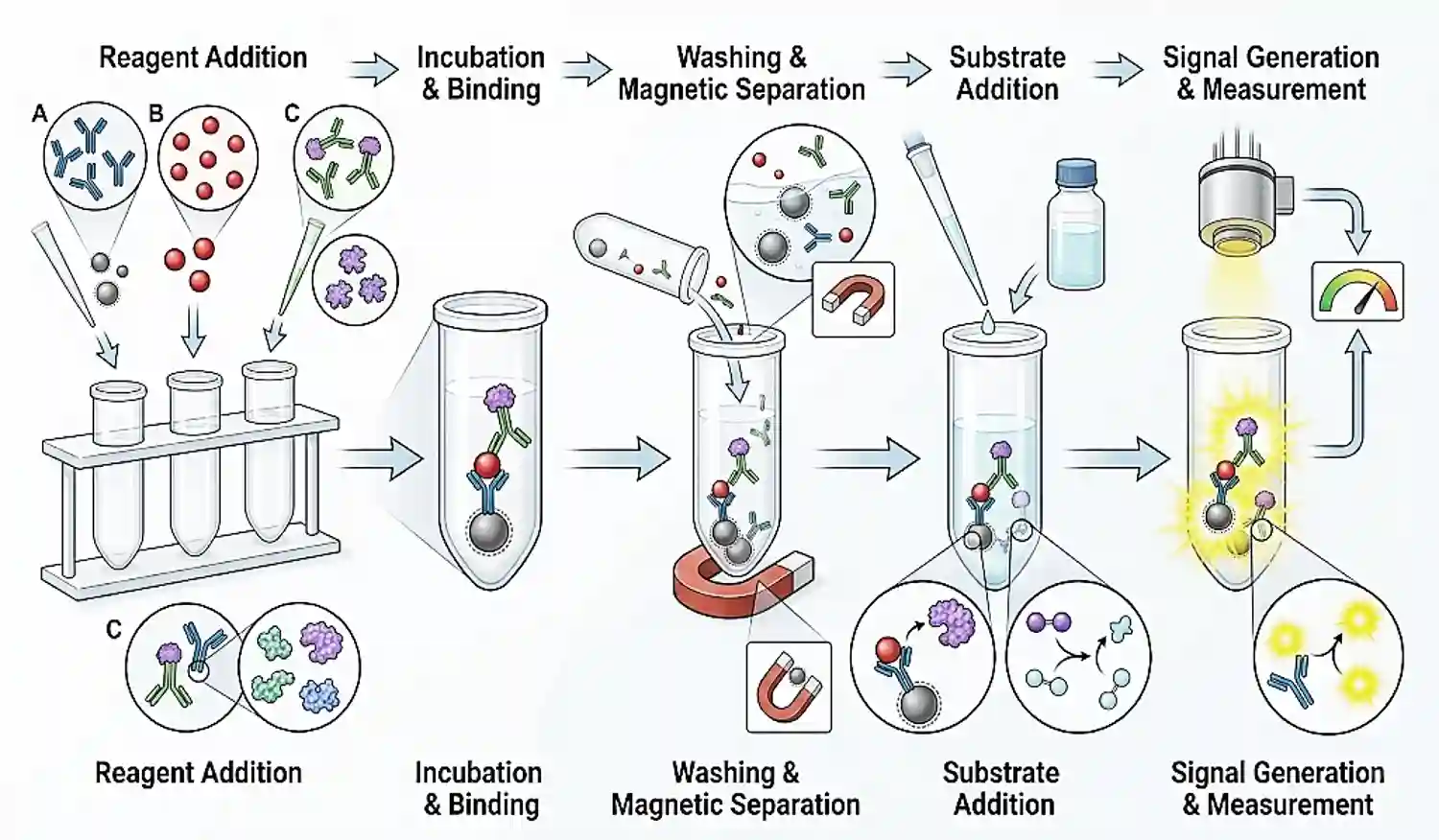
Chemiluminescence immunoassay (CLIA) is a modern laboratory technique used to detect and measure very small amounts of specific substances, such as antigens, antibodies, and hormones, in blood and other biological samples. It is widely used in medical laboratories because it is highly sensitive, accurate, and suitable for processing a large number of samples in a short time.
Principle
The basic principle of CLIA is the specific reaction between an antigen and an antibody. In this test, either the antigen or antibody is attached to a substance that can produce light during a chemical reaction. When the patient’s sample is mixed with the appropriate reagents, the target substance binds specifically to its corresponding antigen or antibody.
After the reaction takes place, a special reagent is added, which produces light. The amount of light produced is measured using an instrument called a luminometer. The intensity of the light gives an indication of how much of the target substance is present in the sample. Depending on the type of CLIA, more light may mean a higher concentration of the substance, while in some tests the relationship may be the opposite. The result is then calculated by comparing the measured signal with known standards.
Procedure
Although the exact procedure can differ depending on the test, the general steps are quite similar. First, the patient’s serum, plasma, or another suitable sample is added to a reaction vessel containing specific antibodies or antigens. If the substance being tested for is present, it binds to the corresponding reagent.
In many CLIA systems, magnetic particles coated with antibodies are used to help separate the substances that have reacted from those that have not. After incubation, the mixture is washed to remove unwanted materials. A chemiluminescent label or enzyme-linked reagent is then added. Following another incubation and washing step, a special substrate or trigger solution is added. This causes a chemical reaction that produces light.
The luminometer measures the amount of light produced, and the instrument compares the result with calibration standards to determine the concentration of the substance. Quality-control samples are also tested to make sure that the results are reliable.
Applications
CLIA has many applications in medical diagnosis. It is commonly used to measure hormones such as thyroid-stimulating hormone (TSH), thyroxine, insulin, and reproductive hormones. It is also useful for detecting infections by identifying specific antigens or antibodies produced in response to infectious organisms.
Another important application is the detection and monitoring of certain cancers through tumor markers such as prostate-specific antigen (PSA) and alpha-fetoprotein (AFP). CLIA can also be used to measure cardiac markers, vitamins, drugs, allergy-related substances, and various other biochemical compounds.
Overall, CLIA is an important technique in modern clinical laboratories. Its high sensitivity, specificity, speed, and ability to be automated make it especially useful for routine diagnostic testing. Because it can detect very small amounts of substances accurately, CLIA has become a valuable tool for diagnosing diseases and monitoring patients.


