
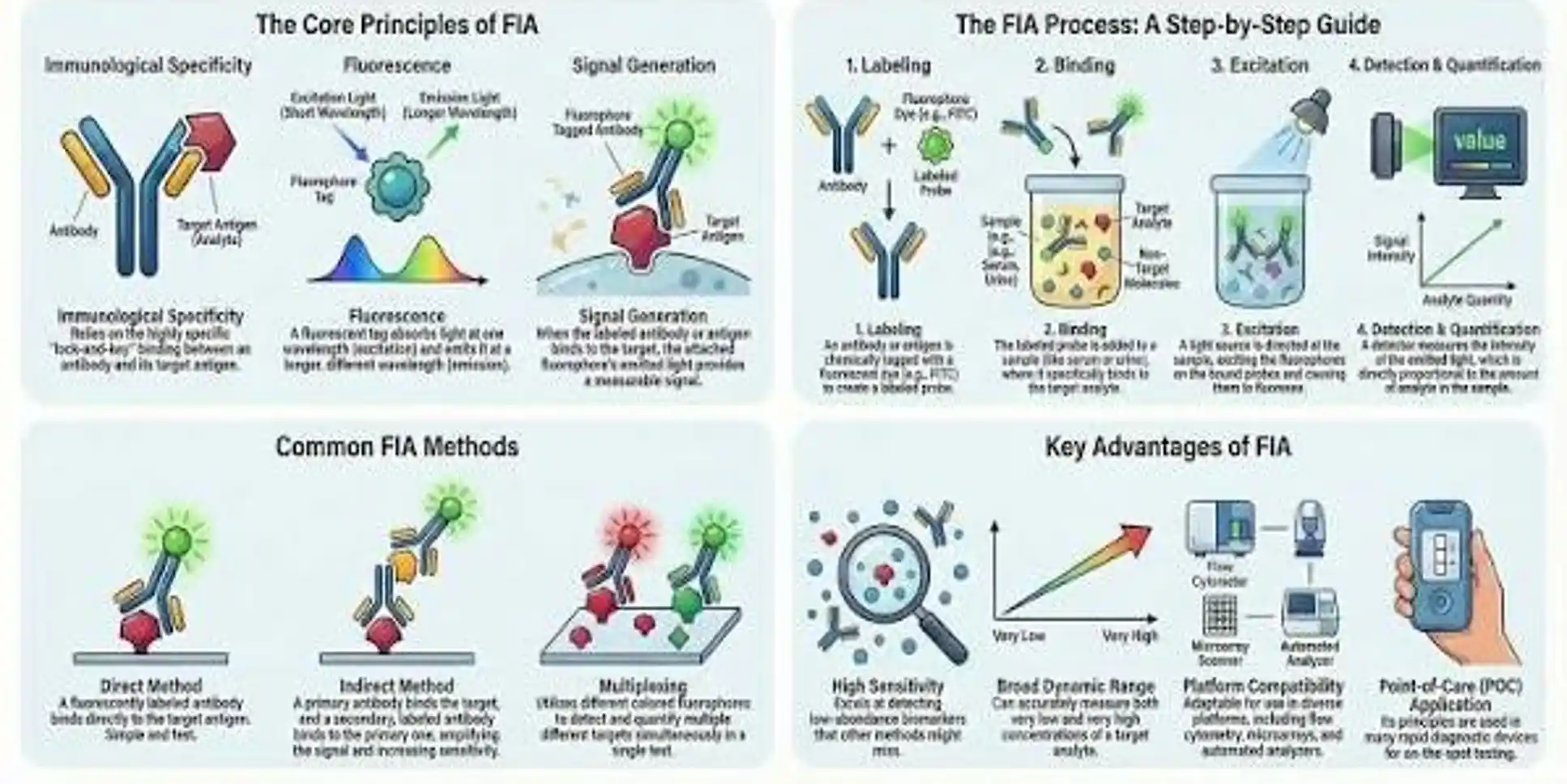
Fluoroimmunoassay (FIA) is a laboratory technique used to detect and measure very small amounts of specific substances, such as antigens, antibodies, hormones, proteins, and drugs. It combines the specificity of an antigen-antibody reaction with the sensitivity of fluorescence detection. Because it can detect substances at very low concentrations, FIA has become useful in clinical diagnostics, biomedical research, biotechnology, and pharmaceutical testing.
Principle
The principle of FIA is based on the highly specific interaction between an antigen and its corresponding antibody. In this technique, either the antigen or antibody is attached to a fluorescent substance called a fluorophore. When the fluorophore is exposed to light of a particular wavelength, it absorbs energy and becomes excited. As it returns to its normal state, it releases energy in the form of fluorescent light.
The amount of fluorescence produced can be measured using an instrument such as a fluorometer or fluorescence reader. The intensity of the fluorescence provides information about the amount of the target substance present in the sample. Depending on how the assay is designed, a higher concentration of the target may produce either a higher or lower fluorescence signal. The result is usually determined by comparing the sample signal with a calibration curve prepared using known concentrations.
Common fluorescent labels used in FIA include fluorescein isothiocyanate (FITC), rhodamine, and other fluorescent dyes.
Procedure
The exact procedure depends on the type of FIA being performed, but the basic steps are similar. First, the patient’s or test sample, such as serum, plasma, urine, or another biological material, is added to a reaction system containing a specific antigen or antibody.
In a direct FIA, a fluorescently labelled antibody binds directly to the target antigen. In an indirect FIA, an unlabelled primary antibody first binds to the target, followed by a fluorescently labelled secondary antibody. Other formats, such as sandwich and competitive assays, may also be used depending on the type of analyte being tested.
After the antigen-antibody reaction has taken place, the reaction mixture may be washed to remove substances that have not specifically bound. The fluorescent label is then exposed to the appropriate wavelength of light. The emitted fluorescence is measured using a suitable instrument. The result is compared with standards or controls to determine whether the target substance is present and, when applicable, to estimate its concentration.
Positive, negative, and quality-control samples are generally included to ensure that the test is performing correctly and that the results are reliable.
Applications
FIA has many applications in clinical and biomedical laboratories. It can be used to detect antibodies and antigens associated with infectious diseases, autoimmune disorders, and allergies. It is also useful for measuring hormones, proteins, therapeutic drugs, and other important biological markers.
Fluorescence-based immunological techniques are particularly useful in immunology and clinical diagnostics. They can help identify specific proteins, microorganisms, or antibodies in cells and tissues. In research laboratories, FIA is used to study protein expression, receptor interactions, cellular processes, and other biological mechanisms.
The technique also has applications in pharmaceutical research, biotechnology, food testing, and environmental analysis.
In simple terms, FIA works by using the specific binding between an antigen and antibody and then using fluorescence to detect that interaction. Its high sensitivity, specificity, and ability to detect very small quantities of substances make it a valuable technique in modern diagnostics and biomedical research.


