Talk about coming out of the blue. On a summer afternoon in July 2024, people across five U.S. states looked up and saw a fireball blazing across the daytime sky. Some heard a loud sonic boom, like a jet breaking the sound barrier. Moments later, a fist-sized chunk of that fireball crashed through the roof of a home in Hillsborough, New Jersey, and landed right in a couple’s bedroom.
Nobody was hurt. But two years on, that unlucky-lucky rock has turned into one of the most exciting finds in space science this year. Scientists say it is packed with amino acids -the basic chemical “Lego bricks” that living things use to build proteins – and most of them are not found naturally on Earth.
From Ceiling to Science Lab
The space rock, now called the Hillsborough meteorite, weighed only about one kilogram (roughly the size of a bag of sugar). It had been zooming through Earth’s atmosphere at 32,000 miles per hour before breaking apart 22 miles above the ground. Only one piece is known to have survived the fall.
Here’s the twist that made all the difference: instead of panicking, the homeowners kept a cool head. They put on disposable gloves, scooped up the fragments and dust with aluminium foil, and sealed everything in glass jars. That quick thinking meant the sample stayed almost untouched by Earth’s air, dust, and bacteria – a meteorite hunter’s dream come true.
“We knew almost immediately that what happened to us was incredibly rare, and we felt a responsibility to preserve the meteorite for the scientific community,” the homeowners said.
What’s Actually Inside It
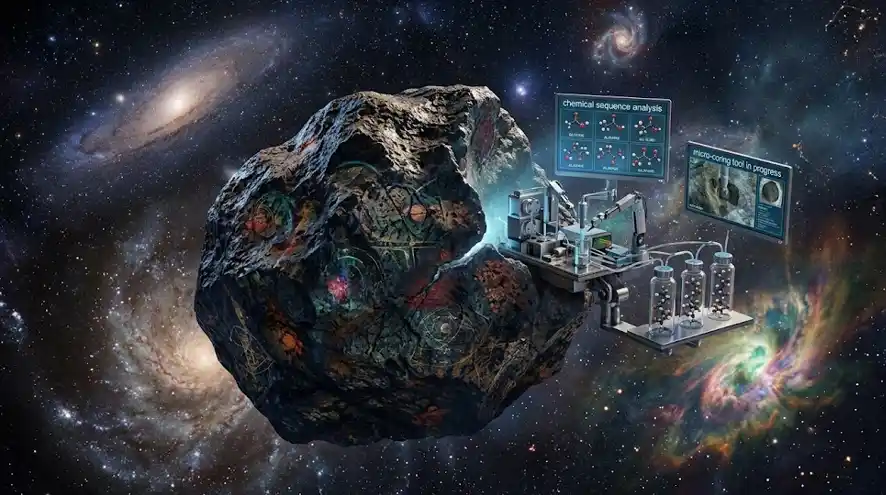
Scientists classified Hillsborough as a CM carbonaceous chondrite -jargon for a very old, carbon-rich type of space rock that formed in the early solar system, before Earth even existed. Think of it as a time capsule from over 4.5 billion years ago.
Inside, researchers found:

– Hundreds of amino acids, most of them types that don’t occur naturally in Earth life. Dr Danny Glavin, a NASA scientist and study co-author, called them “truly extraterrestrial in origin.”
– Sodium-rich salts, evidence of ancient brines*salty water that once flowed inside the meteorite’s parent asteroid.
– Signs that the rock is a rare in-between type, dubbed CM½, meaning it sits halfway between two known meteorite categories based on how much water altered it long ago.
Dr Glavin said the amino acid mix here was even more varied than samples brought back by NASA and Japan’s asteroid missions (OSIRIS-REx and Hayabusa2) – a big deal, since those missions cost hundreds of millions of dollars and involved landing on actual asteroids.
Don’t Get Ahead of Yourself: This Isn’t “Alien Life”
It’s tempting to jump to conclusions and say scientists found aliens. That would be putting the cart before the horse. Amino acids are the *ingredients* for life, not life itself – like finding flour in a kitchen doesn’t mean there’s already a cake baking. What the discovery does show is that the raw materials for life could easily have hitched a ride to early Earth on rocks just like this one.
As Professor Peter Brown of Western University put it, the ancient brine found inside is “a really strong indicator of how water has moved, evolved, and reacted with organics” -in plain English, it’s solid proof that liquid water and life-friendly chemistry were mixing together inside asteroids billions of years ago.
A Rock With a Long Journey
Researchers believe Hillsborough’s story began with a massive asteroid collision far out in the asteroid belt, between Mars and Jupiter. A smaller crash about 6 million years ago knocked a piece into an orbit heading toward Earth. That fragment kept breaking apart from the heat and cold of sunlight until, about 200,000 years later, it finally struck home -quite literally.
Fragments of the meteorite are now being kept at the American Museum of Natural History in New York, where researchers will keep studying it for years to come.
For the homeowners, it’s still hard to wrap their heads around. “It’s still surreal to think that this meteorite travelled through space for millions of years before ending its journey in our home,” they said. Talk about a rock star arrival.
References
- Jenniskens, Peter, Glavin, Danny, Schmitt-Kopplin, Philippe, & Hankey, Mike. (2026). Meteor over New York City: Brines in a primitive CM asteroid. Science Advances. American Association for the Advancement of Science.
- National Aeronautics and Space Administration, Goddard Space Flight Center. (2026, July). NASA study of pristine meteorite adds to story of ancient asteroids. NASA Astromaterials Research. https://science.nasa.gov/science-research/astromaterials/nasa-study-of-pristine-meteorite-adds-to-story-of-ancient-asteroids/
- SETI Institute. (2026). Press release: Analysis of the Hillsborough meteorite. SETI Institute, Mountain View, California.