
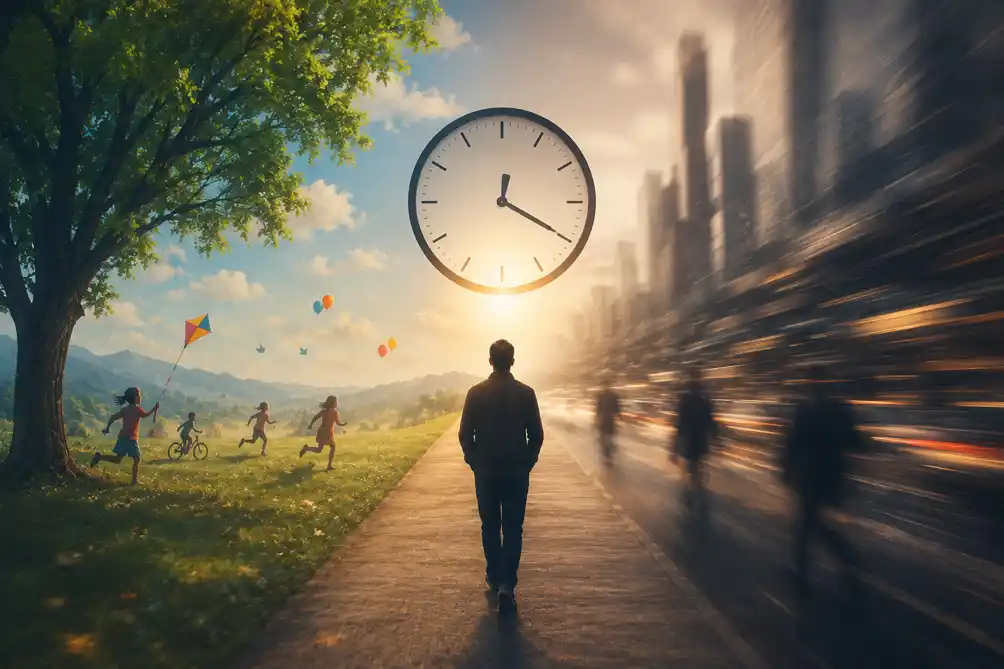
Remember how a summer holiday seemed to last forever when you were a child? Now, entire months can disappear before you even realise it. Birthdays arrive faster, years seem to fly by, and many adults eventually find themselves wondering: Why does time feel like it’s speeding up as we get older?
The surprising answer is that time itself isn’t moving any faster we are experiencing it differently.
Scientists call this subjective time perception. The way we experience the passage of time depends on attention, memory, emotions, and the number and type of experiences we have. Research does suggest that many people report time passing faster as they age, although the effect is not universal and studies have found considerable variation between individuals.
One explanation involves novelty.
Think about childhood. Your first day at school, first trip, first friendship, first festival, and countless other experiences are completely new. Your brain has to process a huge amount of unfamiliar information, creating rich and detailed memories. When you look back, those periods can feel much longer because they contain so many distinct memories.
As adults, life often becomes more predictable. We follow similar routines—wake up, work or study, eat, commute, sleep, repeat. When many days resemble one another, fewer individual events stand out in memory. Looking backward, an entire month can therefore feel as though it disappeared almost instantly. Recent research continues to investigate the roles of routine, memory, attention, and personal meaning in these retrospective judgments.
Another explanation is that each year represents a smaller proportion of your life. A year is an enormous part of a five-year-old’s experience but a much smaller fraction of a 50-year-old’s life. This proportional idea is intuitively appealing, although researchers have not established it as a complete scientific explanation.
Our perception of time also changes depending on whether we’re experiencing an event or remembering it later. During a boring lecture, every minute can feel painfully long. But when you look back on an entire year filled with routine, it may seem incredibly short. Psychological research distinguishes between these prospective and retrospective experiences of time.
So, can we actually make life feel slower?
We can’t slow the clock, but we may be able to create more memorable experiences. Learning something new, travelling, meeting different people, changing routines, and paying closer attention to everyday experiences can give the brain more distinctive moments to remember.
Perhaps that’s why childhood feels so long not because children have more time, but because they experience more of it as new.
The clock has been ticking at the same speed all along. It’s our memories that determine how quickly the journey feels when we look back.


