
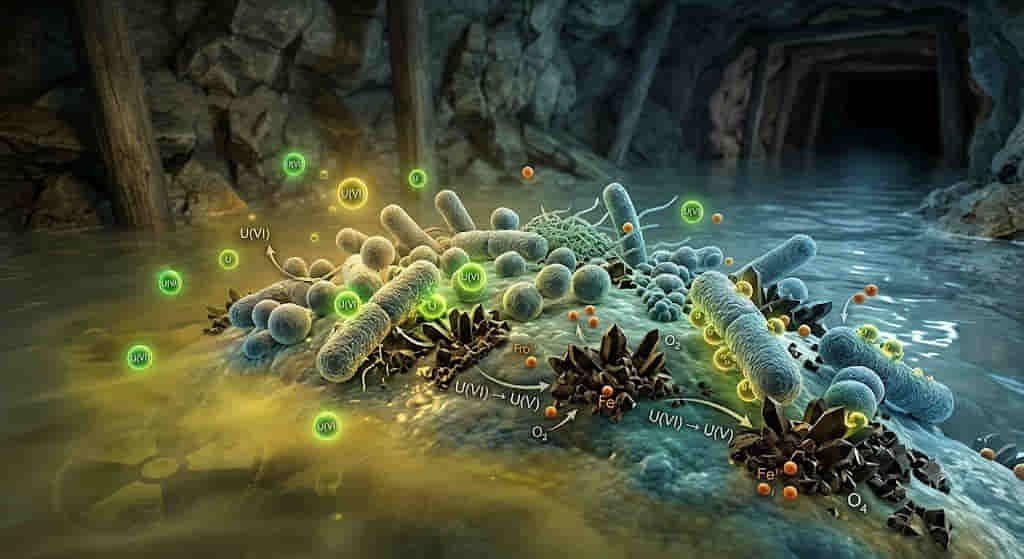
Imagine hiring a cleaning team to remove one of the world’s most dangerous pollutants, only to discover they have been working for free for years. It sounds like a science fiction movie, but it is happening deep below the ground in Germany. Nearly 2,000 metres beneath the Earth’s surface lies an old uranium mine filled with radioactive water. While humans spend huge amounts of money trying to clean it, billions of tiny bacteria have quietly taken up the job. Like invisible miners, these microbes do not fear uranium. Instead, they seem to say, “Leave it to us!” Their surprising talent could one day help clean polluted water around the world.
To understand this amazing story, we first need to know what uranium is. Uranium is a naturally occurring radioactive metal used to produce nuclear energy. In water, it usually exists in chemical forms called oxidation states, mainly uranium (VI) and uranium (IV). Scientists from Germany’s Helmholtz-Zentrum Dresden-Rossendorf and Spain’s University of Granada collected water from the old Wismut uranium mine and recreated the same low-oxygen conditions in the laboratory.
They added glycerol, a simple carbon source that acts like food for bacteria. Over 130 days, something incredible happened. The cloudy yellow water slowly became crystal clear, while a black solid settled at the bottom. Around 95% of the dissolved uranium disappeared from the water, not because it vanished, but because the bacteria changed it into a stable mineral.
Now comes the real chemical magic. Think of uranium like a restless traveller standing between two railway stations. Normally it prefers Station +6 or Station +4. Scientists believed that Station +5 was only a temporary stop where uranium never stayed for long. Surprisingly, these bacteria acted like skilled station masters. They held uranium safely at the rare +5 oxidation state, something scientists had rarely seen happen naturally. The uranium then combined with iron and oxygen to form a stable mineral called FeU(V)O₄. Even more fascinating, the bacterial cell walls acted like tiny construction workers, trapping uranium and turning it into a solid mineral. This process is called biomineralisation. Instead of allowing uranium to spread through groundwater, the microbes lock it in place, much like cement trapping steel bars inside a building.
| “While humans build expensive cleanup plants, nature sends billions of microscopic workers free of charge.” Thus, the future of cleaning our planet may lie not in bigger machines, but in smaller microbes.” |
Why does this matter so much? Uranium pollution is not limited to Germany. Groundwater in countries such as India, the United States, Canada, France, South Africa, and Australia has shown unsafe uranium levels in some regions. Alarmingly, researchers have even detected uranium in breast milk samples from parts of Bihar, raising concerns about long-term exposure. Traditional cleanup methods often require expensive chemicals, complex machinery, and produce hazardous waste that must also be managed. In comparison, these bacteria behave like nature’s own recycling engineers. They work quietly, consume simple nutrients, and transform dangerous uranium into a stable mineral with very little environmental disturbance. As the old proverb says, “Little drops make the mighty ocean.” Sometimes, the smallest organisms solve the biggest problems.
From an advanced microbiology perspective, this discovery represents a major step in environmental biotechnology and geomicrobiology. The microbial community performs reductive biomineralisation under anaerobic conditions, stabilising the highly unusual pentavalent uranium intermediate before precipitating it as FeU(V)O₄. This finding challenges the long-held belief that uranium (V) is merely a short-lived intermediate and suggests that microbial metabolism can directly influence uranium speciation and long-term immobilisation.
If scientists can understand the genes, enzymes, and metabolic pathways responsible for this remarkable chemistry, future bioremediation systems may use carefully selected microbial communities to clean radioactive wastewater safely and economically. The journey from laboratory discovery to large-scale application is still long, but these tiny microbes have already shown that nature often writes solutions where humans see only problems.
Although the findings are highly promising, scientists caution that the journey has only begun. Laboratory success must still be tested under real environmental conditions before these bacteria can be widely used in contaminated rivers, lakes, and groundwater systems. Researchers must understand how long the mineral remains stable, how different environmental conditions affect the process, and whether large-scale treatment systems can be developed.
Even so, this discovery sends a powerful message. The same microbes once ignored beneath our feet may become tomorrow’s environmental superheroes. Like silent soldiers working without applause, they remind us that nature often carries the best solutions to problems created by humanity. In the battle against radioactive pollution, these microscopic miners may one day become our greatest allies.


