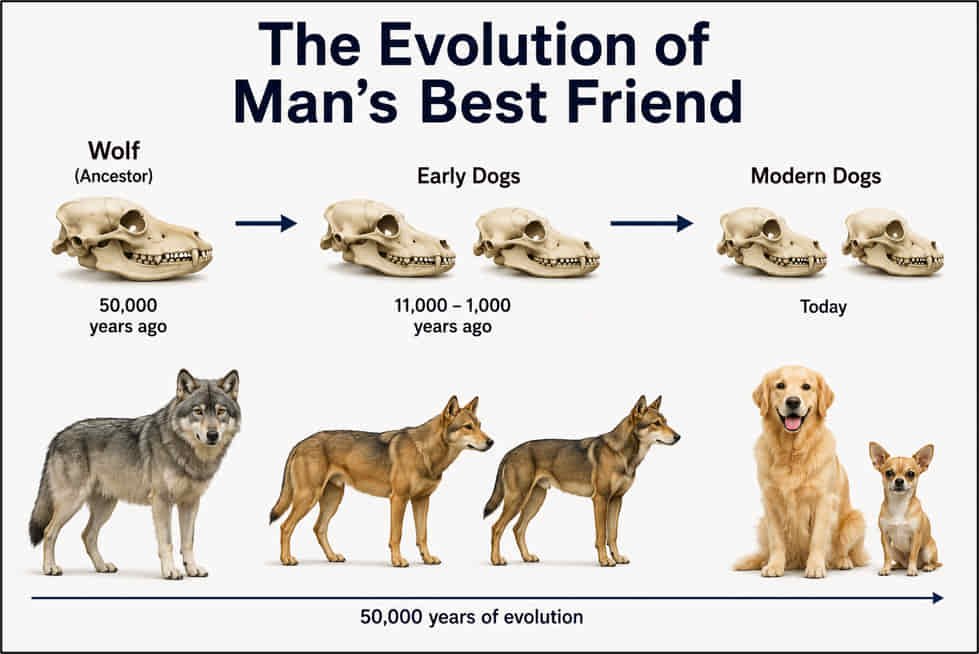
Stand a tiny Chihuahua beside a towering Great Dane, and it feels almost impossible to believe they belong to the same species. One fits comfortably in your lap, while the other could rest its head on your dining table. Yet both share a common ancestor-the gray wolf.
For years, scientists believed this extraordinary diversity was a relatively recent phenomenon, created through centuries of human selective breeding. But two groundbreaking studies published in science have turned that idea on its head, revealing that the roots of today’s remarkable dog diversity stretch back more than 11,000 years.
To uncover the history of man’s best friend, researchers examined 643 ancient dog and wolf skulls collected over an astonishing 50,000-year period. Their discovery was eye-opening. The first unmistakably “dog-like” skulls appeared around 11,000 years ago, shortly after the end of the last Ice Age during the beginning of the Holocene epoch. Even more surprising, these early dogs already displayed an impressive range of shapes and sizes. In other words, the seeds of the Great Dane and the chihuahua were being planted over ten millennia ago – long before anyone was selectively pairing up dogs for looks. It turns out that variety wasn’t a modern invention-it was already in the making when civilization itself was still taking its first steps.
Before that, though, things looked very different. Every single skull from the Late Pleistocene – some up to 50,000 years old, including a few previously thought to belong to early dogs – turned out to still look essentially wolf-like. So while wolves and dogs likely diverged genetically during the Pleistocene, their skulls didn’t start looking distinctly “dog” until the Holocene began. It’s a reminder that becoming a dog wasn’t a single dramatic event – it was a slow unfolding, with early dogs living for tens of thousands of years looking almost indistinguishable from their wild cousins.
A second study took a completely different approach: instead of skulls and bones, it looked at DNA. Researchers analyzed 73 ancient dog genomes from across Eastern Eurasia, spanning the last 10,000 years, to track how dog ancestry shifted over time -and it lined up remarkably well with how human groups moved. As hunter-gatherers, farmers, and pastoralist herders spread across the continent, their dogs’ genetic signatures moved with them. Dogs, it turns out, weren’t just picked up locally wherever people settled – they were companions people brought along on the journey, generation after generation.
There were some fascinating exceptions, too. Some hunter-gatherer groups in Siberia, who were genetically more closely related to Western Eurasian humans, were nonetheless found with Eastern (Arctic-type) dogs rather than the Western dogs typically associated with their human relatives elsewhere. That mismatch hints that dogs may have moved through trade and cultural exchange between different groups, independent of exactly who they were biologically related to – turning ancient dog DNA into a kind of side-channel record of human history that doesn’t perfectly mirror the human genetic record itself.
Their bones preserve the story of how their bodies slowly changed from wolves into the astonishing variety of breeds we know today. Their DNA preserves the story about the journeys, friendships, and cultural exchanges of the people who walked beside them.
Far from being a product of recent breeding alone, the incredible diversity of modern dogs has roots that extend deep into prehistory, shaped by natural selection, early human influence, and thousands of years of shared adventures. As the old saying goes, a dog is man’s best friend. These new discoveries suggest they are also our oldest travel companions – and perhaps some of history’s most faithful storytellers.
Source:
Evin, A., Ameen, C., Brassard, C., et al. (2025). The emergence and diversification of dog morphology. Science.
Zhang, Y., et al. (2025). Ancient dog genomes reveal population history across Eastern Eurasia. Science.