
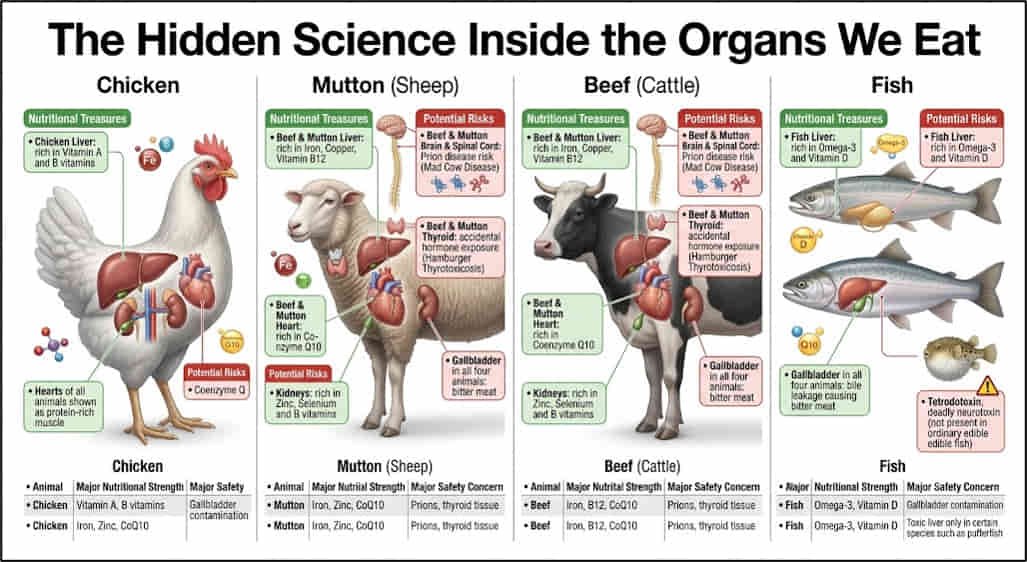
Every cut of meat tells a story written by millions of years of evolution. The butcher’s knife may slice through chicken, mutton, beef, or fish in the same way, but nature has crafted each one with a completely different biological blueprint. Beneath the familiar flesh lie hidden treasure chests of nutrients and secret chambers that demand caution.
Some organs are nutritional powerhouses that nourish the body, while others can harbour toxins or harmful compounds if not handled correctly. In the kitchen, every animal offers both a feast and a lesson. Let us peel back the layers of anatomy and discover how science transforms an ordinary meal into one of nature’s most fascinating stories.
Each animal stores nutrients differently because their bodies perform different jobs. A chicken, built for quick bursts of movement, stores large amounts of vitamin A and B vitamins in its liver, making it a powerful nutrient reserve. Beef and mutton, which support heavy muscles and constant movement, have hearts and kidneys rich in iron, zinc, selenium, and coenzyme Q10, a molecule that helps cells produce energy. Fish, the silent swimmers of the sea, are nature’s “liquid pharmacies.” Their livers contain vitamin D and omega 3 fatty acids, nutrients that support the brain, heart, and immune system. It is almost as if each animal says, “This is the gift I have protected for you.”
The liver is often called the body’s chemical factory, and every species runs its factory differently. Beef and mutton liver are packed with haem iron, copper, vitamin B12, and folate, making them excellent foods for preventing anaemia. Chicken liver has a milder taste but is one of the richest natural sources of vitamin A, which supports vision and immunity. Fish liver, especially from cod, stores large amounts of fat soluble vitamins A and D because marine animals depend on these nutrients to survive in cold, low sunlight environments. The heart, meanwhile, is not just a pump but also a muscle rich in coenzyme Q10 and essential amino acids. Kidneys, although known for filtering waste, also contain valuable proteins, selenium, and B vitamins. Nature wastes nothing.
However, every treasure chest has a warning label. The brain and spinal cord of cattle and sheep can harbour abnormal proteins called prions, which cause variant Creutzfeldt Jakob disease, commonly known as mad cow disease. Unlike bacteria or viruses, prions are simply misfolded proteins that force healthy proteins to fold incorrectly, creating a deadly chain reaction inside the brain. Fish and chickens do not naturally carry these mammalian prion diseases, making this particular risk unique to certain livestock. It reminds us that sometimes the smallest molecule can become the biggest villain.
Another hidden danger lies in the thyroid gland. This butterfly shaped gland produces hormones that control the body’s metabolism. If thyroid tissue from cattle or sheep accidentally remains attached to neck meat and is eaten repeatedly, it can release excessive thyroid hormones, a condition known as hamburger thyrotoxicosis. The heart begins to race, body temperature rises, and metabolism speeds up like a car with a stuck accelerator. In chickens and fish, the thyroid tissue is tiny and scattered, making this problem extremely uncommon.
One organ unites all four animals with a common warning, the gallbladder. Think of it as a tiny green balloon filled with concentrated bile. If it bursts during cleaning, the bitter liquid spreads quickly into the surrounding meat, spoiling its taste. Although bile itself is not poisonous in the small amounts that may accidentally contaminate meat, it creates such an intensely bitter flavour that the food often becomes unpleasant to eat. In this case, chemistry defeats culinary skill.
The ocean hides one final surprise. Most edible fish livers are highly nutritious, but a few marine species carry dangerous toxins. The liver and other organs of the pufferfish, known as fugu in Japan, contain tetrodotoxin, one of the world’s most powerful natural neurotoxins. This toxin blocks sodium channels in nerve cells, preventing electrical signals from reaching muscles. A victim remains conscious while the body gradually becomes paralysed. There is no specific antidote, which is why only specially trained chefs are licensed to prepare fugu in some countries. Here, one careless cut can turn a gourmet meal into a medical emergency.
Modern food science teaches us that there are no “good” or “bad” organs, only organs that must be understood. Proper veterinary inspection, hygienic slaughter, correct cooking, and informed food choices transform these biological structures into safe and nutritious foods. As researchers continue to study animal anatomy and food chemistry, they help us unlock better nutrition while protecting us from hidden risks. In the kitchen, knowledge is the sharpest knife.
The Final Verdict: Comparing the Anatomy
| Aspect / Organ | Chicken | Mutton (Sheep) | Beef (Cattle) | Fish |
| Liver | Soft, mild, high Vitamin A | Rich, earthy, high iron | Heavy, metallic, nutrient-dense | Oily, supreme Omega-3 & Vit D |
| Brain / Spine | Safe (rarely eaten) | Extreme Danger (Prions) | Extreme Danger (Mad Cow) | Safe (highly prized in soups) |
| Thyroid | Too small to matter | Danger (Hormone overdose) | Danger (Hormone overdose) | Scattered, completely safe |
| Gallbladder | Bitter (must discard) | Bitter (must discard) | Bitter (must discard) | Bitter (must discard) |
| Special Risks | Salmonellosis (if raw) | Parasites (if undercooked) | Parasites (if undercooked) | Lethal Toxins (in specific species) |


