
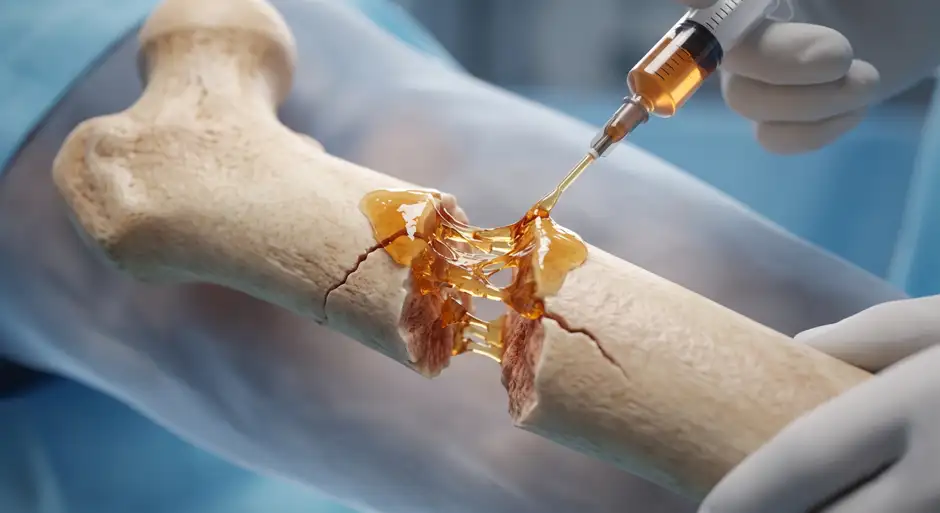
What if fixing a complicated fracture didn’t always require plates, screws, and large incisions? Chinese researchers have developed an injectable bone adhesive, called Bone-02, that can bond fractured bone fragments in about three minutes. Even inside the wet, blood-filled environment of the human body. The idea sounds almost like medical superglue, but its inspiration came from something much more natural: oysters. Oysters can remain firmly attached to rocks and other surfaces despite constantly being surrounded by seawater. Their ability to stick in such a wet and turbulent environment gave researchers a clue: if nature can create an adhesive that works underwater, perhaps medicine could use the same principle to solve one of orthopaedic surgery’s biggest challenges, which is, keeping tiny bone fragments together when conventional screws and plates are difficult to use.
This is particularly important for comminuted fractures, where a bone breaks into several pieces. Imagine trying to complete a jigsaw puzzle when the pieces are tiny, irregular, and constantly moving. Surgeons must carefully reposition these fragments and hold them in place while the bone gradually repairs itself. Traditional fixation methods use metal plates, screws, or wires to provide this stability. Bone-02 is designed to provide another option: an adhesive that can be injected directly into the fracture and rapidly solidify, holding the fragments together.
The material is a bioabsorbable organic-inorganic composite, designed to maintain strong adhesion even in a blood-rich environment. According to Zhejiang University, it can naturally degrade and be absorbed by the body over roughly six months, potentially eliminating the need for a second operation simply to remove fixation material. In one reported case involving a complicated wrist fracture, the adhesive was delivered through a small 2–3 cm incision and used to stabilise the fragments in about three minutes.
It is important to understand that the glue does not heal the fracture. It stabilises the fracture in minutes; the bone itself does not heal in three minutes. Bone cells still need weeks to rebuild and remodel the damaged tissue. The rapid step is the mechanical fixation that gives the fragments a stable environment in which biological healing can occur.
Bone-02 has reportedly been evaluated in more than 150 patients in China, but larger clinical studies and longer-term evidence will be important before determining how widely it can replace conventional fixation. Still, beyond the excitement, Bone-02 highlights a broader direction in medicine: moving from purely mechanical fixation toward bio-inspired materials that work with the body rather than against it. If future studies confirm its safety and effectiveness, it could reshape how surgeons approach complex fractures. But for now, it remains a promising glimpse into what is possible when engineering meets nature.
Sources


