
A thin layer of dust on a window or a car may seem like nothing more than a housekeeping problem. Many of us simply wipe it away and move on. Because it comes from nature, dust often gets a free pass. But appearances can be deceptive. Like a wolf wearing sheep’s clothing, dust can quietly enter our lungs without knocking on the door. It may look soft and harmless, yet it can become an invisible enemy hiding in plain sight. As the old saying goes, “Looks can be deceiving.”
“Not every danger arrives with a loud noise, some drift silently in the air.”
When people think about pollution, they usually picture factory chimneys, vehicle smoke, or plastic floating in rivers. Dust rarely enters the conversation because it does not smell bad or leave black stains in the sky. Ironically, what looks clean is not always safe. Scientists measure air pollution using substances such as nitrogen oxides, sulphur oxides, carbon compounds, and suspended particulate matter, commonly called PM. Dust forms an important part of this particulate pollution. Tiny mineral particles seem to whisper, “You cannot see all of us, but you are breathing us every day.”
A landmark study that analysed ten years of data from 103 locations across Europe has now shown that airborne mineral dust is becoming a serious public health concern. Using machine learning, a form of artificial intelligence that learns from large amounts of data, researchers examined nearly 18,500 daily measurements. They discovered that in southern Europe, transported desert dust alone contributes about 31 percent of the World Health Organization’s recommended annual PM10 limit. PM10 refers to particles smaller than 10 micrometres that can enter the nose and lungs during breathing.
The health effects are difficult to ignore. During days when large dust clouds passed through the region, researchers observed measurable increases in daily deaths and hospital admissions for breathing problems. Children were the most affected. Respiratory hospitalisations in people younger than fifteen years increased by more than 2 percent during heavy dust events. A tiny grain of dust may appear weaker than a grain of rice, but together billions of them can become a powerful army marching into our lungs. Sometimes, small things leave the biggest scars.
Why has dust escaped so much attention? There are several reasons. First, it looks natural, so people rarely see it as pollution. Nobody gathers to protest a sandstorm. Second, many environmental regulations separate naturally transported dust from human-made pollution when calculating air quality standards. This makes dust almost disappear from the policy record. Third, until recently, scientists lacked large-scale evidence showing how dust behaves across entire continents. Most earlier studies depended on computer models or satellite images, both of which have important limitations.
New evidence shows that the problem is becoming worse. Ice cores collected from the Alps act like frozen history books, preserving tiny particles trapped over centuries. Scientists found that dust deposits have increased by about 110 percent since pre-industrial times. Much of this increase is linked to growing desertification in North Africa and changing wind patterns that carry more dust across the Mediterranean region. Nature itself seems to be saying, “I am changing, and you must pay attention.” Climate change and dust pollution are becoming partners in a dangerous dance, each strengthening the other.
Dust also affects life beyond human health. Large dust storms have disrupted more than 1,500 flights during the past three years. Aviation, one of the most weather-sensitive industries, faces reduced visibility and operational challenges during these events. What begins as a distant cloud over a desert can end up delaying travellers thousands of kilometres away. It is a reminder that in nature, everything is connected.
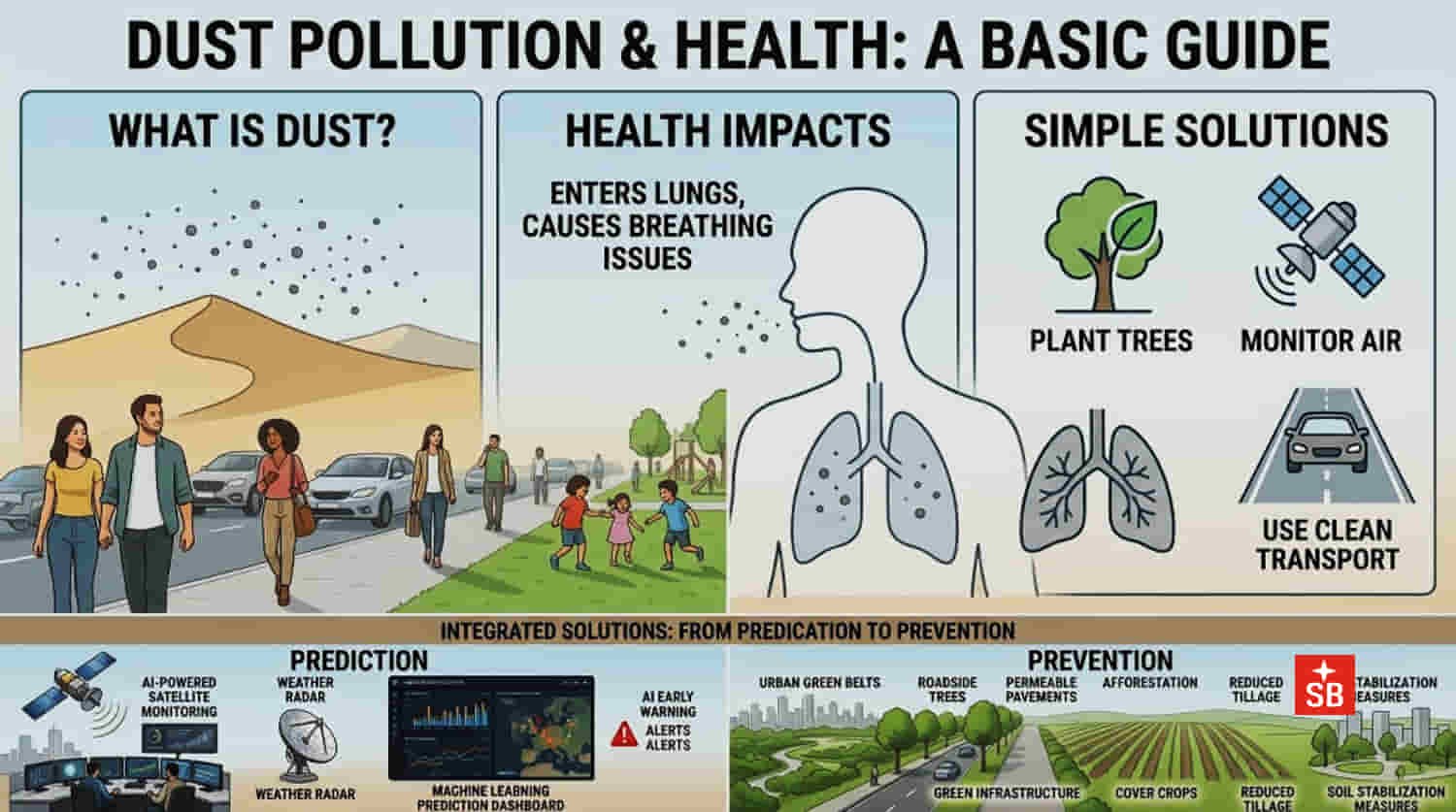
Fortunately, science is fighting back with smarter solutions. Artificial intelligence based systems, including Random Forest and Satellite Fusion models, can now predict dust levels much more accurately than older forecasting methods. These early warning systems help cities issue health alerts before dust clouds arrive. Scientists also use elemental fingerprinting, which studies elements such as aluminium, titanium, and silicon, to identify whether dust comes from distant deserts or from local roads, farms, and construction sites. Like experienced detectives, these techniques help identify the true source of the problem.
Nature itself also offers powerful solutions. Planting trees, creating green belts, using permeable roads, protecting dry lands, growing cover crops, reducing excessive soil tilling, and applying soil-binding materials can reduce the amount of dust released into the air. Healthy land behaves like a protective blanket, holding the soil together instead of allowing the wind to carry it away. Prevention, once again, proves better than cure.
Dust is far more than a layer waiting to be cleaned from a table. It is an important part of the air we breathe, the climate we experience, and the health we protect. Treating dust as a harmless background character is no longer wise. Sometimes the greatest dangers do not roar like lions, they float quietly around us. The smallest particles can carry the biggest message, clean air is not a luxury, it is the foundation of healthy life.
Source:
Kok, J. F., Adebiyi, A. A., Albani, S., Balkanski, Y., Checa-Garcia, R., Chin, M., Colarco, P. R., Hamilton, D. S., Huang, Y., Ito, A., Klose, M., Li, L., Mahowald, N. M., Miller, R. L., Obiso, V., Pérez García-Pando, C., Rocha-Lima, A., & Wan, J. S. (2023). Mineral dust aerosol impacts on global climate and climate change. Nature Reviews Earth & Environment, 4, 71–86. https://doi.org/10.1038/s43017-022-00379-5
Li, T., Cohen, A. J., Krzyzanowski, M., Zhang, C., Gumy, S., Mudu, P., Pant, P., Liu, Q., Kan, H., Tong, S., Chen, S., Kang, U., Basart, S., Touré, N. E., Al-Hemoud, A., Rudich, Y., Tobias, A., Querol, X., Khomsi, K., Samara, F., … Shen, H. (2025). Sand and dust storms: A growing global health threat calls for international health studies to support policy action. The Lancet Planetary Health, 9, e34–e40. https://doi.org/10.1016/S2542-5196(24)00308-5
Stafoggia, M., Zauli-Sajani, S., Pey, J., Samoli, E., Alessandrini, E., Basagaña, X., Cernigliaro, A., Chiusolo, M., Demaria, M., Díaz, J., Faustini, A., Katsouyanni, K., Kelessis, A. G., Linares, C., Marchesi, S., Medina, S., Pandolfi, P., Pérez, N., Querol, X., Randi, G., Ranzi, A., Tobias, A., Forastiere, F., & the MED-PARTICLES Study Group. (2016). Desert dust outbreaks in Southern Europe: Contribution to daily PM10 concentrations and short-term associations with mortality and hospital admissions. Environmental Health Perspectives, 124, 413–419. https://doi.org/10.1289/ehp.1409164


