
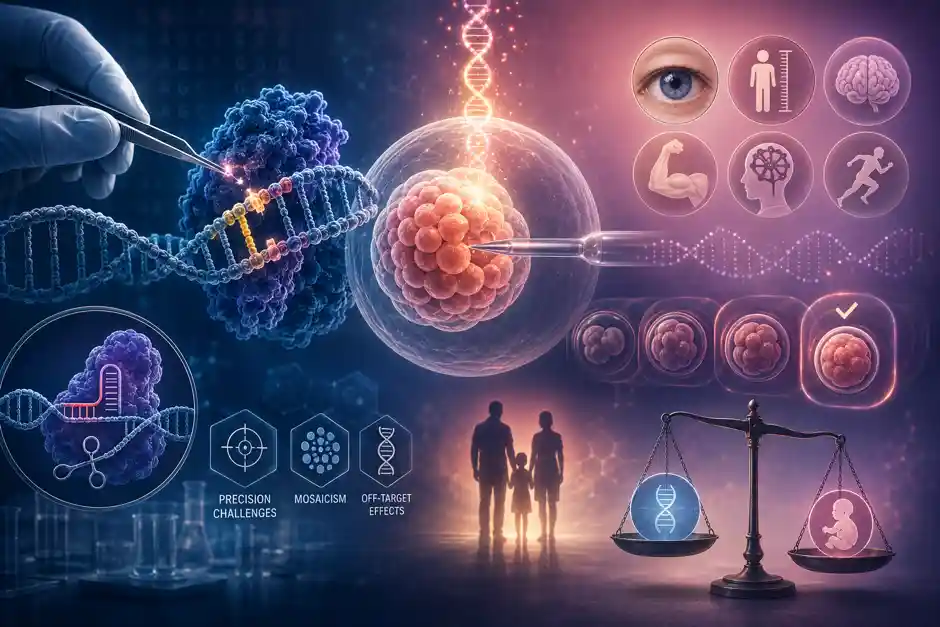
The idea of a “designer baby” once sounded like science fiction: choose a baby’s eye colour, height, intelligence, or athletic ability before birth. Today, advances in CRISPR gene editing, embryo screening, and reproductive genetics have made the concept feel much less imaginary. But how close are we really to creating genetically customised babies?
For a layperson, a designer baby means a child whose genetic characteristics are deliberately selected or changed before birth. It may sound like ordering features from a catalogue, but human biology is far more complicated than any shopping list. Genes are not simple switches with one setting for every trait.
The answer is closer scientifically but much farther clinically and ethically than headlines sometimes suggest. Science may be moving quickly, but safety and ethics are acting like careful brakes on a very fast vehicle. Just because something can be attempted does not mean it is ready to be used.
One technology attracting enormous attention is CRISPR-Cas9, which allows scientists to make targeted changes to DNA. In principle, editing an embryo could potentially correct a disease-causing mutation before the embryo develops. Because the change would be present in the embryo’s cells, it could potentially be inherited by future generations. This is known as heritable or germline genome editing.
CRISPR-Cas9 is often described as a genetic “scissors”, although the reality is more sophisticated than simply cutting DNA. It can be guided towards a particular DNA sequence, where researchers try to make a precise change. In that sense, CRISPR is like editing a sentence in an enormous biological book, but even a tiny edit can sometimes have consequences elsewhere.
Scientists have already demonstrated that human embryos can be genetically edited in laboratory research. However, that does not mean genetically edited babies are currently safe or medically ready.
There is a wide gap between “possible in a laboratory” and “safe in a human pregnancy”. That gap is where much of modern biomedical research takes place. As the old saying goes, “Look before you leap”, especially when the leap could affect a person and generations yet to be born.
One major challenge is precision. CRISPR can sometimes make unintended changes elsewhere in the genome, known as off-target effects. Researchers must also deal with mosaicism, where only some cells in an embryo are successfully edited while others remain unedited. A change that appears successful in a small sample of cells may therefore not accurately represent what happens throughout the developing embryo.
Off-target effects are like correcting one spelling mistake and accidentally changing words on another page. Mosaicism adds another twist because an embryo may become a genetic patchwork, with edited and unedited cells existing side by side. In genetic jargon, this makes the outcome much harder to predict.
There is another problem: biology is incredibly complex.
Human biology does not always follow a neat rulebook. A single genetic change can interact with many other genes and environmental factors, creating outcomes that scientists may not be able to predict perfectly. The genome behaves less like a simple machine and more like a vast orchestra, where thousands of players must work together.
Traits such as height, intelligence, personality, athletic ability, and even many aspects of disease risk are influenced by thousands of genetic variants as well as nutrition, environment, education, lifestyle, and chance. Changing one gene is therefore unlikely to produce a predictable “upgrade” in a human being.
This is where the word “designer” can be misleading. A baby’s characteristics are not like settings on a smartphone that can simply be adjusted from low to high. Nature mixes genes, surroundings, experiences, and chance in ways that can surprise even experienced researchers. In other words, there is no single genetic button marked “intelligence” or “athletic ability”.
In fact, some forms of genetic selection are already possible without editing DNA. Preimplantation genetic testing (PGT) can allow doctors to identify embryos carrying certain genetic abnormalities during IVF. But selecting embryos based on complex traits is far more uncertain and raises significant ethical concerns.
PGT and gene editing are therefore not the same thing. PGT generally involves testing embryos and selecting among them, while genome editing attempts to alter DNA itself. The distinction is important because choosing between existing genetic possibilities is different from rewriting the genetic instructions.
So, could parents eventually choose their baby’s characteristics?
Technically, science is moving toward increasingly powerful ways of analysing and modifying human DNA. But creating a genetically enhanced baby is not currently a safe or established medical procedure. The International Society for Stem Cell Research says that clinical use of heritable genome editing remains premature, while the World Health Organization has stated that it would be irresponsible at this time to proceed with clinical applications of human germline genome editing.
The scientific toolbox is becoming more powerful, but the toolbox alone cannot decide how it should be used. “Can we?” and “Should we?” are two very different questions. The first belongs mainly to science, while the second reaches into medicine, law, society, and human values.
The bigger question may therefore not be “Can we edit embryos?” but “Which changes, if any, should we be allowed to make?”
That question opens a much bigger door. Correcting a serious inherited disease may appear very different from selecting a preferred height, eye colour, or athletic ability. The line between treatment and enhancement may become one of the most difficult ethical boundaries in future medicine.
We may be approaching a future where preventing certain inherited diseases becomes increasingly possible. But turning babies into genetically customised products remains far beyond what current science can safely deliver.
The irony is that the closer science gets to editing our genetic code, the more carefully society may need to think before touching it. The real breakthrough may not be creating a “perfect” baby, but learning how to prevent suffering without turning human life into a genetic design project. Science can open the door, but wisdom must decide how far we should walk through it.


