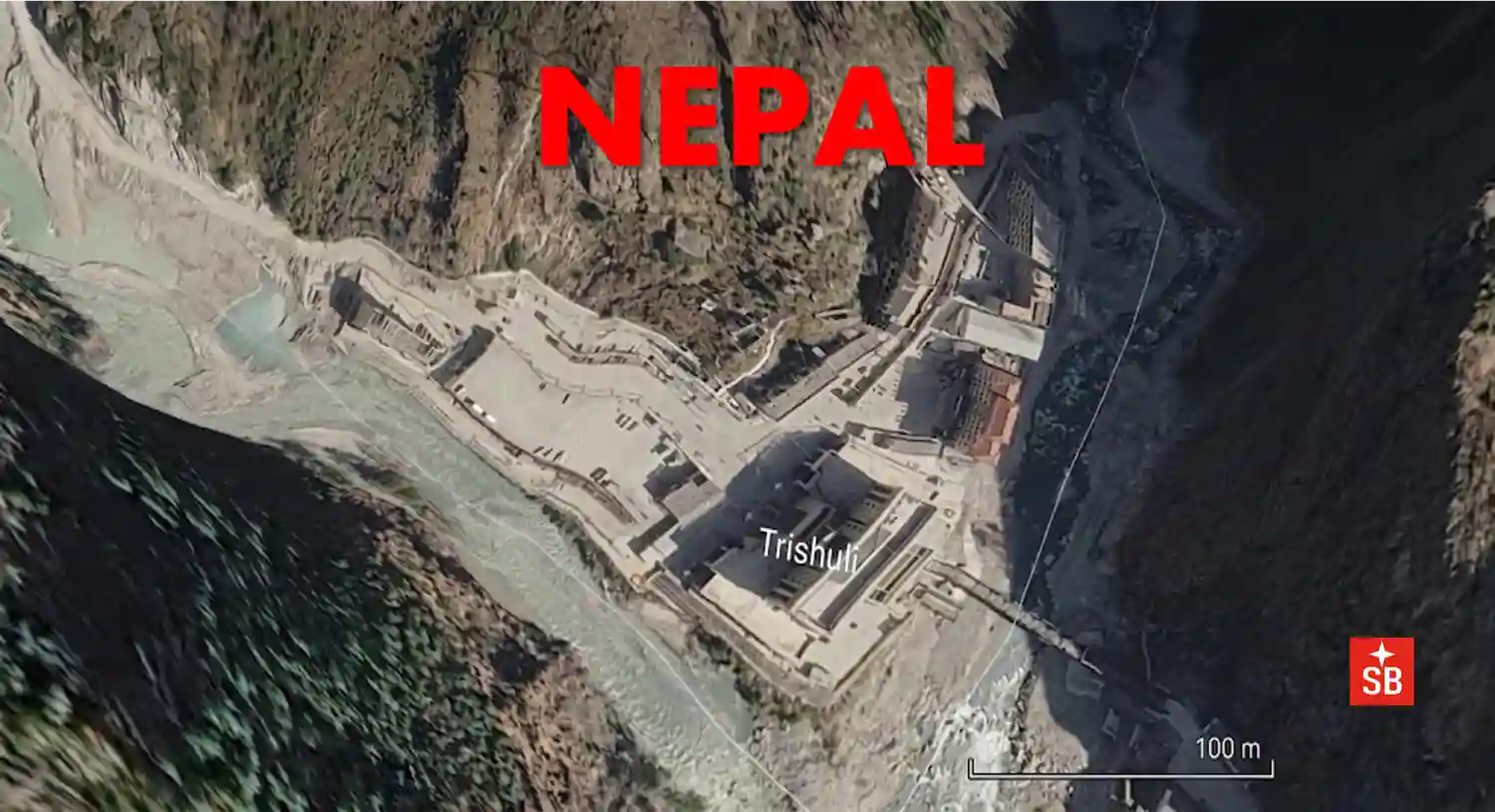
On the 26th of August 2026, a wall of mud, ice, and water tore down a valley on the Nepal-Tibet border and erased villages in seconds. As of this morning, more than 350 people are confirmed dead in Nepal, three more in China, and over 1,300 people, including hundreds of foreign tourists and workers, remain unaccounted for. Bridges that had stood for generations are simply gone. Multi-storey buildings were pulled off their foundations like loose teeth. Families who were drinking morning tea at 7:30 AM were, in a matter of half an hour, running for their lives. This is not a freak accident. It is the latest entry in a pattern this region has been writing for years, and one that keeps getting ignored until the water is already at the door.
What actually happened?
Disaster researchers at Kathmandu’s International Centre for Integrated Mountain Development believe the immediate trigger was an ice-rock avalanche on a glacier that blocked the Lhende Khola, a tributary of the Bhotekoshi River. When that natural dam gave way, it released a sudden, catastrophic surge downstream into the Trishuli River system: the same waterway that has now flooded twice in fourteen months. A magnitude 4.4 earthquake was also recorded in the same area early Wednesday, though scientists are still working out whether it was a contributing trigger or a coincidence of an already unstable slope. China’s state media has warned that landslides have since formed a new lake upstream, raising fears of a second collapse with more rain forecast over the next three days. In other words: this wasn’t simply “too much rain.” It was ice, rock, and gravity conspiring on terrain that was never stable to begin with.
The ground itself is the problem
It’s worth pausing on why this stretch of the Himalayas keeps producing disasters like this one. The mountains here are geologically young and still rising, the product of the Indian tectonic plate ramming into Eurasia at a few centimeters a year, a collision that never really stopped. That ongoing convergence leaves the slopes riddled with fractures, prone to landslides, and regularly rattled by seismic activity, like the earthquake recorded hours before Wednesday’s flood. Layer climate-driven glacial melt on top of that, swelling high-altitude lakes and destabilizing ice that used to sit still for decades, and you get a landscape primed to fail with almost no warning. A blocked river, an ice avalanche, a shaking slope: in a region this geologically restless, any one of these can be the spark, and Wednesday’s flood likely involved more than one at once.
Why this keeps happening — and why it will happen again
Last year, almost the exact same valley flooded when a glacial lake across the border in Tibet overflowed in the heat. Nine people died then. Nobody outside Nepal much noticed. This year, the death toll is already forty times higher, and the world is paying attention mostly because hundreds of the missing are foreign pilgrims and tourists headed to Mount Kailash. That should bother us. A mountain community’s danger shouldn’t need a foreign passport count to become international news.
The uncomfortable truth is that the Nepal-Tibet border has become one of the most climate-exposed frontiers on Earth, and the infrastructure, warning systems, and cross-border coordination haven’t kept pace with how fast the danger is escalating. Hydropower stations, markets, and homes continue to be built directly in these flood corridors because there is often nowhere else for people to live and work. Early-warning systems exist in patches, not as a connected regional network. And when disaster hits a border zone split between two governments, rescue coordination is instantly harder — a lack of connectivity and power has already been cited as slowing search efforts on the ground.
None of that is a natural disaster. That’s a policy failure sitting on top of a natural hazard.
What should actually change
Grief alone won’t stop the next one. What might: binational glacial-lake monitoring that doesn’t stop at a border on a map; hard limits on rebuilding directly in known flood corridors, even when land is scarce; and real investment in early-warning infrastructure for mountain communities that don’t have the luxury of tourist-board attention. The people of Rasuwa and Nuwakot districts have now watched this valley flood twice in just over a year. They deserve more than condolences the next time the mountain gives way, because in this landscape, there will be a next time.
Sources:
- CNN, “Nepal flash floods latest: Hundreds killed in Nepal flood as fears grow of secondary disaster”, Aug 27, 2026
- NPR, “At least 98 killed and hundreds missing after flash floods in Nepal and China”, Aug 26, 2026
- Al Jazeera, “Rescuers search for survivors after Nepal–China floods kill at least 165”, Aug 26, 2026
- Weather.com, “Nepal flash floods: avalanche latest information”, Aug 26, 2026
- Wikipedia, “2026 Nepal floods”
Note: Death tolls and the number of missing are changing rapidly as search-and-rescue operations continue. Figures above reflect reporting as of the morning of August 27, 2026 — verify against live sources before publishing.