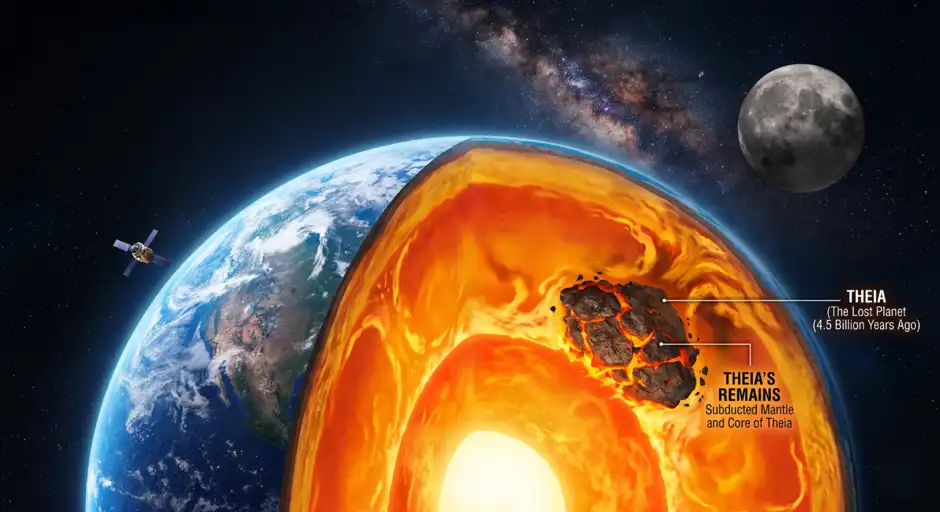
There is a planet inside Earth that you cannot see. It has no surface, no atmosphere and no orbit around the Sun. In fact, it may have disappeared almost 4.5 billion years ago. Scientists call this lost world Theia. Theia is the name given to a planetary body that is thought to have collided with the young Earth during the early history of the Solar System. The collision was enormous. The impact is believed to have thrown huge amounts of molten and rocky material into orbit around Earth, eventually forming the Moon.
But what happened to Theia itself?
For years, scientists assumed that most of it was mixed into the young Earth or blasted into space. Now, researchers have proposed a surprising possibility: some of Theia may still be buried deep inside our planet. The clues come from deep within Earth’s mantle.
As seismic waves travel through Earth, they find two enormous regions near the boundary between the mantle and the core where the waves travel unusually slowly. These structures, known as large low-velocity provinces, or LLVPs, are each thousands of kilometres across. They are also denser than the surrounding mantle. For decades, scientists have debated what these mysterious regions actually are. In 2023, researchers proposed that they could be buried remnants of Theia’s mantle.
Their computer simulations showed that during the Moon-forming collision, some of Theia’s dense mantle material could have been pushed deep into Earth’s interior. Over billions of years, that material could have sunk and gathered near the core, forming structures similar to the LLVPs observed today. If this idea is correct, something remarkable happened during one of the most violent events in Earth’s history: part of another planet became part of Earth and survived for billions of years.
The idea also connects two mysteries which are the origin of the Moon and the strange structures hidden deep inside Earth. But it’s not being claimed that Theia has been found beyond doubt. The LLVPs are detected through seismic evidence, and their exact origin is still debated. Even the Moon-forming impact itself is an active area of research, with newer studies examining how the collision happened and how Earth and Moon ended up so chemically similar. Still, the possibility is extraordinary.
The Moon above us may be the most visible reminder of that ancient collision. But if they are right, Earth itself may contain another reminder, hidden nearly 3,000 kilometres beneath our feet. The planet that once collided with Earth may not have completely disappeared. It may have become part of the world that collision created.