
A spacecraft drifting down under parachutes onto the vast grasslands of Kazakhstan may look like the end of a long adventure. In reality, it is the beginning of many new discoveries. On July 26, 2026, NASA astronaut Chris Williams and Roscosmos cosmonauts Sergey Kud-Sverchkov and Sergei Mikaev safely returned to Earth after spending 241 days aboard the International Space Station, or ISS. During their mission, they circled Earth 3,856 times and travelled more than 102 million miles. While these numbers are impressive, the real treasure they brought home was knowledge. Like bees collecting nectar from thousands of flowers, the astronauts gathered scientific discoveries that could one day improve life for millions of people.
“Every journey into space brings humanity one step closer to a healthier future.”
The International Space Station is often called a laboratory in the sky, and for good reason. Unlike laboratories on Earth, the ISS provides a unique environment where gravity is almost absent. This condition, called microgravity, changes the way materials, living cells, and even fluids behave. Scientists often say, “Space removes gravity from the equation, allowing nature to reveal its hidden secrets.” This makes the station an ideal place to study questions that cannot easily be answered on Earth.
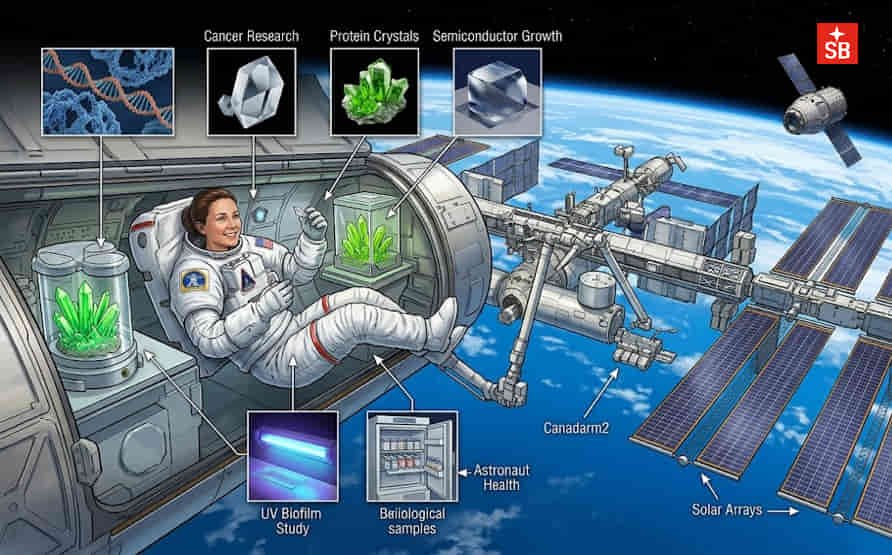
One of the most exciting parts of the mission focused on improving cancer treatment. Working with European Space Agency astronaut Sophie Adenot, Chris Williams studied tiny rod-shaped structures inspired by DNA. These microscopic structures assembled more evenly in microgravity than they usually do on Earth. Researchers hope they can one day carry medicines deep inside solid tumours and slowly release them exactly where they are needed. It is like sending a carefully guided courier directly to the correct house instead of dropping medicine across an entire city. This targeted drug delivery could reduce the harmful side effects often seen with conventional cancer treatments.
Williams also grew protein crystals for medical research. Protein crystals formed in space are often more organised because gravity does not disturb their growth. These clearer crystal structures help scientists understand how important proteins work inside the body. This knowledge can guide researchers in designing more effective medicines, including possible oral treatments for cancer. Every crystal is like a tiny instruction manual waiting to be read by scientists.
The mission also reached beyond medicine into the world of advanced technology. Inside the station’s Microgravity Science Glovebox, Williams grew semiconductor crystals used in electronic materials research. On Earth, gravity causes fluids to circulate unevenly during crystal growth. In microgravity, these disturbances almost disappear, allowing larger and more uniform crystals to form. These materials may contribute to future generations of faster computers, powerful artificial intelligence systems, advanced medical devices, and highly efficient electronic components. Space, quite literally, is helping build the future of technology.
Keeping astronauts healthy during long missions was another major goal. Williams tested ultraviolet light as a way to prevent biofilms from forming inside the station. Biofilms are sticky layers of bacteria and other microbes that can grow on surfaces and inside water systems. Left unchecked, they can threaten both crew health and spacecraft equipment. Ultraviolet light quietly tells harmful microbes, “Your journey ends here,” reducing the need for strong chemical disinfectants during future missions to the Moon and Mars.
Williams also looked after the station’s special science freezer kept at minus 80 degrees Celsius. Blood and urine samples stored inside help scientists understand how months of weightlessness affect the human body. Bones, muscles, the heart, the immune system, and even the brain respond differently when gravity almost disappears. These valuable samples are helping researchers prepare astronauts for future deep-space missions that may last several years.
Life aboard the ISS is not limited to laboratory work. Chris Williams completed two demanding spacewalks, one in March to prepare the station for new Roll-Out Solar Arrays and another in June to repair the Canadarm2 robotic arm. Working outside the station is like repairing a moving ship while floating in an endless ocean of space. Every movement requires patience, skill, and absolute concentration. Once fully installed, the new solar arrays are expected to increase the station’s electricity production by about 30 percent, providing more power for future scientific experiments.
The crew also tested small robotic arms designed for precise automation and helped capture Northrop Grumman’s Cygnus XL cargo spacecraft, which delivered about 11,000 pounds of food, equipment, and scientific supplies. These technologies are paving the way for smarter and more independent spacecraft in the future.
The importance of this mission reaches far beyond the astronauts themselves. Microgravity serves as a natural laboratory where scientists can observe biological processes, material science, and engineering in ways that are impossible on Earth. Lessons learned in orbit may lead to better medicines, cleaner water systems, stronger electronic devices, improved robotics, and safer human space exploration. Every experiment is like planting a seed whose benefits may bloom years later.
The 241-day mission reminds us that space exploration is much more than rockets and breathtaking photographs. It is an investment in human health, technology, and knowledge. As the proverb wisely says, “Knowledge is a treasure that follows its owner everywhere.” The International Space Station continues to prove that even hundreds of kilometres above Earth, discoveries made among the stars can brighten lives here at home. Every orbit carried not only astronauts around our planet, but also humanity one step closer to a better future.
Source:
National Aeronautics and Space Administration. (2026, July 23). NASA astronaut Chris Williams closes out space station mission. NASA. https://www.nasa.gov/missions/station/iss-research/nasa-astronaut-chris-williams-closes-out-space-station-mission/
National Aeronautics and Space Administration. (2026, July 25). Expedition 74 crew boarding Soyuz, saying farewell to station soon. NASA. https://www.nasa.gov/blogs/spacestation/2026/07/25/expedition-74-crew-boarding-soyuz-saying-farewell-to-station-soon/


