
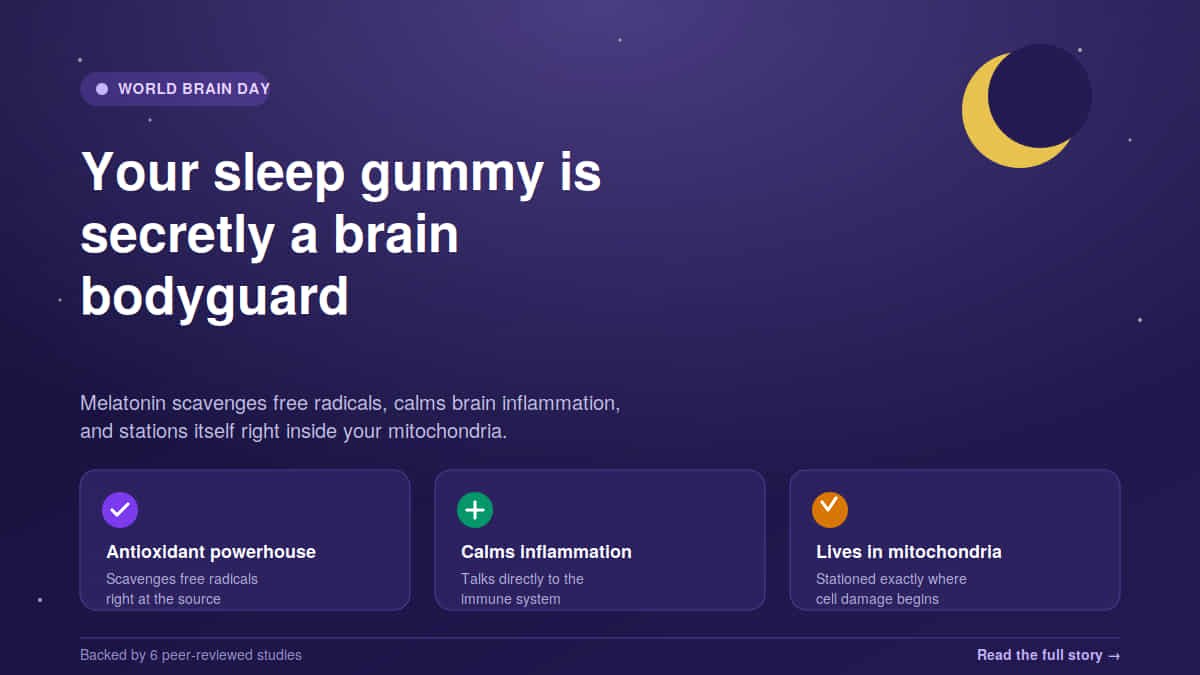
Happy World Brain Day! Let’s talk about the cheap, over-the-counter molecule nobody’s hyping, and probably should be.
What’s the first thing that comes to mind when you hear “Melatonin”? A gummy bear you chew before bed? A jet-lag hack? That’s it? That’s the problem. We’ve mentally filed melatonin under “sleep aid” and closed the drawer. But peel back the label, and you’ll find a molecule doing something far more interesting: quietly patrolling your brain, mopping up cellular damage, calming inflammation, and possibly slowing down the very processes behind neurodegeneration. Scientists have a word for this kind of do-it-all molecule: pleiotropic, meaning it doesn’t just do one job; it does many, often at the same time, in the same tissue.
Here’s why melatonin deserves way more attention than a bedtime footnote. It’s not just the sleep hormone; it’s your pineal gland’s multitasking MVP. Melatonin is synthesized from tryptophan and released by the pineal gland in a nightly rhythm, peaking in darkness and tapering off toward morning, which is why it’s become synonymous with sleep-wake regulation. Beyond sleep promotion, melatonin plays an important role in neuroprotection, acting as both a direct antioxidant and free radical scavenger in laboratory and animal studies.
And here’s the kicker: Melatonin isn’t just floating around your bloodstream. It’s actually synthesized in, taken up by, and concentrated inside your mitochondria, the energy factories of your cells, and notably, the same organelles that generate most of the cell-damaging free radicals in the first place. Melatonin is, quite literally, stationed at the site of the crime.
The Antioxidant Nobody Told You About
Free radical damage (oxidative stress) is one of the prime suspects behind brain aging and neurodegenerative disease. Melatonin’s antioxidant résumé is genuinely wild. It scavenges radicals directly, regulates the enzymes that control oxidant formation, and even helps mitochondria avoid generating radicals in the first place. It also upregulates the body’s own antioxidant enzyme squad led by glutathione peroxidase, glutathione reductase, superoxide dismutases, and catalase, essentially recruiting your body’s internal cleanup crew rather than doing all the work solo.
This isn’t just theoretical. In patients with ALS, melatonin’s antioxidant properties were found to reduce oxidative stress measurably: a small but striking clinical data point for a supplement sitting quietly in the sleep-aid aisle.
The Calm-Down Molecule: Melatonin and Inflammation
Chronic, low-grade brain inflammation is increasingly implicated in everything from mood disorders to cognitive decline. Melatonin has a hand here too: one of its most significant pleiotropic effects is modulating the immune system to reduce both chronic and acute inflammation, largely through two-way signaling between the pineal gland (acting as a neuroendocrine relay) and the immune system. Melatonin’s neuroprotective role also involves anti-inflammatory activity, support for immune function, and help regulating glucose metabolism: three separate levers, one small molecule, all pulling in the same protective direction for the brain.
Could It Help in Alzheimer’s? Researchers Are Actually Asking
This is where it gets genuinely newsworthy. A recent systematic literature review specifically examined whether melatonin should be recommended to Alzheimer’s patients not only for sleep disturbances but also for its broader neuroprotective potential. Meanwhile, a dedicated review on melatonin’s “neurogenic potential” argues the molecule shows real promise across a whole spectrum of neurological and neuropsychiatric disorders owing to its strong antioxidant properties against free radicals.
So Why Isn’t Everyone Talking About This?
Partly because melatonin is cheap, unpatentable, and sold in gas-station gummies, which doesn’t exactly scream “cutting-edge neuroscience.” Partly because “sleep hormone” is a much easier headline than “amphiphilic pleiotropic indoleamine with mitochondrial-targeted antioxidant and immunomodulatory properties”. More importantly, the uphill road from being called a supplement to consideration in mainstream therapies is a regulatory battle that needs a well-oiled ecosystem to take up.
The Takeaway
Melatonin isn’t a miracle cure, and none of this means you should start megadosing before your next exam. But on World Brain Day, it’s worth giving credit where it’s due: one of the most slept-on (pun very much intended) molecules for brain health might already be sitting in your medicine cabinet. Only researchers and their time will tell whether it can be the next big translatable thing in brain research.
Source:
- Melhuish Beaupre, L.M., Brown, G.M., Kennedy, J.L. Melatonin’s neuroprotective role in mitochondria and its potential as a biomarker in aging, cognition and psychiatric disorders. Translational Psychiatry 11, 339 (2021). https://doi.org/10.1038/s41398-021-01464-x
- Potes, Y., Cachán-Vega, C., Antuña, E., et al. Benefits of the Neurogenic Potential of Melatonin for Treating Neurological and Neuropsychiatric Disorders. International Journal of Molecular Sciences 24, 4803 (2023). https://doi.org/10.3390/ijms24054803
- Potes, Y., Caballero, B. Special Issue on “Pleiotropic Benefits of Melatonin: From Basic Mechanisms to Disease.” International Journal of Molecular Sciences 24, 5223 (2023). https://doi.org/10.3390/ijms24065223
- Onaolapo, O.J., et al. Pharmacological Effects of Melatonin as Neuroprotectant in Rodent Model: A Review on the Current Biological Evidence. PMC (2024). https://pmc.ncbi.nlm.nih.gov/articles/PMC11448813/
- Review of Melatonin’s Effectiveness and the Side Effects on Alzheimer’s Disease. PMC (2024). https://www.ncbi.nlm.nih.gov/pmc/articles/PMC11738298/
- Neuroprotective effects of melatonin in neurodegenerative and autoimmune central nervous system diseases. PMC (2023). https://pmc.ncbi.nlm.nih.gov/articles/PMC10295826/


