
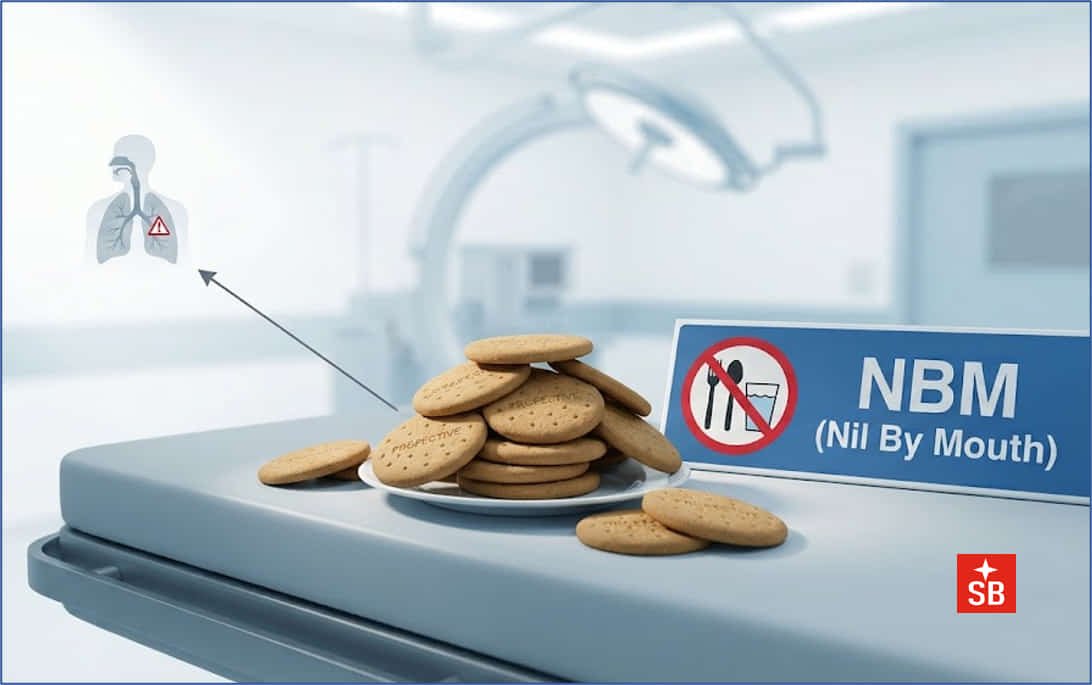
A single biscuit may look harmless, but before surgery it can become a silent enemy. As the old saying goes, “A stitch in time saves nine.” In hospitals, one small truth told at the right time can save a precious life. Many people think, “It is only one biscuit, nothing will happen.” That small thought can open the door to a big tragedy. The 2013 medical thriller film Ankur Arora Murder Case reminds us of this painful reality. In the story, eight-year-old Ankur is taken for a simple appendix surgery. “A nurse informs the surgical team that the child had eaten biscuits. Unfortunately, the information is not acted upon, and the surgery proceeds. During anesthesia, food from the stomach enters the lungs, leading to a fatal complication.” The film is dramatic, but its message is real. A biscuit may cost only a few rupees, but in the operation theatre its hidden price can be a human life.
This story also teaches an important lesson for patients and their families. Sometimes people hide the truth because they fear that surgery will be postponed, doctors may become angry, or they may miss an auspicious time. Such thinking is like covering fire with paper, it only delays the danger. Doctors cannot read minds, they can only act on the information they receive. Honesty is the best medicine before surgery. Even if you have eaten one biscuit, one fruit, or taken a few sips of milk or tea, tell the healthcare team immediately. A delayed surgery is far safer than a rushed surgery with hidden risks. Time can be recovered, but life cannot.
Doctors follow an important rule called Nil By Mouth, commonly written as NBM. It means the patient must not eat or drink anything for a fixed number of hours before surgery. Think of the stomach like a school classroom before an examination. If the room is empty and quiet, everything runs smoothly. If it is crowded and noisy, confusion begins. In the same way, an empty stomach allows anesthesia to work safely. Food left inside the stomach becomes an unwanted passenger waiting for the wrong moment to travel upward.
Normally, our body works like a careful security guard. If food or liquid tries to enter the windpipe, we cough or swallow immediately. During general anesthesia, this guard goes to sleep. The body’s natural protective reflexes stop working for some time. If food comes back from the stomach, it may slip into the lungs. Doctors call this pulmonary aspiration. This medical emergency can block the airway, burn the lungs because of stomach acid, cause severe pneumonia, lead to breathing failure, and in rare cases even result in death. In simple words, when the guard sleeps, danger quietly walks through the open gate.
Medical science explains this process clearly. General anesthesia suppresses airway protective reflexes, reduces muscle tone in the esophagus, and increases the risk of regurgitation. Gastric contents entering the respiratory tract can produce chemical pneumonitis, airway obstruction, aspiration pneumonia, acute respiratory distress syndrome, and cardiovascular complications. The NBM protocol is therefore not a hospital formality. It is an evidence based patient safety measure developed after years of clinical research. Every fasting hour acts like another brick in a protective wall built around the patient.
An empty stomach also gives surgeons a better working space. During abdominal and pelvic operations, food and gas can make the stomach and intestines swollen. Imagine trying to repair a bicycle inside a room filled with large boxes. Every movement becomes difficult. Likewise, swollen bowel loops reduce visibility and increase the chance of accidental injury. A clean field helps surgeons perform delicate procedures more safely and efficiently. As surgeons often say, “A clear view is half the victory.”
For planned surgeries, doctors usually follow standard fasting guidelines. Solid food is generally stopped at least eight hours before surgery. Infant formula is usually stopped six hours before, breast milk four hours before, and clear liquids such as plain water may be allowed until two hours before anesthesia, depending on the doctor’s advice and the patient’s condition. These timings may change for children, pregnant women, emergency cases, or people with certain medical conditions. Therefore, always follow the instructions given by your surgical team.
Many people also wonder about their daily medicines. Being NBM does not always mean stopping every tablet. Medicines for blood pressure, heart disease, or epilepsy are often allowed with only a tiny sip of water. However, drinking a full glass of water to swallow a pill can restart the fasting period because it fills the stomach again. Some medicines, especially blood thinners or diabetes medicines, may need to be stopped or adjusted before surgery. Never guess. Ask your doctor, because one question today can prevent many problems tomorrow.
The message is simple but powerful. A biscuit before surgery is not just a biscuit, it can become a wolf in sheep’s clothing. The operating theatre rewards honesty, not silence. The safest patient is the one who speaks the truth without fear. Every member of the healthcare team, doctors, nurses, technicians, patients, and family members, becomes a link in the same safety chain. If one link breaks, everyone is at risk.
As a simple quote reminds us, “Truth before surgery protects tomorrow, silence before surgery may steal tomorrow.” Let every patient remember that the shortest confession can become the longest gift of life.


