
You set your alarm for 7:00 a.m., yet your eyes suddenly open at 6:57. You glance at the clock, wondering how you managed to beat the alarm again. It happens so often that it almost feels as though your brain has a built-in clock.
Is your body actually keeping track of time, or is it just a remarkable coincidence?
The answer is a little of both.
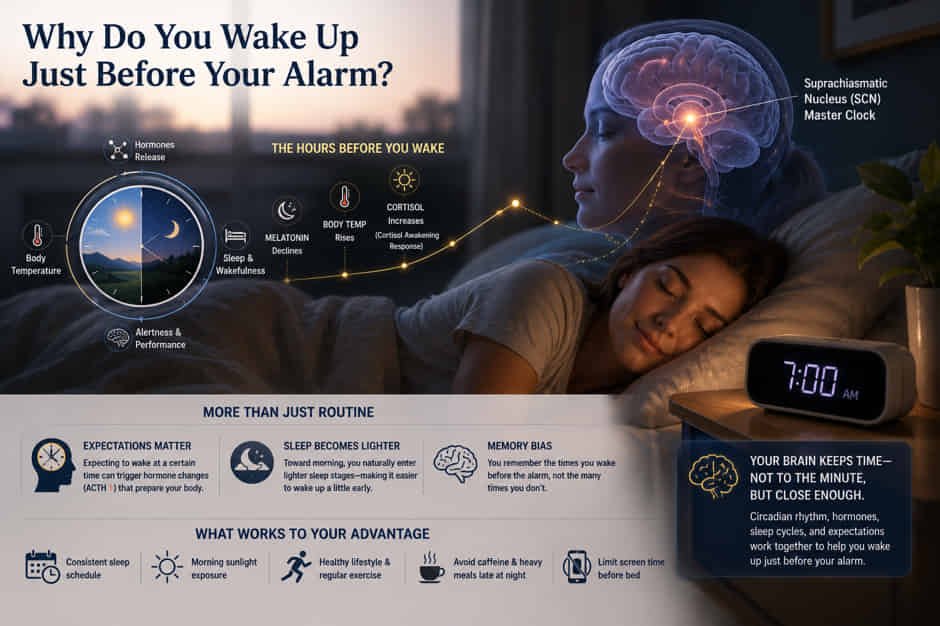
Deep inside your brain is an internal timekeeper that quietly coordinates when you sleep and when you wake. This system, known as the circadian rhythm, runs on a cycle of about 24 hours and regulates sleep, body temperature, hormone release, metabolism, and many other biological functions. At the heart of this system lies a tiny cluster of nerve cells called the suprachiasmatic nucleus (SCN) in the hypothalamus. Often described as the body’s “master clock,” the SCN uses environmental signals, especially sunlight, to synchronize your body’s daily rhythm with the outside world.
Your Brain Starts Preparing Before You Wake
If you maintain a fairly regular sleep schedule, your brain gradually learns when you usually wake up. Long before your eyes open, your body begins preparing for the day. During the final hours of sleep:
- Your body temperature slowly rises.
- Sleep-promoting signals begin to fade.
- Alertness gradually increases.
- Levels of cortisol, a hormone that helps you wake up and become alert, naturally climb.
This early-morning surge is called the cortisol awakening response, and it helps your body transition smoothly from sleep to wakefulness. In other words, your body often starts waking up before you become consciously aware of it.
Your Expectations Can Influence Your Body
Interestingly, your expectations may also play a role.
In a fascinating experiment, researchers told volunteers they would be awakened earlier than usual. Even before the expected wake-up time, participants showed increased levels of adrenocorticotropic hormone (ACTH), which stimulates the release of cortisol. The finding suggests that the brain doesn’t simply react when the alarm rings, it may actually prepare the body in advance based on when it expects to wake. This demonstrates how closely the brain links anticipation with the body’s hormonal systems.
Is Your Brain Really That Accurate?
Not exactly.
Your brain is excellent at predicting roughly when morning arrives, but it is not functioning like a digital clock counting down every second.
Sleep occurs in repeating cycles lasting about 90 minutes, and these cycles become progressively lighter toward the early morning. If your alarm is scheduled near the time your body naturally reaches a lighter stage of sleep, you are more likely to wake on your own shortly before it rings. There’s also a psychological factor. We vividly remember the mornings when we wake three minutes before the alarm because they feel uncanny. We usually forget the many mornings when the alarm wakes us first. Psychologists call this confirmation bias, our tendency to notice and remember events that match our expectations while overlooking those that do not.
So, Why Do You Wake Up Before Your Alarm?
It is usually the combined result of several biological processes working together:
- A well-trained circadian rhythm.
- A consistent sleep schedule.
- The natural rise of cortisol before waking.
- Lighter sleep stages in the early morning.
- Your brain’s expectation of waking at a certain time.
Together, these mechanisms make waking a few minutes before your alarm surprisingly common.
The Bottom Line
Your brain doesn’t know the exact time in the way a clock does. Instead, it uses an intricate network of biological rhythms, hormones, and learned routines to estimate when morning is approaching. So the next time you wake up just before your alarm sounds, don’t be too surprised. Your alarm clock may announce the morning, but if you’ve built a consistent sleep routine, your brain was already expecting it.


