
When scientists first introduced CRISPR-Cas9, it revolutionized genetics by giving researchers a way to cut DNA at specific locations and rewrite the genetic code. It was often described as a pair of “molecular scissors.” This simple comparison helped people understand a complex technology, because scissors cut where they are directed to cut. But despite its remarkable success, cutting DNA has limitations. The repair process isn’t always precise and can sometimes introduce unwanted changes. In other words, when DNA is repaired after a cut, the biological “editor” may sometimes leave behind a few spelling mistakes.
Now, researchers have developed a newer technology that aims to edit genes with even greater accuracy, prime editing. It is like upgrading from a pair of scissors to a pencil with an eraser and a precise instruction manual. The goal is not simply to cut, but to make the right change at the right place.
Often described as a “search-and-replace” tool for DNA, prime editing allows scientists to rewrite genetic sequences without creating the double-stranded breaks used in traditional CRISPR editing. The phrase “search-and-replace” sounds familiar because it is similar to correcting a word in a computer document. Instead of tearing the whole page, the system tries to change only the part that needs correction. That is where the real attraction lies.
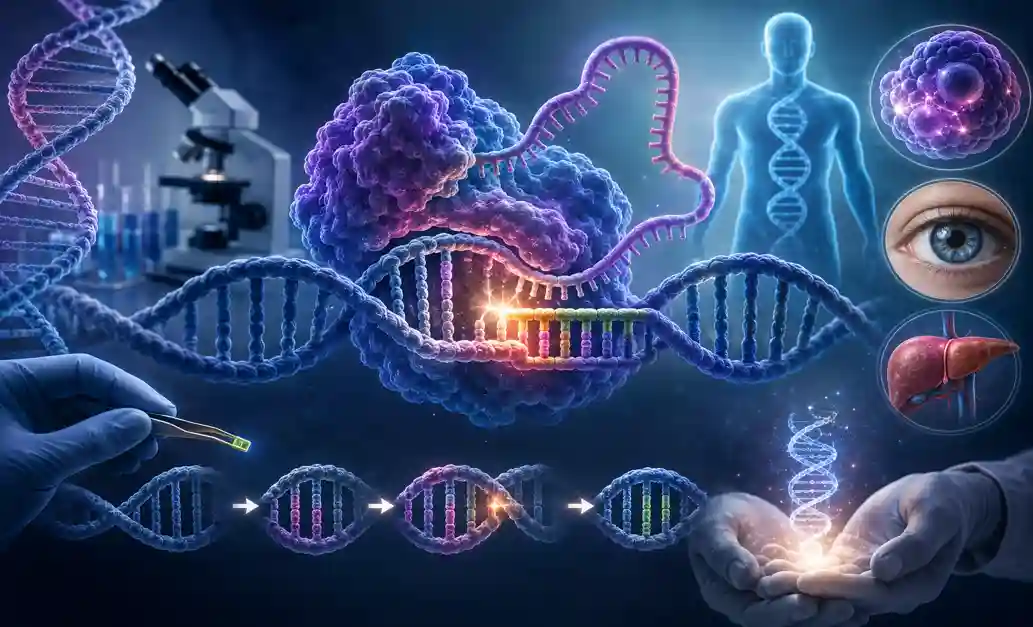
Instead of cutting both strands of DNA, prime editing uses a modified Cas9 protein that makes only a small nick in one DNA strand. This protein is linked to an enzyme called reverse transcriptase. Working together with a specially designed prime editing guide RNA (pegRNA), the system identifies the target DNA sequence and carries the instructions for the desired genetic change. The reverse transcriptase then copies the new genetic information directly into the DNA, allowing precise insertions, deletions, or single-letter substitutions.
Here, the molecular machinery works almost like a careful proofreader. The guide RNA acts like an address label, helping the system find the right place, while the reverse transcriptase helps write the new sequence. It is a case of “measure twice, edit once”, because precision matters when even one DNA letter can influence health.
Why is this important?
Many inherited diseases are caused by tiny changes in DNA, sometimes the alteration of just a single genetic letter. Traditional CRISPR can correct some of these mutations but may also create unintended insertions or deletions during DNA repair. Prime editing was designed to reduce these unwanted changes while greatly expanding the types of mutations that can potentially be corrected. A tiny genetic error can sometimes have a huge biological effect, proving that small things can cast long shadows.
Since its introduction in 2019, researchers have successfully used prime editing in laboratory cells and animal models to correct mutations associated with disorders such as sickle cell disease, Tay-Sachs disease, and certain forms of cystic fibrosis, among many others. Scientists are also exploring its potential for treating eye diseases, liver disorders, and rare genetic conditions. The list of possibilities is growing, but science must still separate promising ideas from proven treatments. As the saying goes, “the proof of the pudding is in the eating.”
However, prime editing is still an emerging technology. Its promise is enormous, but its journey from laboratory bench to hospital bedside is not a short one. Science may have found a sharper pencil, but it still has to learn where and how to use it safely.
One of the biggest challenges is safely delivering the editing machinery into the right cells inside the body. Researchers are also working to improve editing efficiency and further reduce unintended “off-target” changes. Before prime editing becomes widely available in hospitals, it must undergo extensive laboratory testing and carefully designed clinical trials to demonstrate both safety and effectiveness. In medicine, there is no shortcut to safety, because a promising treatment must first prove that its benefits outweigh its risks.
So, is prime editing the future of gene therapy?
It has enormous potential, but it is not a cure-all. Prime editing represents one of the most precise gene-editing technologies developed so far, yet many scientific and medical challenges remain before it becomes a routine treatment. The irony is that the technology is becoming better at changing DNA, while scientists are becoming more careful about deciding when and where that change should happen.
The biggest breakthrough may not be that scientists can edit DNA but that they are learning to rewrite it with increasing precision, opening new possibilities for treating genetic diseases once thought impossible to cure. The journey has moved from “cut and repair” towards “find and rewrite”, a small change in wording that reflects a much bigger change in scientific thinking. In the world of genetics, every letter counts, and prime editing is teaching scientists how powerful a carefully placed correction can be.


