
Every cell in our body has tiny structures called mitochondria, often known as the “powerhouses of the cell.” They work like miniature power stations, producing the energy needed to keep our organs alive and active. But when these power stations fail, the whole city slows down. Diseases such as Parkinson’s disease, heart failure, and certain eye disorders often begin when mitochondria stop working properly. Scientists have now developed an exciting technology called MitoCatch that acts like a smart courier, delivering healthy mitochondria directly to the cells that need them most. As the saying goes, “A stitch in time saves nine.” This discovery may offer timely help before damaged cells reach the point of no return.
Earlier attempts at mitochondrial transplantation faced two major roadblocks. Healthy mitochondria often failed to enter cells efficiently, and even when they did, they could not distinguish between healthy and diseased cells. It was like sending an ambulance without knowing the correct address. Inspired by viruses, which are experts at entering specific cells, researchers borrowed nature’s clever strategy. “If viruses can find the right cells, why can’t healthy mitochondria?” the scientists wondered. Instead of causing disease, this idea uses the same principle for healing. It is a beautiful example of turning an enemy’s trick into a doctor’s tool.
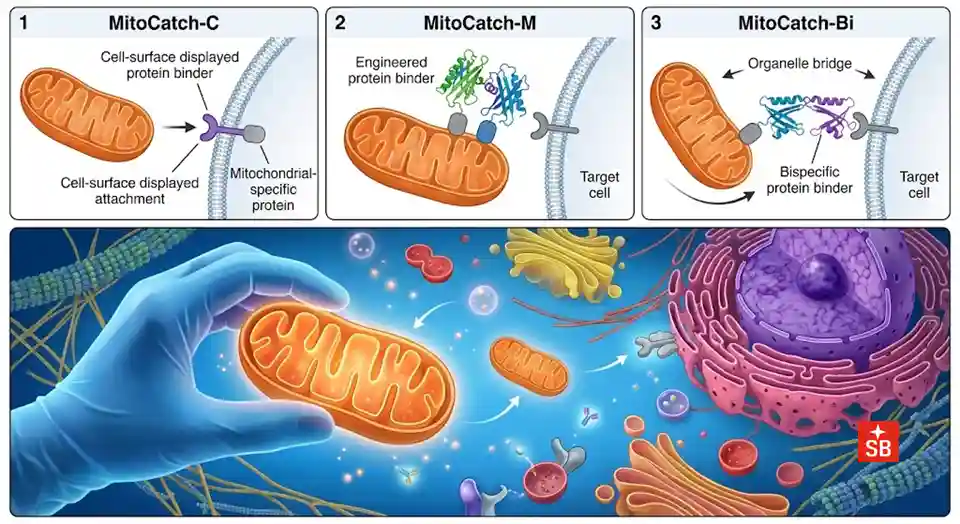
To solve this challenge, scientists created MitoCatch, a programmable delivery system that works like a GPS guided parcel service. The technology uses specially designed protein binders that act as molecular hooks, helping healthy mitochondria attach to selected target cells. MitoCatch works in three different ways. One method places binders on recipient cells, another places them directly on donor mitochondria, and a third uses bispecific binders that connect both the mitochondria and the target cell like a strong biological bridge. These protein binders include nanobodies, full length antibodies, and designed ankyrin repeat proteins, making the system flexible for many medical applications.
Using atomic force microscopy, researchers confirmed that these molecular hooks significantly strengthen the attachment between donor mitochondria and target cells. They also discovered that delivery efficiency could be adjusted by changing the strength of the protein binders or by increasing the number of binding interactions, a property known as avidity. A high affinity binder was developed against TOM20, a receptor found on the outer membrane of mitochondria. This clever design allows healthy mitochondria from almost any donor source to be redirected towards different cell types simply by changing the cell targeting binder. It is much like changing the destination on a navigation system while using the same delivery vehicle.
The results were truly remarkable. MitoCatch successfully delivered healthy mitochondria into cultured human cells, induced neurons, organoids, primary human tissues, and even living mice. The targeting efficiency improved by more than thirty fold compared with previous methods. Once inside the cells, the transplanted mitochondria remained alive, functional, and actively produced energy. In neurons obtained from patients with inherited mitochondrial diseases, the treatment improved cellular respiration and increased cell survival. In mice with optic nerve injury, targeted delivery protected retinal ganglion cells and improved their function in a dose dependent manner. These findings show that healthy mitochondria are not just passengers, they become hardworking members of their new cellular home.
This breakthrough opens an exciting chapter in regenerative medicine. Instead of treating only the symptoms of mitochondrial diseases, doctors may one day repair the root cause by replacing damaged cellular power stations with healthy ones. MitoCatch represents a new generation of organelle therapy, where entire cell components can be delivered with remarkable precision. As the proverb wisely says, “Where there is life, there is hope.” By combining protein engineering, cell biology, and molecular medicine, scientists are transforming a simple biological idea into a powerful treatment that could brighten the future for patients suffering from neurological disorders, heart diseases, vision loss, and many other mitochondrial conditions.
Source: Ayupov, T. Programmable delivery of mitochondria to specific cell types. Nat Rev Mol Cell Biol 27, 562 (2026). https://doi.org/10.1038/s41580-026-00986-w


