
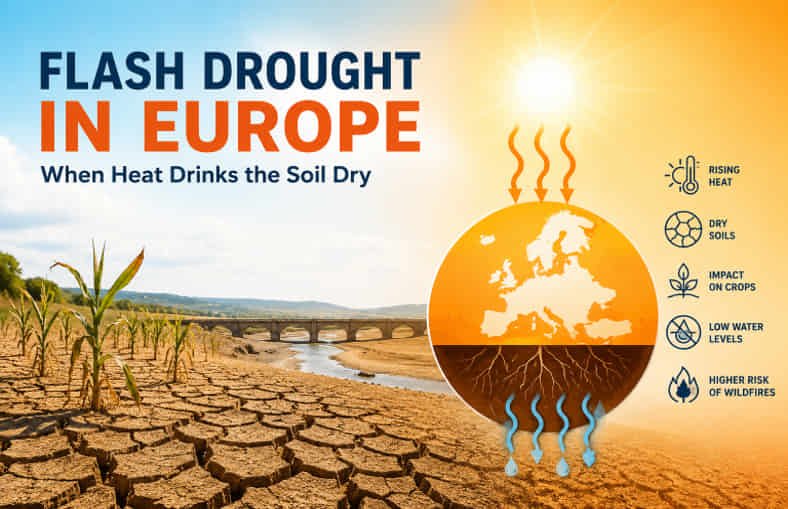
Europe is facing a new kind of drought, one that isn’t just caused by a lack of rain. Scientists now warn that extreme heat is literally pulling moisture out of the soil. This creates a fast-moving environmental crisis that is changing agriculture, ecosystems, rivers, and energy production across the continent. According to a new analysis by the World Weather Attribution (WWA) group, climate change has fundamentally altered how drought develops, making severe dry spells much more common.
Traditionally, drought was seen as a simple result of low rainfall over time. But researchers say today’s droughts are increasingly driven by record-high temperatures. These temperatures greatly increase evaporation from soils, rivers, lakes, and even plants. This process, known as atmospheric thirst, happens because hotter air can hold more water vapor, pulling moisture from the land at a faster rate. Even areas that received enough rainfall in winter are now facing rapidly drying soils as intense summer heat strips away stored water.
The findings are alarming. Scientists estimate that human-induced climate change has made agricultural soil droughts about five times more likely in western Europe and eleven times more likely in eastern Europe. Even more surprising, the atmospheric conditions that lead to rapid evaporation are now about 80 times more likely in western Europe than before the industrial era. In other words, the climate today is creating droughts that would have been extremely rare just a century ago.
The effects are already visible across Europe. Major rivers like the Rhine and Danube are running unusually low and causing disruption in shipping and reducing hydroelectric power generation. Farmers are seeing smaller harvests as crops struggle to access water locked deep within increasingly dry soils. France is expected to have one of its poorest maize harvests in decades, while grain production losses have reached millions of tonnes. Water restrictions are common in several countries, and dry vegetation has significantly increased the risk of wildfires.
What makes this situation particularly concerning is its speed. Scientists describe it as a “flash drought,” a phenomenon where landscapes go from healthy to severely water-stressed in weeks instead of months. Early-season heatwaves quickly deplete soil moisture, preventing plants from completing their growing cycle. Vegetation that thrived during a wet spring suddenly turns into dry fuel, creating ideal conditions for large wildfires. This dangerous mix of drought and fire is becoming a more familiar feature of European summers.
The impacts go far beyond agriculture. Dry soils lessen the land’s natural ability to cool itself because less energy is used for evaporation, which causes more heat to stay in the atmosphere. This creates a feedback loop: hotter temperatures dry soils faster, and drier soils make heatwaves even more intense. As this cycle strengthens, ecosystems lose resilience, groundwater recharge declines, biodiversity suffers, and the chances of future droughts increase.
Scientists stress that this crisis is not just a weather anomaly; it is a clear signal of long-term climate change. Europe has already warmed faster than most other regions, and unless greenhouse gas emissions are quickly reduced, similar heat-driven droughts are expected to become more common. Researchers argue that adaptation measures, such as better water storage, drought-resistant crops, smarter irrigation systems, and coordinated water management between countries, must go hand in hand with serious cuts in fossil fuel emissions.
The message is clear: the world’s droughts are changing. Rainfall alone no longer tells the whole story. Heat has become an equally powerful force, silently draining moisture from the ground. Europe’s experience serves as a warning for the rest of the world, showing that in a warming climate, the biggest threat might not be the lack of rain, but the relentless ability of rising temperatures to dry out the land.


