
Cancer treatment has often been compared to fighting a fire. Sometimes, while trying to put out the flames, nearby areas also get wet or damaged. But what if doctors could aim only at the burning spot without touching the surroundings? Scientists have now developed a promising technique that may do exactly that. Instead of making large surgical cuts or exposing healthy tissues to powerful radiation, doctors may one day guide a tiny device straight into a tumour and destroy it using carefully controlled heat produced by light. It is like using a matchstick to light one candle instead of setting the whole room ablaze. Small in size but mighty in purpose, this technology could change the way some cancers are treated.
“The best healing is often the one that harms the least.”
The treatment is called photothermal therapy. In simple words, it uses a special laser to heat cancer cells until they can no longer survive. Healthy cells nearby are meant to remain as safe as possible. The laser seems to tell the tumour, “Your time is over,” while leaving the surrounding tissue with little disturbance. Scientists have studied this method for many years because it can target tumours more accurately than several conventional treatments. In medical language, this targeted destruction is known as selective photothermal ablation. The goal is simple, treat the enemy while protecting the innocent.
However, every bright idea has faced one dark challenge. In the traditional method, the laser shines from outside the body. Before reaching the tumour, much of its energy is absorbed or scattered by healthy tissues. It is like trying to water a plant through a thick wall, most of the water never reaches the roots. To compensate, doctors often need stronger lasers. Ironically, increasing the laser power to destroy cancer cells may also increase the chance of heating healthy tissues. As the proverb says, “Too much of anything is good for nothing.”
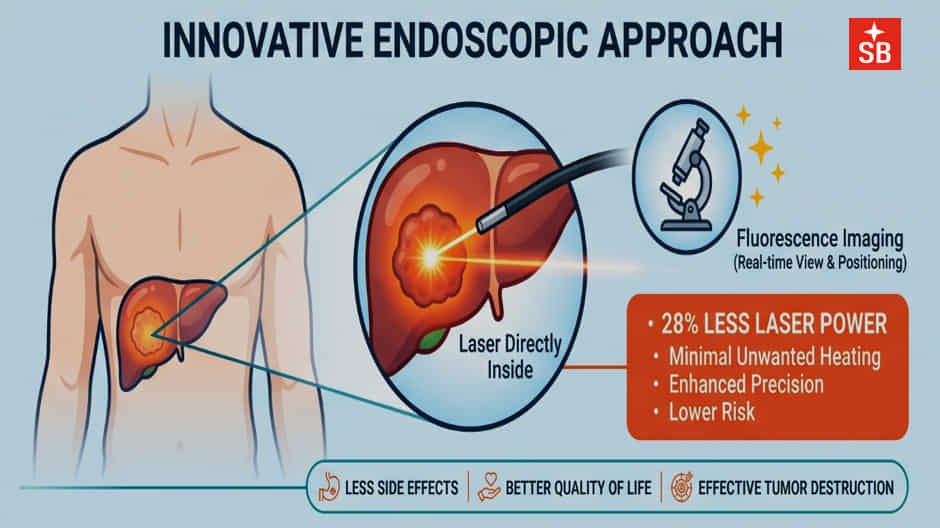
Researchers have now found a smarter path. They designed a thin endoscopic device that carries the laser directly into the tumour. Instead of travelling through layers of healthy tissue, the laser reaches its target almost face to face. The device also contains a fluorescence imaging system, which works like a glowing map inside the body. It allows doctors to see the tumour in real time and place the laser with remarkable precision. The tumour almost seems to hear the message, “There is nowhere left to hide.”
Because the laser is delivered directly to the tumour, the same heating effect was achieved while using about 28 percent less laser power than conventional photothermal therapy. This is an important scientific achievement because lower energy means less unwanted heating of nearby healthy tissues. It is similar to cooking food on the exact flame needed instead of turning the stove to its highest setting. Less energy, less damage, and more precision, this beautiful balance is what modern medicine aims to achieve.
This innovation could become especially valuable for cancers located deep inside the body, where ordinary laser treatment struggles to reach. Organs such as the liver, pancreas, or digestive tract may benefit from this approach because the endoscopic device can travel closer to the tumour before treatment begins. Although the early results are encouraging, scientists must still perform carefully designed clinical studies to confirm that the technology is safe and effective for patients before it becomes part of routine medical practice.
The future of cancer treatment is slowly shifting from fighting harder to fighting smarter. Precision is becoming the new weapon. Doctors are learning that healing is not only about destroying disease but also about protecting what is healthy. Every successful innovation brings medicine one step closer to treatments that are gentler on the body while remaining powerful against cancer.
For patients, this research offers a message of hope. One day, doctors may not need to expose the whole body to treatment when only a small area needs attention. Instead, they may deliver heat exactly where it is needed and nowhere else. Like a skilled sculptor removing only the unwanted stone, this tiny beam of light could help preserve healthy tissue, reduce side effects, and improve the quality of life for people facing one of the world’s greatest health challenges.


