
Saturn has worn its glittering rings like a royal crown for more than four hundred years in the eyes of human observers. They sparkle like a necklace of frozen diamonds, making Saturn one of the most beautiful planets in our Solar System. Yet beauty often hides mystery. Scientists still do not know exactly how these famous rings were formed or what they are truly made of. Now, NASA believes the answers may come not by simply looking at the rings, but by gently reaching out and touching them. Sometimes, seeing is believing, but touching is understanding.
“Curiosity is the hook, science is the line, discovery is the greatest catch.”
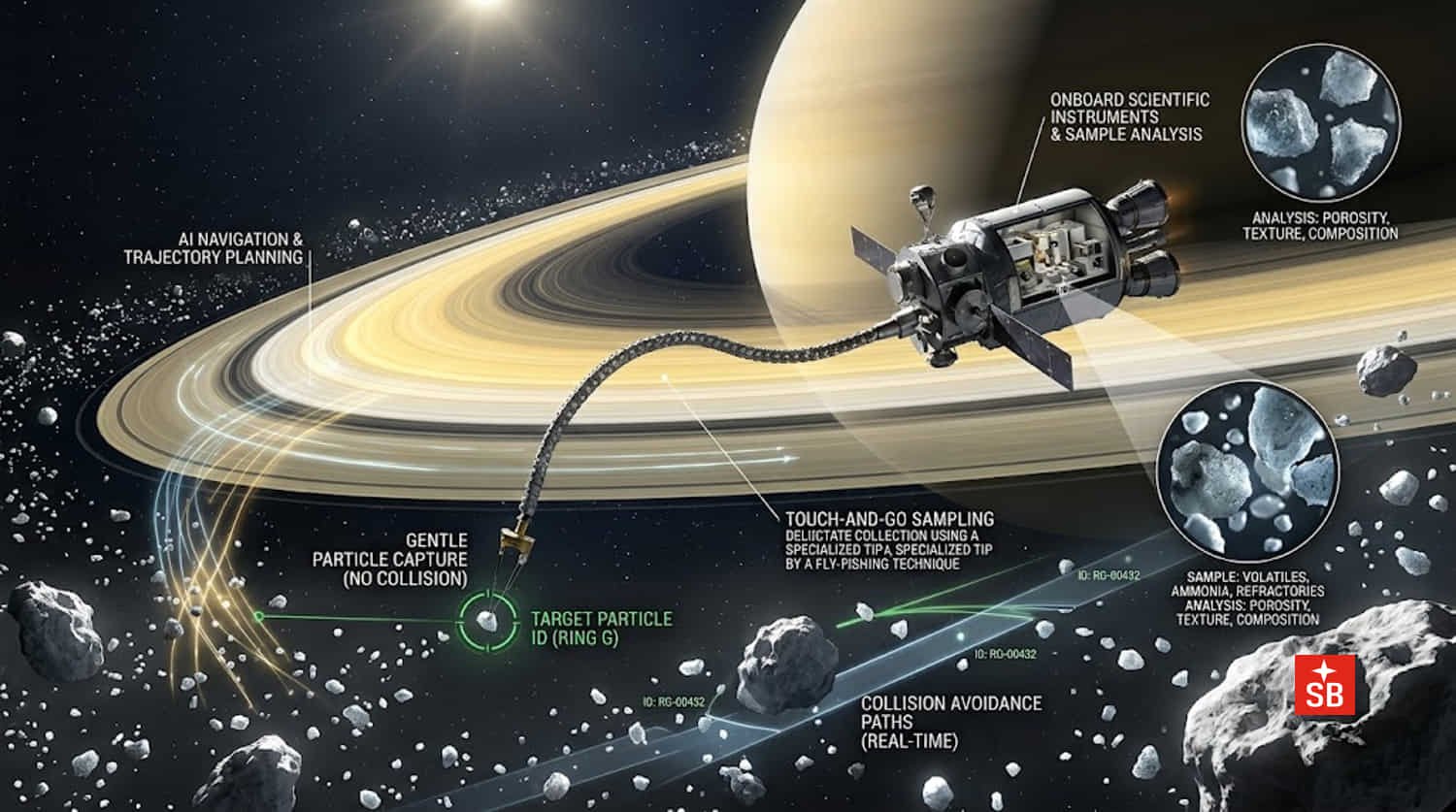
This bold idea is called PRAXIS, short for Planetary Rings Autonomous Exploration with In-situ Sampling. The mission concept was selected under NASA’s 2026 Innovative Advanced Concepts, or NIAC, program. Instead of acting like a tourist taking photographs from far away, PRAXIS plans to become a careful explorer. It will carry an intelligent robotic system powered by artificial intelligence, or AI, to collect tiny samples from Saturn’s rings. It is like a scientist saying, “Pictures have told us many stories, now let the rings speak for themselves.”
The mission is far from simple because Saturn’s rings are not solid circles. They are made of billions of icy particles that range from tiny grains of dust to giant chunks as large as houses. Every particle races around Saturn at enormous speeds while constantly colliding, separating, and changing direction. It is like standing in the middle of an endless traffic jam where every vehicle is moving at racing speed. One small mistake could lead to disaster. In scientific terms, this ever-changing motion is controlled by gravity, orbital mechanics, and particle interactions, creating an extremely dynamic environment.
Rather than diving into this dangerous swarm, PRAXIS plans to stay safely above the rings. The spacecraft will extend a long, soft, flexible boom inspired by the technique of sport fishing. Once its AI spots a suitable target, the boom will quietly move forward, gently touch a moving ring particle, collect a tiny sample, and quickly return to safety. The spacecraft almost seems to whisper, “Hold still for just a moment, I only need a tiny piece of your story.” It is a beautiful example of working smarter rather than harder.
Artificial intelligence is the silent captain of this mission. It will constantly watch the surroundings, avoid collisions, choose the best particles, guide the sampling arm, and make rapid decisions without waiting for instructions from Earth. Since radio signals take more than an hour to travel between Earth and Saturn, the spacecraft cannot afford to hesitate. Time, quite literally, is of the essence. This remarkable independence is known as autonomous navigation, a technology becoming increasingly important in deep-space exploration.
Once a sample is collected, miniature scientific instruments inside the spacecraft will immediately examine it. They will measure its size, shape, porosity, chemical composition, and surface texture. These tiny instruments act like detectives searching for clues hidden inside each icy fragment. Every particle could hold a page from the Solar System’s ancient history book. Scientists hope these direct measurements will answer questions that photographs alone could never solve.
The famous Cassini mission transformed our understanding of Saturn during its remarkable thirteen-year journey. It revealed giant waves inside the rings, mysterious gaps, propeller-shaped structures, and strange gravitational patterns. Yet even Cassini could only observe the rings from a distance. Ironically, after spending more than a decade beside Saturn, it never physically picked up a single ring particle. PRAXIS hopes to bridge this important gap by becoming the first mission to collect and study ring material directly.
The importance of this mission reaches far beyond Saturn. Uranus and Neptune also wear delicate rings, while smaller objects such as Chariklo and Chiron possess surprisingly thin ring systems of their own. Scientists believe these natural laboratories may resemble the giant disks of gas and dust that surrounded the young Sun billions of years ago, from which planets were born. In other words, Saturn’s rings are not just beautiful decorations. They are like a family photo album preserving memories from the childhood of our Solar System.
If PRAXIS eventually flies into space, it could change the way we understand not only Saturn but also the birth of planets themselves. Every tiny ice particle may carry a secret waiting to be uncovered. As the old proverb reminds us, “Little drops make the mighty ocean.” Likewise, countless tiny ring particles together may reveal one of the greatest stories in planetary science. Sometimes, the biggest discoveries begin with the smallest catch, and in this case, science may truly go fishing among the stars.


