
For millions of people living with arthritis, every morning feels like negotiating with stubborn joints before the day can truly begin. The knees refuse to bend, the fingers protest while holding a cup, and the hips whisper, “Not so fast.” What begins as a small ache often grows into an uninvited guest that never seems to leave. As the saying goes, “A stitch in time saves nine,” but arthritis often creeps in silently before anyone notices. Many people think the pain comes from weak muscles, but the real trouble hides inside the joint. There, a smooth cushion called cartilage slowly wears away. It works like the shock absorbers of a car, protecting the bones from bumping into each other. When this cushion becomes thin, the bones start rubbing together like two rough stones, creating pain, stiffness, and swelling. It is like trying to ride a bicycle without air in the tyres, every movement becomes harder than it should be.
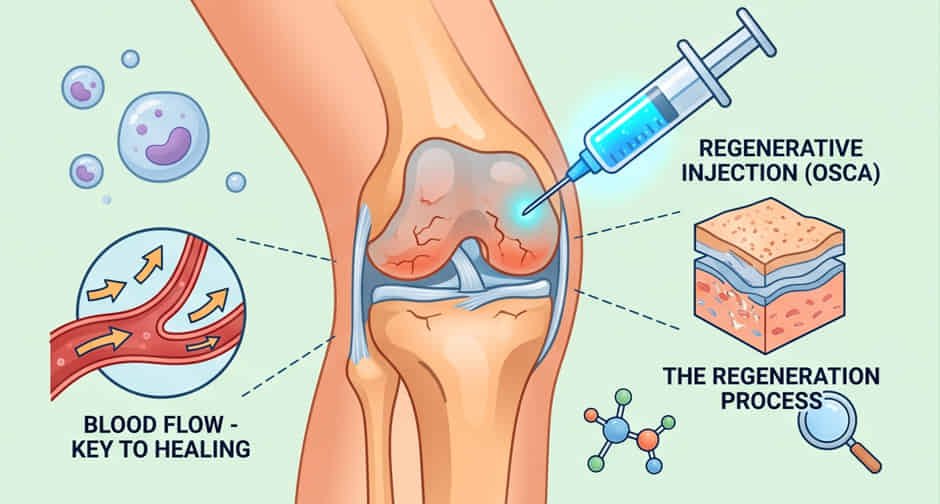
To understand why repairing cartilage is so difficult, think of a road filled with potholes but without repair workers or supply trucks. Unlike the skin, which quickly heals a cut, cartilage has almost no direct blood supply. Blood carries oxygen, nutrients, and repair cells, but very little reaches this tissue. In scientific terms, cartilage is called an avascular tissue, meaning it lacks its own network of blood vessels. Because of this, the body’s natural repair system works at a snail’s pace. One could almost hear the cartilage sigh, “I want to heal, but I have no helpers.” This biological limitation explains why damaged cartilage rarely grows back on its own.
That is why today’s arthritis treatments mainly focus on calming the storm instead of rebuilding the house. Painkillers reduce discomfort, steroid injections decrease inflammation, and lubricating injections help the joint move more smoothly. Doctors often describe these as symptom relieving therapies rather than disease reversing treatments. They certainly make life easier for many patients, but they do not replace the lost cartilage. It is a bit ironic that modern medicine can replace a failing heart valve or even transplant organs, yet repairing a thin layer of cartilage remains one of its toughest challenges. In simple words, these treatments silence the alarm, but they do not repair the broken door.
Now, scientists in South Korea are trying to change that story. They have developed an experimental regenerative injection called OSCA, which aims to encourage the body’s own repair machinery to rebuild damaged joint tissue. Instead of placing an artificial patch over the problem, the treatment attempts to create the right environment for healthy cartilage to grow naturally. It is rather like preparing fertile soil so that a plant can grow back on its own instead of sticking on plastic leaves. Researchers hope the joint itself will say, “Give me the right conditions, and I will try to heal.” Early Phase I clinical trials have shown encouraging safety results, but scientists stress that larger clinical trials are still needed to confirm whether the treatment can truly restore joint function and repair cartilage over the long term.
From a scientific perspective, OSCA belongs to the growing field of regenerative medicine, a branch of medical science that aims to restore damaged tissues instead of merely controlling symptoms. Osteoarthritis has long been viewed as a progressive degenerative disease, where cartilage loss is largely irreversible because of its poor regenerative capacity. If future Phase II and Phase III clinical trials demonstrate both safety and effectiveness, treatments may shift from symptom management to biological repair. That would represent a major paradigm shift in orthopaedic medicine, moving from slowing damage to encouraging tissue regeneration.
The journey is still at an early stage, and it would be wise not to count the chickens before they hatch. Many experimental therapies show promise in the laboratory but fail during larger human studies. Yet every medical breakthrough begins with a single careful step. If OSCA continues to succeed in future trials, tomorrow’s arthritis treatment may no longer be about simply living with pain. Instead, doctors may one day help worn out joints rebuild themselves, turning what once sounded like science fiction into everyday medical reality.
Sources


