Medical faculty promotions in India require strict adherence to the National Medical Commission’s (NMC) mandatory research publication criteria. Under the latest gazetted regulations, career progression for doctors is no longer just a matter of clinical experience or teaching longevity. It hinges heavily on strict and unforgiving research publication standards.
Many medical educators discover too late that years of intensive research have been completely invalidated by a single overlooked oversight, such as a journal falling out of an approved database or a misinterpreted authorship rule.
For any doctor anticipating promotion from Assistant Professor to Associate Professor, or from Associate Professor to Professor, understanding the nuances of indexation, authorship tiers, and predatory practices is now an absolute professional necessity.

The Two Pillars of Promotion: Indexation and Authorship
The NMC has structured its promotional benchmarks around two uncompromising criteria: where you publish and where your name appears on the manuscript. Failing to meet either of these criteria completely disqualifies the paper from receiving promotional credit.
NMC Promotion Pillars Under Recent Norms
- The Seven Approved Databases
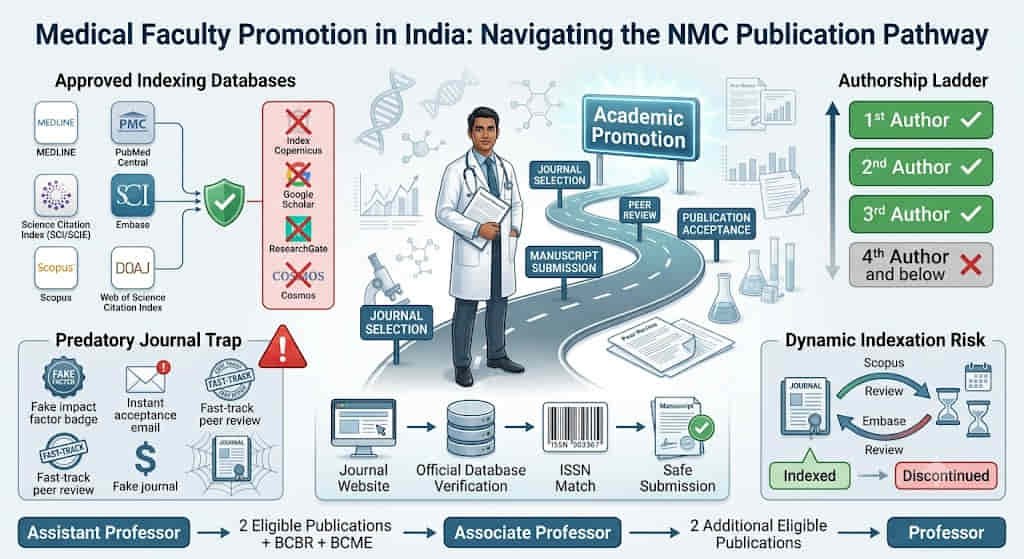
The NMC explicitly recognizes only seven indexing databases:
• MEDLINE
• PubMed Central (PMC)

• Science Citation Index / Science Citation Index Expanded (SCIE)
• Embase (Excerpta Medica)
• Scopus
• Directory of Open Access Journals (DOAJ)
• Citation Index (Web of Science)
If a journal is not indexed in at least one of these seven platforms at the exact time of publication, the paper carries no weight for promotion. Databases popular among low-tier publishers, such as Index Copernicus, Google Scholar, ResearchGate, or Cosmos, are completely rejected by the NMC.
Furthermore, the NMC accepts only specific types of manuscripts: Original Research Articles, Systematic Reviews, Meta-Analyses, and Case Series. Case reports, editorials, letters to the editor, short communications, and general narrative reviews do not qualify for promotional credit.
- The Author Position Rule
The days of securing promotion credit by adding one’s name as a multi-author contributor are over. Under the current rules, only the first three authors (first, second, and third authors) receive promotion benefits.
Crucially, the corresponding author position alone no longer guarantees credit if that author is listed fourth or lower on the manuscript. If you are a senior faculty member mentoring a project, you must ensure your name appears within the top three author positions if you intend to use that paper for your upcoming promotion evaluation.
The Dynamic Indexation Trap: The Case of Scopus and Embase
One of the most devastating traps for medical researchers is the constantly changing landscape of journal indexation. Many doctors assume that if a journal is indexed today, it will remain indexed forever. This misconception can prove career-limiting.
The Scopus Discontinuation Window
Scopus evaluates its indexed journals multiple times a year. If a journal begins practicing unethical peer review or significantly increases its publication volume for commercial gain, Scopus may formally discontinue its indexation.
The critical factor is the discontinuation effective date. If you submit an article to a Scopus-indexed journal and Scopus removes that journal from its database before your article is formally processed and assigned to an issue, your paper may not appear in the Scopus repository.
Because the NMC evaluates the journal’s database status at the time of promotional review, a paper published in a newly discontinued journal may become completely useless for your academic profile.
The Post-Publication Embase Drop
A similar hazard exists with Embase. A journal may hold active Embase indexation when you submit your manuscript. However, if the journal is removed from the index shortly after your paper is published, your paper may no longer remain indexed.
When the college screening committee or NMC assessors audit your application, they look for live, verifiable indexation. If the journal has been removed from Embase by the time your application is processed, the paper may be disqualified. You cannot withdraw your paper and republish it elsewhere because it is already permanently available online, effectively wasting your hard work.
| Valid Indexing Databases | Eligible Author Positions | Disqualified Asset Types |
| • MEDLINE • PubMed Central (PMC) • Scopus • Embase • Science Citation Index / Expanded (SCI/SCIE) • Directory of Open Access Journals (DOAJ) • Web of Science Citation Index | • First Author • Second Author • Third Author (Note: Corresponding author position aloneno longer guarantees credit if listed 4th or lower) | • Non-approved Indexes:Index Copernicus, Google Scholar, ResearchGate, Cosmos • Non-approved Articles:Case reports, editorials, letters to the editor, short communications, narrative reviews |
How to Authenticate Journal Indexation and Avoid Fraud
Predatory and fake journals have mastered the art of academic deception. They frequently display fake impact factors, fabricate editorial boards, and use misleading logos. To protect your research, you must know how to verify indexation independently rather than relying on claims made on a journal’s homepage.
| Step | Action Item | Verification Method & Resource | What to Look For |
| 1 | Bypass Journal Claims | Ignore indexing badges displayed directly on the journal’s home website. | Predatory sites routinely display fake or expired logos. |
| 2 | Verify Live Status | Search the journal name or ISSN directly on official index portals. | • PubMed: NCBI NLM Catalog • Scopus: scopus.com • SCIE: Clarivate Master Journal List • DOAJ: DOAJ.org directory |
| 3 | Check Discontinuation | Download the latest monthly Scopus/Embase source spreadsheet. | Ensure the journal is explicitly marked as “Active”and has not been recently dropped. |
| 4 | Match ISSN Numbers | Cross-check the exact p-ISSN(Print) and e-ISSN(Online) strings. | Clone or “hijacked”journals use slightly altered names but cannot duplicate official database registry data. |
| 5 | Assess Peer Review | Evaluate the promised turnaround time and editorial board profiles. | Reject any journal offering “fast-track”or “guaranteed”acceptance through WhatsApp and Instagram ads |
- Never Trust the Journal’s Website
Predatory journals routinely display statements such as “Indexed in PubMed/Scopus” even when they are not. Always bypass the journal’s website and verify the information directly through the official indexing source.
- Verify Through Official Portals
• For PubMed/MEDLINE, search the journal’s name or ISSN in the NCBI NLM Catalog.
• For Scopus, visit Scopus directly and check whether the journal is listed as “Active” or “Discontinued.” Download the latest monthly Scopus Source List to review recent updates.
• For SCIE, search the Clarivate Master Journal List.
• For open-access journals, check the official DOAJ directory.
- Cross-Check the ISSN
Predatory publishers often create clone or hijacked journals with names nearly identical to reputable publications. Always verify that both the p-ISSN (Print) and e-ISSN (Online) exactly match the records in the official indexing databases.
- Identify Predatory Red Flags
Be highly suspicious of any journal that promises “fast-track peer review” or guaranteed acceptance within days in exchange for an Article Processing Charge (APC). Legitimate scientific peer review takes time. If a journal’s editorial board does not include verifiable experts from internationally recognized institutions, steer clear.
Summary of Promotional Requirements
To plan your academic career effectively under the current regulations, keep the following publication requirements in mind:
• Assistant Professor to Associate Professor: Requires two publications completed during service as an Assistant Professor in an NMC-approved indexed journal. The applicant must be the first, second, or third author. Completion of the Basic Course in Biomedical Research (BCBR) and the Basic Course in Medical Education (BCME) is also mandatory.
• Associate Professor to Professor: Requires two additional publications completed during service as an Associate Professor, bringing the total requirement to four cumulative publications across both academic ranks. Publications cannot be retroactively carried over or transferred between ranks.
Publishing scientific research is a demanding process. Before submitting your next manuscript, take five minutes to audit the journal’s current indexation status using official databases. Protecting your research from predatory traps is the best way to ensure that your hard-earned work counts toward your next promotion.