
Receiving a new kidney, liver, or heart can feel like getting a second chance at life. The operation may go perfectly, and the new organ may begin working immediately. But then a silent question arises inside the body. “Are you one of us, or are you a stranger?” For some people, the new organ becomes a trusted friend for decades. For others, the body slowly pushes it away. It is like welcoming a new neighbor into a close-knit village. If trust grows, peace follows. If suspicion remains, conflict begins. As we all know, “Trust takes years to build, but moments to break.” Organ transplantation is not just about surgical skill, it is also about winning the body’s trust.
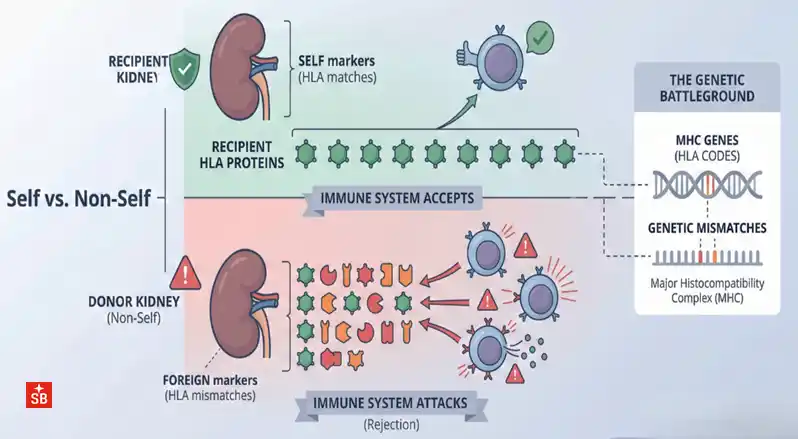
The secret lies in tiny proteins called human leukocyte antigens, or HLAs. These proteins are made by a group of genes called the major histocompatibility complex, or MHC. Think of HLAs as identity cards carried by every cell in your body. Just as a student enters a college by showing a valid ID card, your body’s immune system checks these molecular identity cards every moment. If the ID matches, the immune system says, “Welcome home.” If it does not, alarm bells begin to ring. This natural security system protects us from harmful germs, but during an organ transplant, it can mistakenly treat a life-saving organ like an unwanted visitor. That is the irony of the immune system, its greatest strength can sometimes become its biggest obstacle.
Every donated organ carries its own HLA identity, inherited from the donor. When these markers differ greatly from those of the recipient, specialised immune cells called T lymphocytes recognise the organ as foreign. They release chemical messengers called cytokines, which attract other immune cells and start inflammation. At the same time, B cells may produce donor specific antibodies that attack the blood vessels of the transplanted organ. It becomes a microscopic battlefield where billions of immune cells march like determined soldiers. In scientific jargon, this process is known as transplant rejection, an immune mediated response against donor tissue.
Not all rejection happens in the same way. Hyperacute rejection can begin within minutes if pre existing antibodies attack the donated organ immediately. Acute rejection usually develops over weeks or months as T cells build their defence. Chronic rejection is much slower and may quietly continue for years, causing gradual scarring and reducing the organ’s function. It is like termites silently weakening a strong wooden house from within. This is why doctors carefully match donor and recipient HLA types, especially in kidney transplantation. They also prescribe lifelong immunosuppressive medicines, which gently persuade the immune system to stay calm instead of launching an unnecessary attack.
Still, genes do not tell the whole story. Age, infections, regular use of medicines, and many small differences in the immune system also influence how long a transplanted organ survives. Every successful transplant becomes an ongoing partnership between doctors, medicines, the donor organ, and the patient’s immune system. It is less like winning a single battle and more like maintaining peace between two neighbouring kingdoms. “Let us work together,” the transplanted organ quietly whispers. “I have come to help, not to harm.”
Modern transplantation is therefore much more than replacing a damaged organ. It is a delicate balance of genetics, immunology, and lifelong medical care. Every successful transplant proves that science can help strangers become family. With better genetic matching, improved medicines, and careful follow up, doctors continue to increase the chances that a donated organ will not only survive, but thrive. In the remarkable conversation between self and non self, medicine is teaching the immune system a powerful new lesson, sometimes, accepting a stranger can be the greatest act of healing.


