
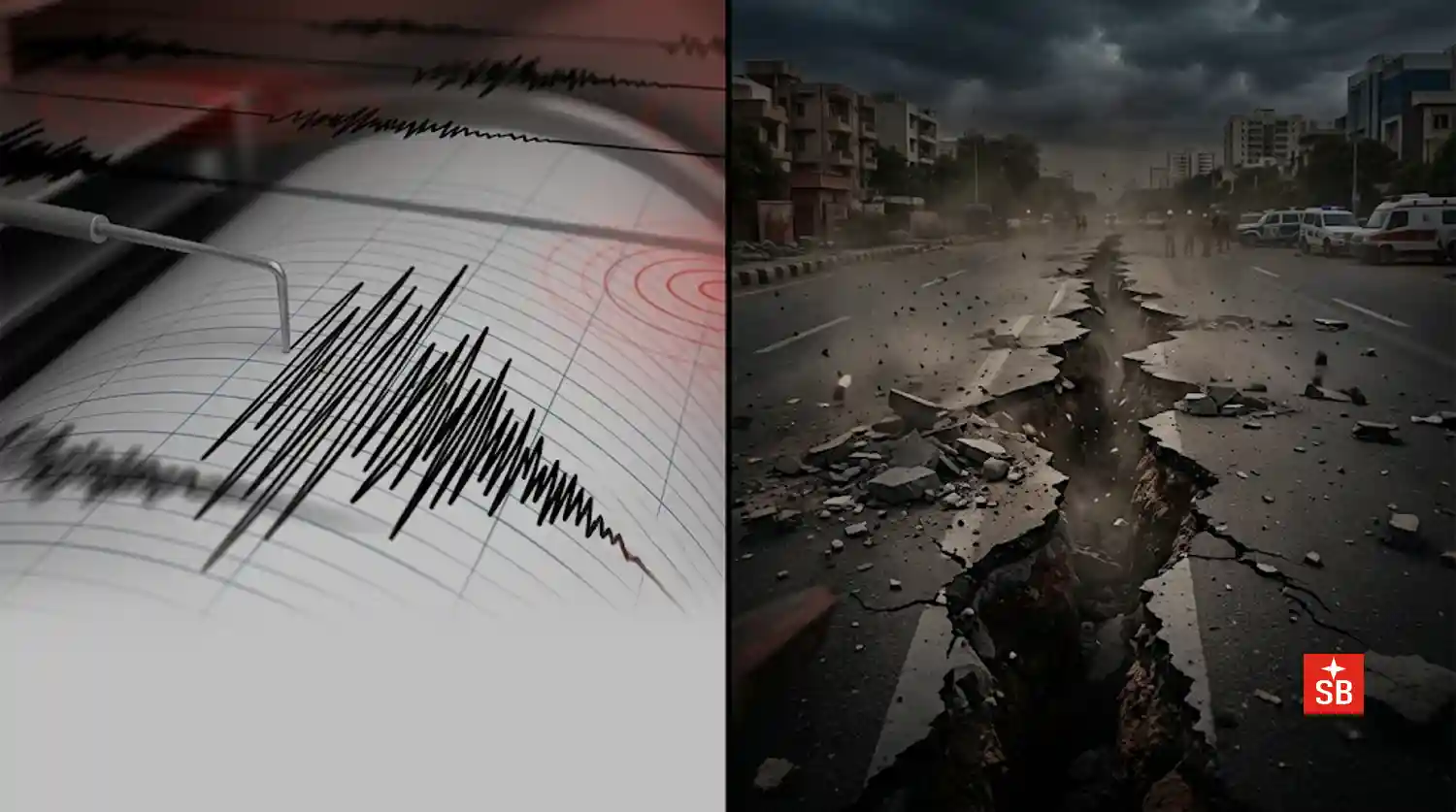
Many people in North Delhi were still enjoying their morning sleep when the ground gave a quick little shake. Some jumped out of bed, while others wondered if a heavy truck had passed by. Soon, the answer became clear. It was a magnitude 2.9 earthquake. Although the tremor lasted only a few seconds and caused no major damage, it reminded everyone that the Earth beneath our feet is never truly asleep. Like a giant living machine quietly breathing beneath us, our planet is always moving, even when everything above looks calm.
The story of an earthquake begins far below the surface. The Earth’s outer layer is broken into huge rocky pieces called tectonic plates. These plates move as slowly as growing fingernails, only a few centimetres every year. But their journey is not smooth.
They often get stuck because of friction, like two rough stones refusing to slide past each other. As time passes, stress quietly piles up like water behind a dam. Finally, the rocks can no longer hold the pressure. “Enough!” the Earth seems to say, and the rocks suddenly slip. The stored energy rushes out as seismic waves, making the ground tremble for a few moments.
Scientists measure an earthquake using its magnitude, which tells us how much energy is released at its source. This scale is logarithmic, a scientific term meaning that every one step increase is much larger than it appears. A magnitude 4 earthquake is not just a little stronger than a magnitude 3. It releases about 32 times more energy.
A magnitude 5 releases nearly 1,000 times more energy than a magnitude 3. In simple words, climbing just one number on the magnitude scale is like replacing a candle with a floodlight. The numbers may sit close together, but their power lives in completely different worlds.
As a general guide, earthquakes below magnitude 3 are usually too weak to cause damage and may not even be noticed. Magnitudes between 3 and 5 can be felt by many people but usually lead to only minor damage. Earthquakes ranging from 5 to 6.9 can crack walls and damage buildings.
Once the magnitude crosses 7, the shaking can become severe enough to destroy entire neighbourhoods. Earthquakes above magnitude 8 are among the strongest natural disasters known to science, capable of changing landscapes in just a few minutes. It is a classic example of the saying, “A stitch in time saves nine,” reminding us that preparedness is always better than panic.
“Nature often whispers before it roars, and wise minds listen to every whisper.”
Delhi lies in Seismic Zone IV, one of India’s high earthquake risk regions. The city feels tremors because it is influenced by the powerful movement of the Indian Plate, which continues to push against the Eurasian Plate. This giant geological tug of war built the mighty Himalayas millions of years ago and is still continuing today. The mountains may appear silent, but beneath them the rocks are constantly under pressure, waiting for opportunities to release their stored energy.
Today’s magnitude 2.9 earthquake was a gentle tap on the shoulder rather than a heavy punch. It caused more curiosity than destruction, but it carried an important scientific message. Small earthquakes remind us that our planet is alive and constantly reshaping itself.
They are nature’s quiet classroom, teaching us that even the strongest ground beneath our feet is part of a restless world. Understanding earthquakes does not stop them from happening, but it certainly helps us replace fear with knowledge, because science turns every tremor into a lesson rather than a mystery.


