
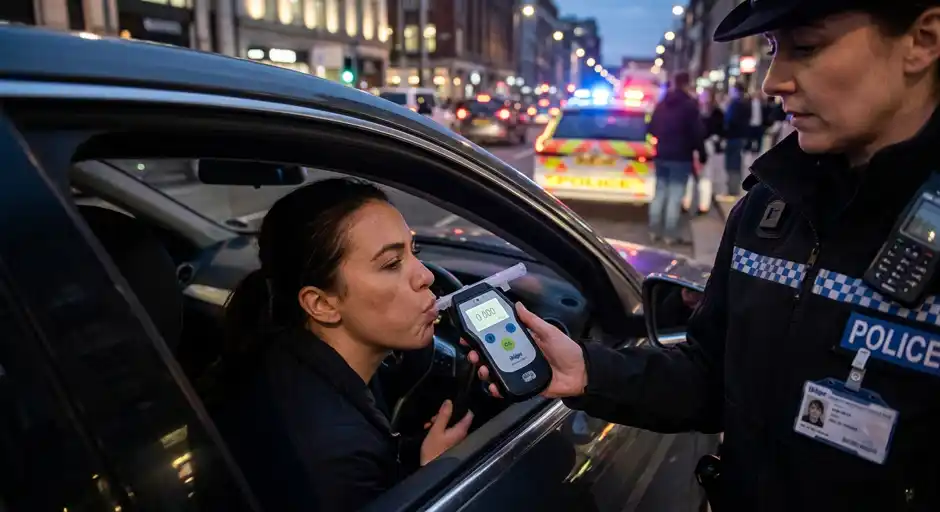
A breathalyzer can tell whether alcohol is present in your breath within seconds. But alcohol is not supposed to be in your lungs. But blowing into it, can reveal something that is actually happening inside your bloodstream? A breathalyzer doesn’t take a blood sample, scan your body, or somehow “detect drunkenness.” So how does blowing into a small device reveal how much alcohol is in your body?
It relies on a simple physiological connection between the blood, lungs, and the air we breathe out. And then uses chemistry to turn that connection into a number.
After alcohol is swallowed, it is absorbed through the digestive system and enters the bloodstream. As blood circulates through the lungs, it passes tiny air sacs called alveoli, where gases move between the blood and the air inside the lungs. Because alcohol is volatile, a small amount of ethanol also moves from the blood into the air in these air sacs. When that air is exhaled, it carries traces of alcohol with it. This is the key to the entire technology.
The concentration of alcohol in deep-lung breath is related to the concentration of alcohol in the blood. So instead of measuring the blood directly, a breathalyzer measures the alcohol that has travelled from the blood into the lungs and then into the breath. It is a little like using steam escaping from a kettle to infer that there is hot water inside. It isn’t measuring the water itself, but the two are closely connected.
But detecting alcohol in breath is only half the problem. The device also needs to measure how much is present. Many modern breathalyzers use a fuel-cell sensor. When ethanol molecules reach the sensor, they undergo a chemical reaction at an electrode. This reaction produces electrons, generating a small electrical current. The greater the amount of ethanol reaching the sensor, the stronger the current.
The device then converts that electrical signal into a breath alcohol concentration reading. Some evidential breath-testing instruments use another technique called infrared spectroscopy. Ethanol absorbs particular wavelengths of infrared light. By analysing which wavelengths are absorbed, the instrument can identify ethanol and determine its concentration.
Breathalyzers aren’t simply measuring whether someone has consumed alcohol, either. Factors such as recent drinking, mouthwash, residual alcohol in the mouth, and improper testing technique can influence a reading. This is why evidential testing follows controlled procedures and calibrated instruments. So the small device used for a roadside breath test is essentially a compact chemistry laboratory. It takes molecules that have travelled from the bloodstream to the lungs, detects them using chemical or optical methods, and uses that information to estimate the alcohol concentration in the body, all from a single breath.


