
When most of us hear the words black hole, we imagine an invisible object in space that sucks everything around it. People think of it as a mysterious object that no one can see or know what is inside. But if black holes themselves cannot be seen, how can astronomers discover one that appears to look like a star? That is exactly what makes a recent discovery by the James Webb Space Telescope (JWST) so intriguing.
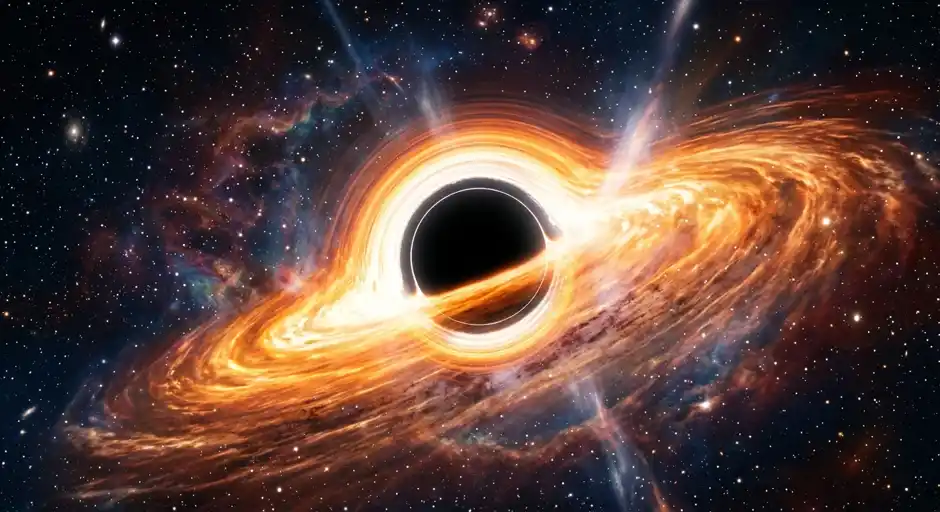
A black hole is not simply a giant vacuum cleaner sucking everything around it. It is a region of space where matter has been compressed so intensely that gravity becomes extraordinarily strong. The black hole itself does not produce visible light, which means astronomers cannot point a telescope at one and simply “see” it. Instead, they look for what happens around it. When gas and dust are pulled towards a black hole, they can form a rapidly rotating disk. Friction and extreme gravitational forces heat this material to enormous temperatures, causing it to release tremendous amounts of energy and light.
Now imagine surrounding that black hole with an enormous, dense cloud of gas. The black hole itself remains invisible, but the material around it can glow so intensely that the entire object may appear like a distant, compact star. This is essentially what astronomers think they have found in an object called MoM-BH-1*, observed when the universe was only about 660 million years old.
So why call it a “black hole star”? It isn’t a normal star with a black hole sitting inside its core. Instead, researchers propose that a rapidly growing black hole is buried inside a massive envelope of gas. The energy produced as material falls towards the black hole heats and illuminates this surrounding gas, creating the star-like appearance detected by JWST.
The timing of the discovery makes it even more fascinating. The universe is about 13.8 billion years old, meaning this object existed when the cosmos was still in its infancy. Astronomers have already discovered surprisingly massive black holes from this period, but that creates a major puzzle: how did they become so massive so quickly? Growing a black hole to millions or billions of times the mass of the Sun takes enormous amounts of matter and time.
A dense cocoon of gas surrounding a young black hole could provide exactly the environment needed for rapid growth. If the interpretation of MoM-BH*-1 is confirmed, it could represent an early stage in the development of the enormous black holes found at the centres of galaxies today.
In a sense, astronomers may have found something that is not really a star at all, but a black hole hidden behind the glow of everything surrounding it. And because we are seeing it from so early in cosmic history, this strange object could help answer one of astronomy’s biggest questions: how did the universe’s first giant black holes get so big, so fast?


