
What happens when two neighbouring cells aren’t equally fit?
The textbook definition to the question “What is a Cell?” is always, A cell is the smallest, basic unit of life that makes up all living things, like plants, animals, and humans. You can think of cells as the tiny building blocks or bricks that form an entire living body.
But cells are not passive in nature like bricks rather they are very active, constantly receiving and transmitting various Physical, Chemical and Mechanical Signals that help keep our body functioning for Day-to-Day activities.
Each tissue in the Body is made up of billions of Cells that keep Dividing and Replenishing after each round of the Cell Cycle. But in a Heterogenous population of Billions of Different cells in a tissue, how does a cell know if the Neighbouring Cell is fit enough to be in that particular Population of Cells or not? Cells also compete for Nutrients and other important resources in a tissue for their Growth and Survival as they live in a community where resources are finite and crucial for survival. Yet another example for the phrase “Survival of The Fittest” from the Darwinian Theory of Evolution that takes place unknowingly inside all living organisms at the Cellular Level.
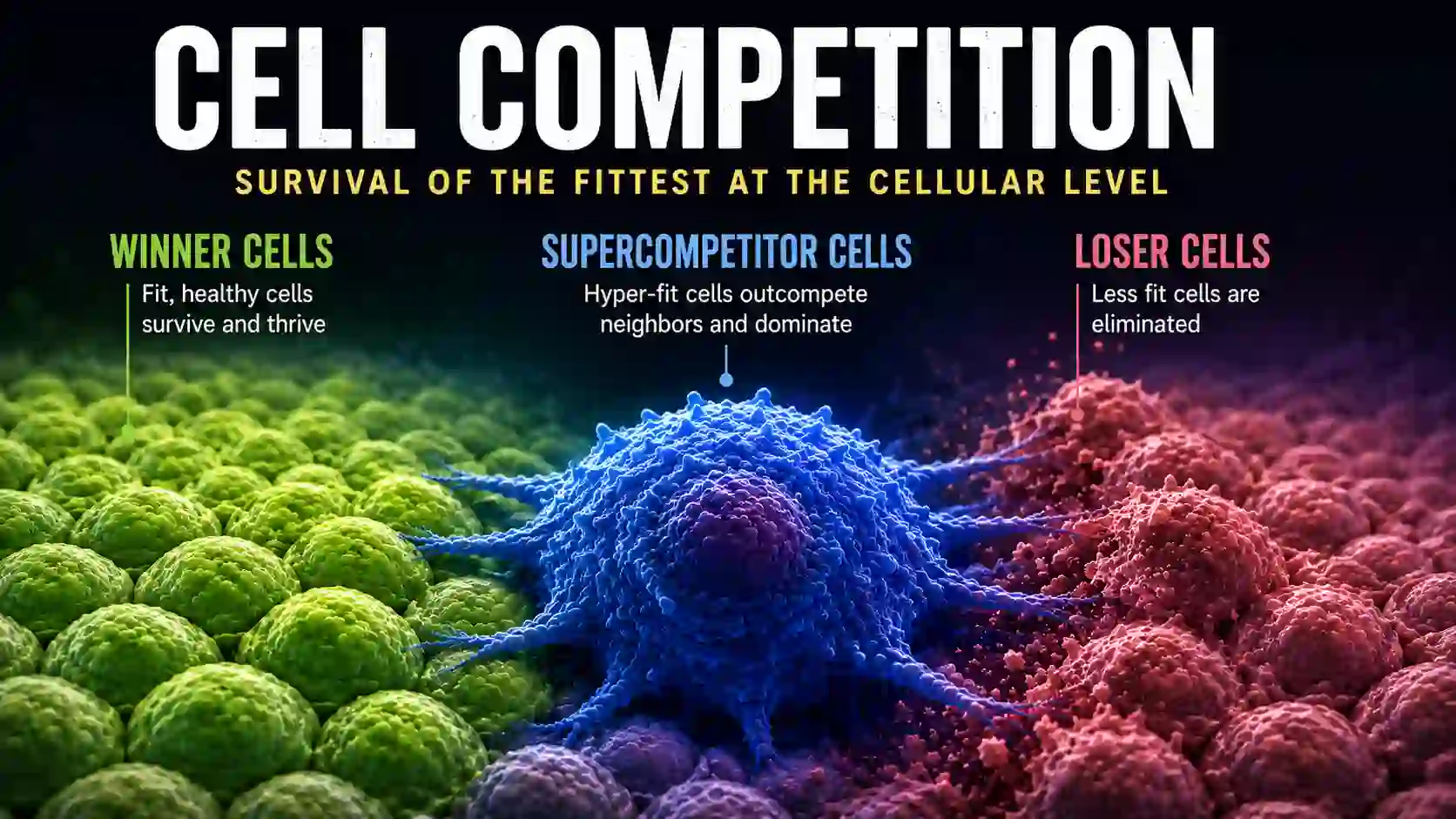
Cell Competition is a Fundamental mechanism that acts as the Quality Control Manager for Tissues and the Billions of cells in the Body by ensuring the selective elimination of “Less Fit” or as Fly researchers (Drosophila melanogaster) fondly call it “Loser Cells” from the tissue. Loser Cells are cells that are relatively less fit than their neighbouring cells and get targeted for Elimination by Programmed Cell Death or Apoptosis.
The neighbouring cells are the Victors of the Arena which are obviously called as “Winner Cells” because they successfully outcompeted and culled the Loser cells from the Tissue. Cell competition plays a critical role in Development, Health and a wide range of physiological and pathological contexts, including cancer.
Cell Competition is a Major research area in the Model organism Drosophila melanogaster as it was first discovered in the Fly by Developmental Biologists Ginés Morata and Pedro Ripoll in 1975.
How do cells know which cells are “Fit” and which cells are “Less-fit”?
Cells have very Complex Mechanisms and Signals that enable them to maintain their Fitness and showcase it to the neighbouring cells as a way of letting them know they are fit enough to survive and function properly. These Signals are also known as “Molecular Fitness Fingerprints” of a cell and they function by displaying specific Surface Proteins and Indicator Molecules on the Cell Surface which can help in signalling their Metabolic Health as well as Growth to Neighbouring Cells.
For example, the Flower (fwe) gene in the Fruit Fly encodes a transmembrane calcium channel which allows cells to communicate their Health status to other cells. The Flower gene has a Ubiquitous isoform (fwe-Ubi) which is produced constantly at Basal Levels in Normal Healthy cells and acts as an indicator for a “Winner” or “Fit” Cell. But when there is an external or internal factor that degrades a cell’s ability to function properly, it is immediately sensed and undergoes a switch into the Lose isoform (fwe-Lose) which ultimately seals the particular cell’s fate and is eliminated by the process of Cell Competition.
Cells are always in contact and have a complex network that allows them to communicate via various signals and chemical molecules, thereby maintaining a constant level of quality and quantity in the tissues to sustain Homeostatic conditions. This complex interconnected network can give them the ability to compare the speed of proteins being synthesized by a cell or how fast a cell is dividing which helps in flagging a particular cell as “Loser” by the Neighbouring cells.
Mechanically, Loser cells possess weak cell-cell adhesion and yield easily to any physical force applied by the neighbouring cells which causes them to compress mechanically and literally be “Kicked out” of tissues by their Stronger neighbours. Cells with Chromosomal Abnormalities, low Mitochondrial Activity and High stress conditions are all flagged as “Loser” cells either by the Neighbouring cells or the Loser cell itself by various mechanisms.
A “Winner” cell does not always mean that the cell is perfect and is better than all the other cells present in the tissue because the Winner cell just might have a competitive advantage over the “Loser” cells in a particular environment. A cell that can win under one set of conditions may Lose under another depending on the Stochasticity of the said environment. This can lead to complications that can perturb the Homeostatic nature of the Living Organism and can also cause certain disease or disorders.
A Fair Battleground?
The most important question to be asked in Cell Competition is “If it is a fair Battleground?”
As in Normal Fit cells will always outcompete the Less-Fit cells in a normal environment wherein a cell population would have normal expression of certain genes that are required for proliferation such as c-Myc, which is a Yamanaka Factor that controls Cell Growth, Division etc. But if the Battleground Dynamics is changed by introducing a cell that has mutations in one of the important factors such as c-Myc, then the Hunters become the Hunted by the elimination of Normal Fit cells from the tissue as well. This process is known as “Super Competition” and the cells that overpower even the “Winner” cells are known as “Super-Competitors”.
Super-Competitors can detect surrounding Fit cells and send short range molecular or biochemical signals that have the ability to trigger apoptosis or Programmed Cell Death in adjacent Fit cells as well as Less-Fit cells. They have a higher proliferation rate than other cells and can expand to take control of the whole battleground. When it comes to Super Competition, cells are faced with a Double-edged sword as it has also been proven that it acts as quality control during embryonic development by ensuring only the Fittest cells form Organs. But early-stage cancer cells are known to hijack this mechanism by the overexpression of particular factors like c-Myc and silencing other important genes involved in Fitness-sensing.
Co-ordination and Competition
Imagine the body with all it’s components such as organs, tissues and cells that have been packaged and compacted with such efficiency and co-ordination between all the components for functioning normally. Likewise, Millions of Proteins and organelles held compactly together by a microscopic cell that is somewhere in the scale of a Thousandth of a Millimetre.
Now, imagine the space needed to fit all that in one entity such as the Cell.
Under all the Co-operation and Co-ordination in the Cells to function normally, there is also a constant Competition for Space and Resources. There is a need to better understand these microscopic contests as they can prove to be useful in solving some major problems in Health and Medicine. Understanding the Fundamental Science in itself is a reason worthy enough to pursue the problem and understand it better. The joy of Knowing the Unknown and the Pursuit of Curiosity alone can bring life-changing Discoveries into light.
| References: 1. Amoyel, M., & Bach, E. A. (2014). Cell competition: how to eliminate your neighbours. Development (Cambridge, England), 141(5), 988–1000. https://doi.org/10.1242/dev.079129 2. Morata G. (2021). Cell competition: A historical perspective. Developmental biology, 476, 33–40. https://doi.org/10.1016/j.ydbio.2021.02.012 3. Patel, M. S., Shah, H. S., & Shrivastava, N. (2017). c-Myc-Dependent Cell Competition in Human Cancer Cells. Journal of cellular biochemistry, 118(7), 1782–1791. https://doi.org/10.1002/jcb.25846 4. Costa-Rodrigues, C., Couceiro, J., & Moreno, E. (2021). Cell competition from development to neurodegeneration. Disease models & mechanisms, 14(7), dmm048926. https://doi.org/10.1242/dmm.048926 |


