
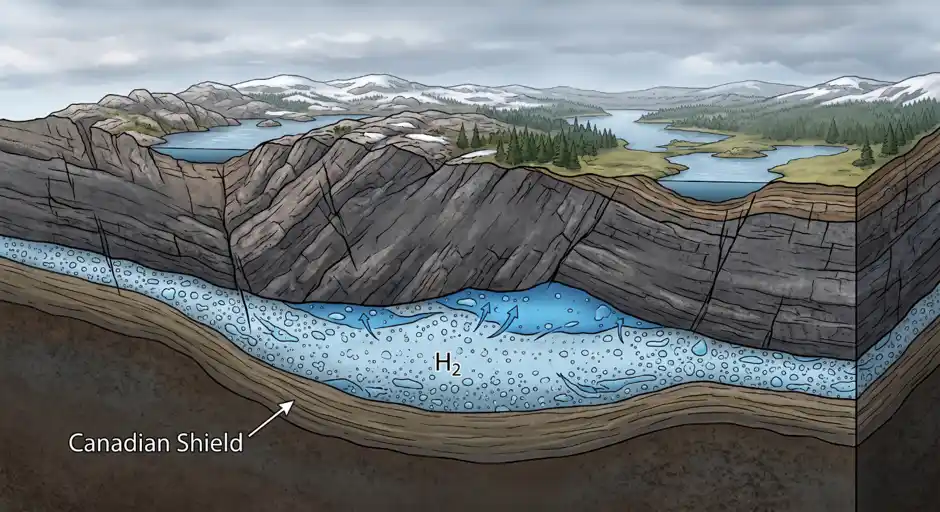
What if some of the fuel we need for the future is already being produced beneath our feet?
Deep beneath northern Ontario, billion-year-old rocks are slowly generating hydrogen gas. Scientists have now measured this natural hydrogen flowing through an operating mine, providing some of the clearest evidence yet that Earth’s ancient rocks could contain a previously overlooked energy resource. The hydrogen is known as white hydrogen, or natural hydrogen. Unlike most hydrogen used today, it does not have to be manufactured first. It forms naturally underground through chemical reactions between rocks and water.
The Canadian Shield is a particularly interesting place to look for it. This enormous geological region contains some of Earth’s oldest exposed rocks, many of which are more than a billion years old. As water moves through fractures in these rocks, chemical reactions can split water molecules and produce hydrogen gas. The gas can then accumulate in underground spaces or move through cracks and boreholes.
But how do scientists know it is actually there?
Researchers from the University of Toronto and the University of Ottawa studied an operating mine near Timmins, Ontario, where thousands of boreholes have already been drilled into the ancient rock. Instead of creating new wells specifically for hydrogen exploration, scientists were able to use these existing openings to measure gas escaping from the rock. What they found was surprising. Individual boreholes released an average of about 8 kilograms of hydrogen per year, and some continued releasing hydrogen for more than a decade. When the researchers extrapolated the measurements across nearly 15,000 boreholes, they estimated that the site could discharge more than 140 tonnes of hydrogen each year.
That doesn’t mean Canada has suddenly discovered a giant hydrogen fuel station underground.The 140-tonne figure is an estimate based on measurements from the mine, and scientists still need to determine how much hydrogen can be safely and economically extracted at a larger scale. Finding hydrogen underground is one challenge; recovering it, storing it and transporting it economically is another. Still, this discovery changes an important part of the conversation around hydrogen. Scientists have traditionally searched for ways to produce hydrogen. The Canadian Shield may therefore be more than a geological record of Earth’s ancient past. Hidden within its rocks could be a source of hydrogen that has been forming for millions or even billions of years.
Sources


