
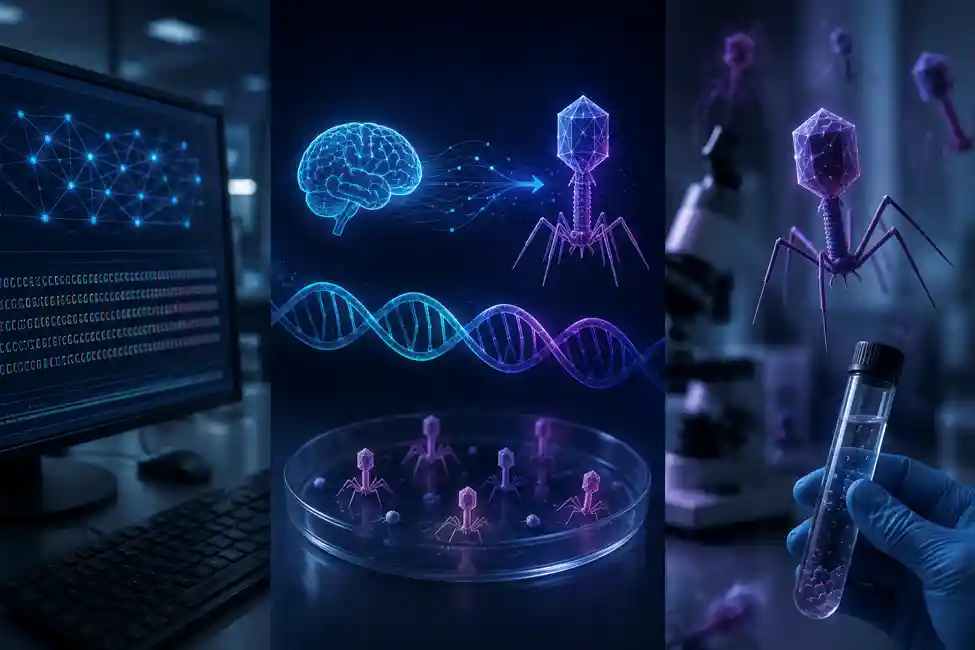
Artificial intelligence is rapidly moving beyond generating text and images. Scientists are now using AI to understand and design biological molecules, including proteins and genetic sequences. One of the most striking recent developments is the use of AI to generate novel virus genomes that do not exist in nature.
But does this mean AI could create dangerous viruses?
The answer is more nuanced than the headlines suggest.
In recent research, scientists used a genome-language model called Evo 2 to generate new bacteriophage genomes. Bacteriophages, or phages, are viruses that infect bacteria rather than humans. Researchers selected AI-generated designs, synthesized their DNA, and tested whether the resulting viruses could function in laboratory experiments. Some of the generated genomes produced functional phages capable of infecting Escherichia coli.
Why is this such a significant development?
Traditionally, scientists study viruses that already exist and modify them experimentally. AI introduces a different approach: instead of starting with a naturally occurring genome, a model can learn patterns from enormous collections of biological sequences and generate new sequences that follow those patterns.
This could have important medical applications.
One promising area is phage therapy. Antibiotic-resistant bacteria are becoming increasingly difficult to treat, and bacteriophages offer a potential alternative because they naturally target bacteria. AI could eventually help researchers identify or design phages with useful characteristics more efficiently, potentially expanding the tools available against drug-resistant infections.
However, the same technology raises biosecurity concerns.
The ability to generate biological sequences with AI creates a classic dual-use problem: a technology developed for beneficial research could potentially be misused. Importantly, the recent experiments did not demonstrate an AI-generated virus capable of infecting humans. The viruses produced in the study were bacteriophages, and researchers deliberately excluded sequences associated with human, animal, and plant viruses from the training process.
There are also major practical barriers. Designing a genetic sequence is only one step. Producing, assembling, testing, and controlling a biological organism requires specialised laboratories, equipment, expertise, and appropriate safety procedures. AI has not eliminated these barriers.
Nevertheless, scientists and policymakers are increasingly discussing safeguards such as DNA-synthesis screening, controlled access to advanced biological AI systems, laboratory oversight, and international governance. The goal is to encourage beneficial research while reducing opportunities for misuse.
So, should we be worried?
We should be attentive, not alarmed.
AI-designed viruses represent an important scientific milestone and could eventually contribute to new treatments and biotechnology. At the same time, the ability to design biology computationally means that safety must develop alongside scientific capability.
The most important question is no longer simply “Can AI design a virus?”
It is “Can we ensure that increasingly powerful biological AI is developed and used responsibly?”


