
Every leaf on Earth performs a miracle every day. Using nothing more than sunlight, water, and an intricate network of molecular machinery, plants transform solar energy into chemical energy with astonishing efficiency. For many years scientists have attempted to copy this biological masterpiece, but managing to replicate the elegant sequence of nature’s processes has always been one of chemistry’s most difficult challenges.
Researchers have now taken a remarkable step closer.
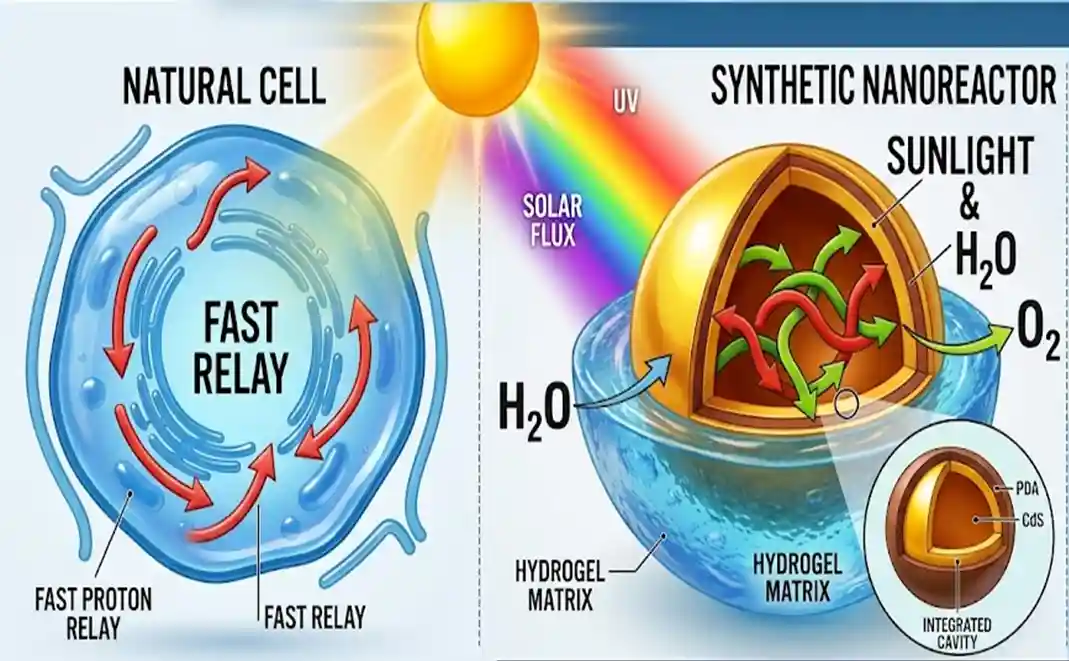
A new study in the Journal of the American Chemical Society has seen scientists design an artificial nanoreactor which does not simply absorb sunlight but acts in a manner more similar to a living cell by making use of two of biology’s most clever techniques in order to greatly enhance photocatalysis.
Imagine a conventional photocatalyst as a busy highway on which electrons and protons continually collide, frequently causing traffic jams that result in the waste of valuable energy; the new nanoreactor substitutes this disorder for something similar to a well-organized metro system in which each passenger knows precisely where to go.
The key innovation is a biomimetic proton relay that is built into a hollow cadmium sulfide (CdS) nanoparticle and is enclosed by a thin layer of polydopamine. Rather than pumping protons actively as living cells do, the shell functions as a molecular relay carrier, constantly accepting and donating protons. This seamless transfer of protons speeds up proton-coupled electron transfer (PCET), which is one of the most fundamental processes in photosynthesis, respiration, and in countless chemical reactions.
The innovation extends beyond that.
The researchers also made use of another characteristic of living organisms: compartmentalization. Since cells divide up reactions among their different organelles, so too does the hollow nanoreactor produce a confined microenvironment in which light can be trapped more efficiently, the reactants become more concentrated and the molecules have to travel shorter distances before reacting. In the field of chemistry, this results in fewer wasted opportunities and a much higher reaction efficiency.
The payoff is extraordinary.
The artificial system managed to attain a record production rate of hydrogen peroxide (H₂O₂) of 3.24 mmol g⁻¹ h⁻¹ when using only visible sunlight, together with a solar-to-chemical conversion efficiency of 1.2%. Hydrogen peroxide is much more than the antiseptic commonly found in medicine cabinets; it is an environmentally friendly oxidant that finds use in wastewater treatment, paper bleaching, chemical manufacturing, and even in some new medical technologies. It would be possible to produce it directly from sunlight and water in place of the energy-intensive industrial processes which at present depend on costly infrastructure and fossil-based chemicals.
In order to work out how the miniature reactor functioned, the team used in situ spectroscopy, theoretical calculations, finite-element simulations, and photochemical analysis. These methods together enabled the scientists to see the molecular “conversation” taking place inside the nanoreactor, showing that the protons and electrons move in carefully coordinated steps instead of bouncing around randomly in the catalyst.
The researchers also went beyond laboratory success; by putting the nanoreactors into an environmentally friendly sodium alginate hydrogel they were able to produce catalyst blocks which could generate hydrogen peroxide under natural sunlight and at the same time remain stable when used repeatedly. This deals with one of photocatalysis’ long-standing weaknesses—its poor durability under real-world conditions.
The study points to an emerging scientific philosophy which is to avoid fighting nature and instead learn from it; rather than attempting to develop faster catalysts by using brute force, researchers are becoming more and more inclined to copy the sophisticated structure which evolution perfected over billions of years.
This project is similar to constructing a solar-powered factory based on the design of a living cell, showing that the future of clean chemistry might not require the development of completely new principles, but instead could consist in making use of the eternal strategies which are already contained in every leaf.
By learning to copy nature’s biological blueprints instead of fighting them, scientists are bringing us one step closer to a future powered entirely by sunshine!


