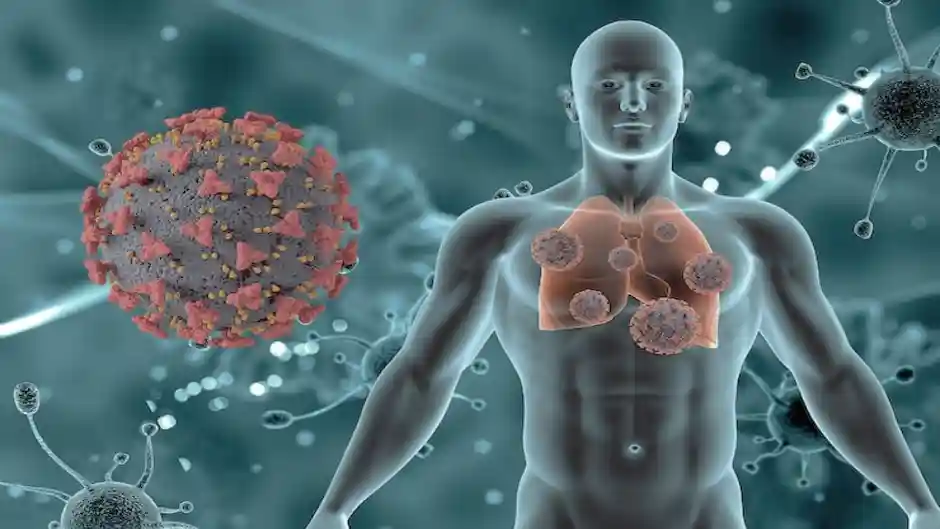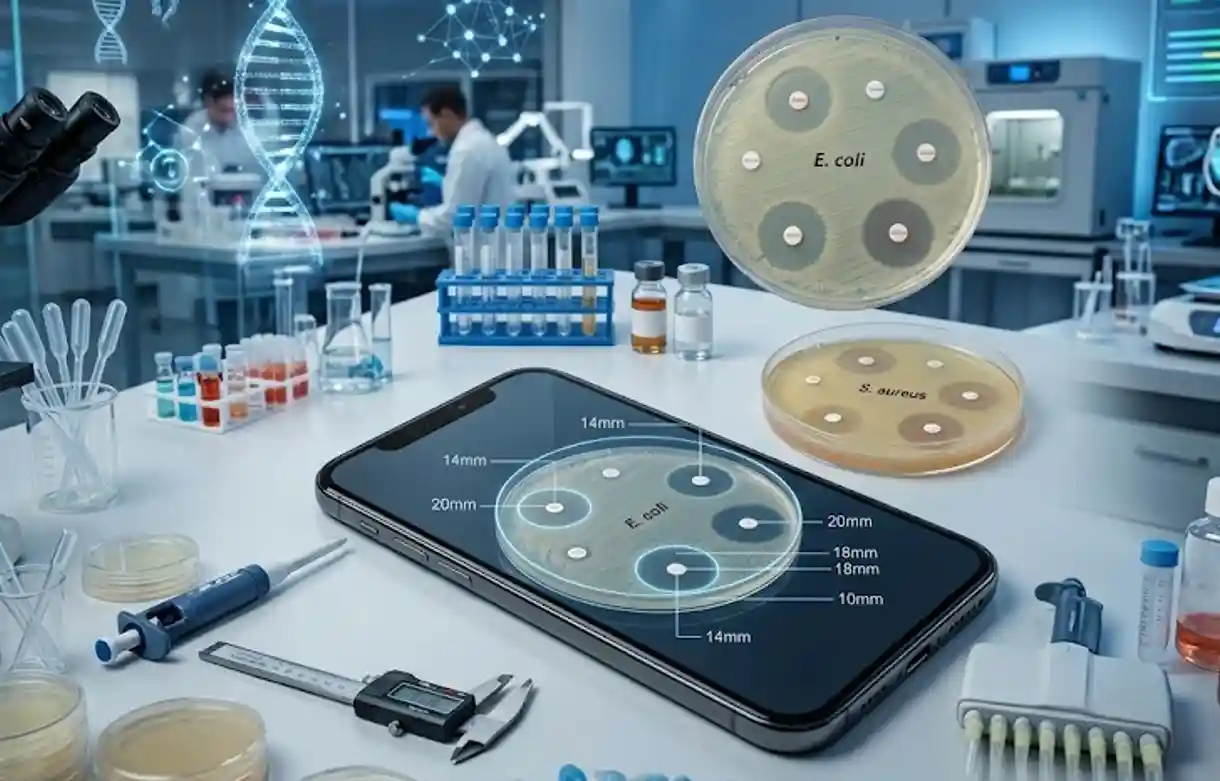
Antibiotic resistance has become one of the greatest threats to modern medicine, making once-curable infections increasingly difficult to treat. Now, researchers have developed a semi-automated smartphone application that can accurately measure and interpret antibiotic susceptibility tests, potentially bringing faster and more reliable detection of drug-resistant bacteria to hospitals and laboratories with limited resources.
The study, conducted by Aravindh and colleagues in 2026, aimed to digitize antimicrobial susceptibility testing (AST), a laboratory procedure used to determine which antibiotics can effectively kill or stop the growth of bacteria. By combining smartphone technology with artificial intelligence-assisted software development, the researchers created an easy-to-use app capable of analysing bacterial culture plates with high accuracy.
The app works with the widely used Kirby-Bauer disk diffusion method. In this technique, small paper discs containing different antibiotics are placed on a bacterial culture growing on Mueller-Hinton agar. If an antibiotic is effective, it prevents bacteria from growing around the disc, creating a clear circular area known as the “zone of inhibition.” The larger the zone, the more susceptible the bacteria are to that antibiotic.

Traditionally, laboratory personnel measure these zones manually using a ruler or calipers and then compare the measurements with Clinical and Laboratory Standards Institute (CLSI) guidelines to classify bacteria as susceptible, intermediate, or resistant. Although reliable, manual measurements can be time-consuming and may vary between observers.
To overcome these challenges, the researchers developed an in-house smartphone application using an AI-assisted coding workflow. The app employs a digital calibration algorithm that converts pixel measurements from smartphone images into precise millimetre values, allowing it to automatically measure inhibition zones and interpret antibiotic susceptibility according to CLSI standards.
The researchers validated the app using 48 isolates of Escherichia coli and 15 isolates of Staphylococcus aureus. Antibiotic susceptibility testing was performed on a total of 1,000 antibiotic discs. Because different bacterial species require different antibiotic panels, Staphylococcus aureus isolates were tested using 14 antibiotics across at least two agar plates, while Escherichia coli isolates were tested with 22 antibiotics across at least three plates.
The smartphone application’s performance closely matched conventional manual interpretation. It achieved an overall categorical agreement of 90.4%, indicating that its classifications were consistent with standard laboratory methods in the vast majority of cases. Statistical analysis also showed a strong level of agreement, with an unweighted Cohen’s Kappa value of 0.836.
Among the 1,000 antibiotic tests, discrepancies occurred in only 96 cases. Importantly, the app recorded no very major errors, meaning it did not incorrectly classify resistant bacteria as susceptible, an error that could lead to ineffective treatment. Major errors occurred in just 0.83% of cases, while minor discrepancies accounted for 9.2%.
The researchers concluded that the smartphone application provides reliable interpretation of antimicrobial susceptibility tests while maintaining a very low major error rate. Its simplicity, portability, and ease of use make it particularly attractive for busy clinical laboratories and healthcare facilities with limited resources, where rapid and standardized interpretation of antibiotic susceptibility tests can improve patient care and strengthen efforts to combat antimicrobial resistance.

If adopted more widely, smartphone-based AST could help standardize laboratory reporting, reduce observer variability, and expand access to reliable antibiotic resistance testing, particularly in low- and middle-income countries where advanced laboratory infrastructure is often limited. By transforming an ordinary smartphone into a practical diagnostic assistant, this innovation demonstrates how digital health technologies can support the global fight against antimicrobial resistance.
Source: Aravindh, A., Gupta, A., Sen, M., Das, A., & Agarwal, J. (2026). A mobile based antimicrobial susceptibility testing device – prototype development and validation. The Indian journal of medical research, 164(2), 220–226. https://doi.org/10.25259/IJMR_214_2026