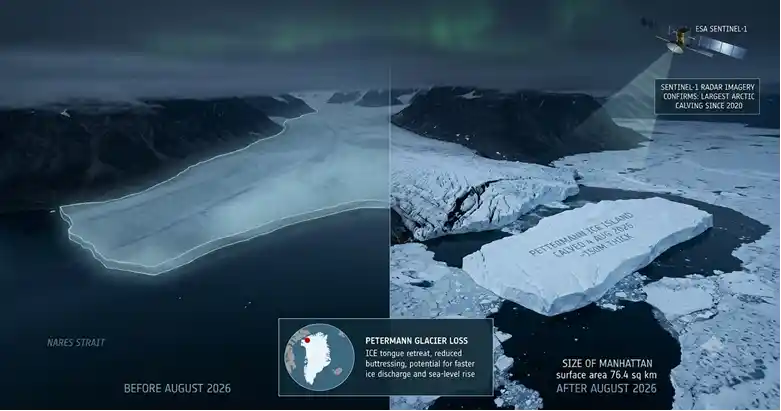
Picture an island of ice as big as Manhattan, up to 150 meters thick, roughly the height of a 50-story building snapping off the edge of Greenland and drifting out to sea. It happened on August 4, 2026, at Petermann Glacier in northwest Greenland, and it’s the biggest bite this glacier has lost since 2012.
What Actually Happened
Europe’s Sentinel-1 satellites, which can see through clouds and darkness using radar, caught the whole thing unfolding in near-real time. Researchers had watched cracks spreading across the glacier’s floating ice tongue for months. Interferometry data from April already showed the ice straining and fracturing. Then, almost overnight between August 3 and 4, a roughly 76-square-kilometer slab tore free. It’s the Arctic’s most dramatic calving event since 2020.
Scientists from the University of Ottawa, Stirling, Lancaster, and Leeds, working with Canada’s Ice Service, have tracked Petermann since 2019 as part of the ESA-backed ARCTEX project. One researcher called the break “remarkable,” noting the team had expected it for years, but seeing it happen still underscored how fast these frozen giants can shift.
Why This Should Worry Us
It’s a warning sign, not a one-off. Petermann had been relatively stable since its last major breaks in 2008, 2010, and 2012. That stability is now over. Researchers say two more massive sections, roughly 97 and 87 square kilometers, are already showing rifts and could detach next. Tabular icebergs are common around Antarctica, but they’re unusual in the Arctic. Studying this one gives scientists rare insight into how floating ice shelves fail: an insight that applies to glaciers worldwide and helps predict future sea-level rise.
A slab this size doesn’t just vanish, it can drift for years, slowly breaking into smaller, harder-to-track fragments. Canadian authorities are already monitoring its path because these fragments pose real collision risks to Arctic shipping lanes and offshore operations, right as Arctic sea routes are opening up more each year. Floating ice tongues like Petermann’s act as buttresses, holding back the glacier’s inland ice. When they weaken and break apart, they can accelerate the flow of land ice into the ocean — the kind of ice loss that directly raises global sea levels.
The Bigger Picture
This isn’t just an Arctic story, it’s an early signal. As satellites keep a close eye on the next two rifts, what happens at Petermann over the coming months could reshape how we understand glacier collapse everywhere, from Greenland to Antarctica to the coastlines the whole world shares.
Reference:
European Space Agency. (2026, August 21). Petermann Glacier sheds Manhattan-sized ice island in 2026 calving. eco Magazine. https://ecomagazine.com/news/research/petermann-glacier-sheds-manhattan-sized-ice-island-in-2026-calving/
European Space Agency. (n.d.). Copernicus Sentinel-1 mission overview. ESA. https://www.esa.int/Applications/Observing_the_Earth/Copernicus/Sentinel-1
ARCTEX Project. (n.d.). ARCTEX: Arctic ice islands and glacier dynamics. EO4Society. https://eo4society.esa.int/projects/arctex/