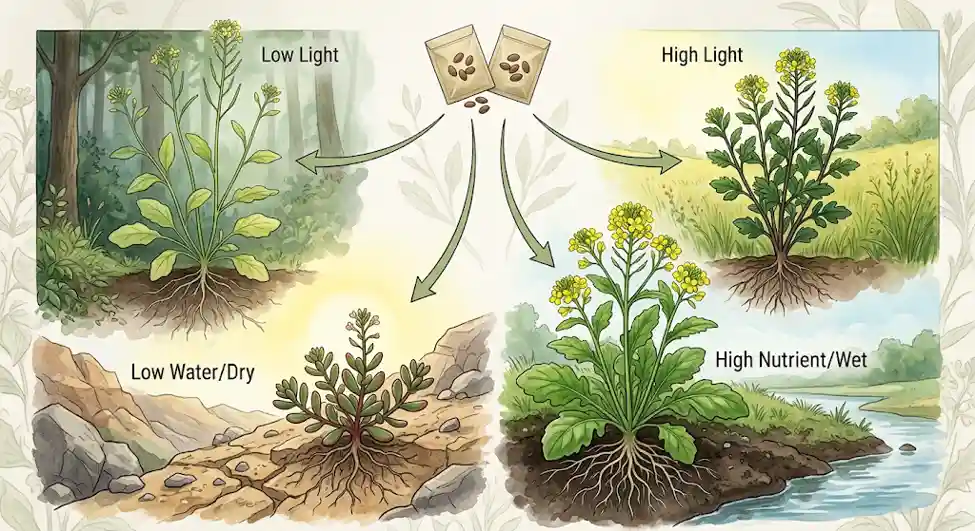
“Nature is constantly communicating with us, but its primary language is written in rays of light.” When pioneering botanist Luther Burbank uttered these words, he was speaking not of poetic abstraction, but of a fundamental biological reality. To human proteins, a beam of sunlight is merely warmth or illumination. To a plant, however, every ray of light is a dense stream of encoded data, a continuous instruction for survival, architecture, and evolution.
The First challenge
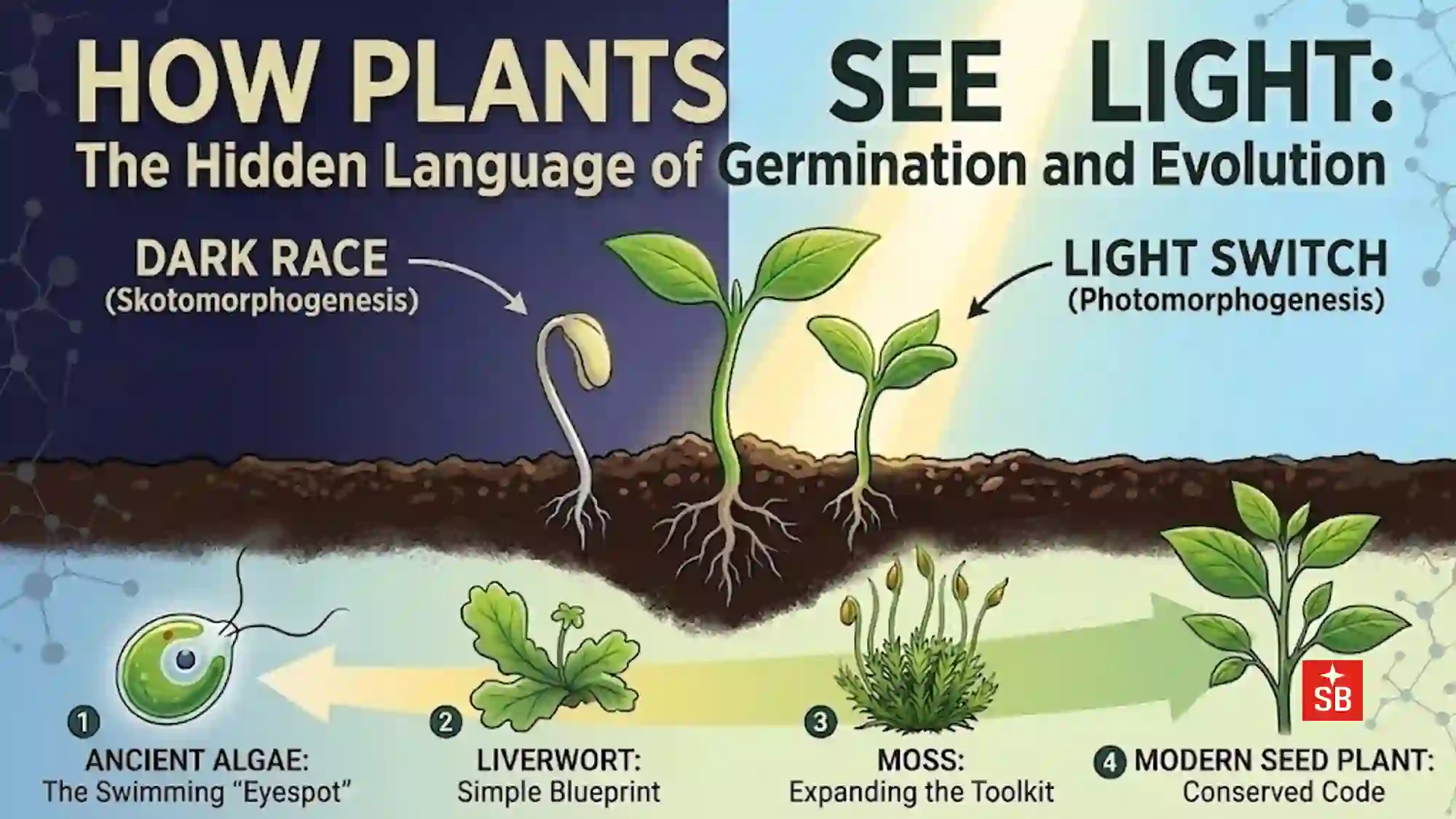
When a seed germinates in that dark soil, it’s literally in a race against the clock. It only has a limited amount of stored energy, and it has to reach the surface before that energy completely runs out. This brings us to a stark duality in plant biology. When a seedling emerges in the dark, it undergoes what’s called ‘skotomorphogenesis’ or ‘dark growth’. It gets super pale and spindly, stretching its stem, the hypocotyl, rapidly upward. It actually keeps its seed leaves, the cotyledons, tightly closed in this little hook shape just to protect its fragile growing tip from the rough soil. But the exact second light hits it, it immediately switches to photomorphogenesis. That desperate stretching stops, the leaves unfold, and a really rapid greening process kicks in to catch the sun and start photosynthesis. It’s a total architectural restoration, all triggered by one single environmental factor.
How exactly does the plant flip this massive switch?
And I’m using the word ‘see’ here very intentionally because plants actually have sophisticated molecular proteins. The answer lies in this intense molecular battle happening inside the tiny seedling. Down in the dark, A whole cascade of hormones, like gibberellic acid and auxin, is just driving that rapid stem elongation. But when the sun comes out. That light literally acts as a roadblock to the dark pathway. Light activates photoreceptors that immediately hunt down and degrade the proteins driving all that dark growth, fundamentally rewiring the seedling’s entire metabolic focus from stretching out to greening up. Think of the plant’s light-sensing toolkit kind of like this. First, we have the phytochromes.
These are the plant’s red light proteins detecting the red spectrum of the sun. Then the cryptochromes and phototropins are the blue light proteins. Now, under the soil, we have proteins called PIFs that promote spindly upward growth. But when light finally hits those red and blue proteins, proteins deactivate the PIFs and activate a protein called HY5. HY5 triggers the unfolding of leaves and the production of green chlorophyll. It’s an incredibly elegant microscopic relay race. Now, to really grasp how this amazingly fine-tuned system came to be, we have to look through the lens of evo or evolutionary developmental biology. Basically, this is a field that compares how different organisms grow to figure out their ancestral relationships. Now, let’s jump into an evolutionary time machine and see exactly how these light rules were originally written.
The algal ancestors’ eye spy:
Let’s travel way back in time, billions of years. Long before there were trees or seeds or, honestly, even soil, plant life began as single-celled organisms in the water. And this brings us to a really surprising fact. The ancient single-celled green algae, Chlamydomonas reinhardtii, literally has an eye spot. Unlike modern plants that are totally rooted in the ground, this ancient ancestor actually uses light to swim. It has a specialised organelle to sense the photon stimulus, and it dynamically changes the motion of its flagella to move toward or away from the light.
Yeah, it’s a plant that swims based on what it sees. And if we look at the light-signalling network in this swimming ancestor, they already possessed elements of the exact same toolkit we just talked about. It has UV sensors and it has those blue light proteins, the cryptochromes and phototropins. But instead of using them to unfurl a leaf, this ancient algae uses them for totally different vital functions like regulating its sexual reproduction and managing its starch metabolism. Essentially, the hardware was being tested out in the water long, long before it was ever used on land.
What happened when plants finally crawled out of the water?
Well, the transition to land meant a massive change in both the quality and the quantity of sunlight. So, early plants had to adapt fast. The liverwort, specifically Marchantia polymorpha, is a perfect model to help us understand this adaptation. It holds this wonderfully streamlined blueprint. While modern seed plants have multiple duplicated copies of light sensors, this early land plant relies on extreme simplicity. For the most part, it just has one single copy of the red light proteins, one copy of the blue light proteins, and one single copy of the PIFs. The crucial takeaway here is just how elegantly this minimal toolkit controls the entire architecture of this idyllic land plant.
It is a beautifully simple three-step reaction. First, the single red light protein senses the sun. Second, it switches, forms, and physically deactivates the PIFs. And third, this simple deactivation tells the plant to start germinating its reproductive structures, and it alters its branching pattern. Just think about that for a second. It’s a single switch dictating the physical structure of the entire organism.
Evolution never really stops tinkering
As early plants became more established on land, a single set of light switches just wasn’t enough to handle the shifting shadows of a growing terrestrial canopy. We start at the top with the algae having barely the basics. Then the liverwort with its simple 1:1 ratio of red and blue light sensors. But the moss, Physcomitrium patens, absolutely exploded its genetic toolkit. It duplicated its genes to possess seven different phytochromes and four phototropins. Evolution basically took that simple blueprint and multiplied it, creating a highly sensitive array of receptors that allowed the moss to detect the subtle differences between direct sunlight and deep shade.
Evolutionary quirk: What I like to call the moss plot twist.
Remember how we firmly established earlier that phytochromes are the red light proteins? Well, moss totally bent the rules. The phytochromes in moss have actually evolved a unique superpower. They are highly sensitive to both red and blue light. So before the genetic toolkit became highly specialised and locked in for modern seed plants, mosses were out there experimenting with these multi-purpose sensors.
The evolutionary light switch:
Let’s pull everything we’ve learned together and connect those ancient swimming algae and adaptable mosses directly back to that modern seed we started with. The research sums up this epic journey perfectly, noting that the light sensors in primitive mosses are highly homologous, which basically just means structurally and genetically deeply similar to those in modern complex seed plants. The very same molecular machinery, the exact same light proteins and dark proteins that dictate how a towering oak tree sprouts from a tiny acorn today were forged billions of years ago in the water, refined by early liverworts, and expanded by ancient mosses. It is an unbroken, conserved chain of biological code. Absolutely incredible. Which leaves us with this final lingering thought for today.
We’ve seen how a single photon of light acts as a master switch cascading down to literally rewrite the genetic expression and physical structure of a plant in a matter of seconds. So, if light can do all of this, what other invisible environmental signals is life on Earth responding to, adapting to, and evolving alongside right under our very noses? Keep your eyes open because the natural world is always communicating.
| Reference: Pradhan, A. A., Rao, K. V., Suyal, S., Singh, N., Zadoo, U., and Datta, S. (2026). Light signaling pathways regulating early plant development: an evo-devo approach. Front. Plant Physiol. 4:1722598. doi: 10.3389/fphgy.2026.1722598. |