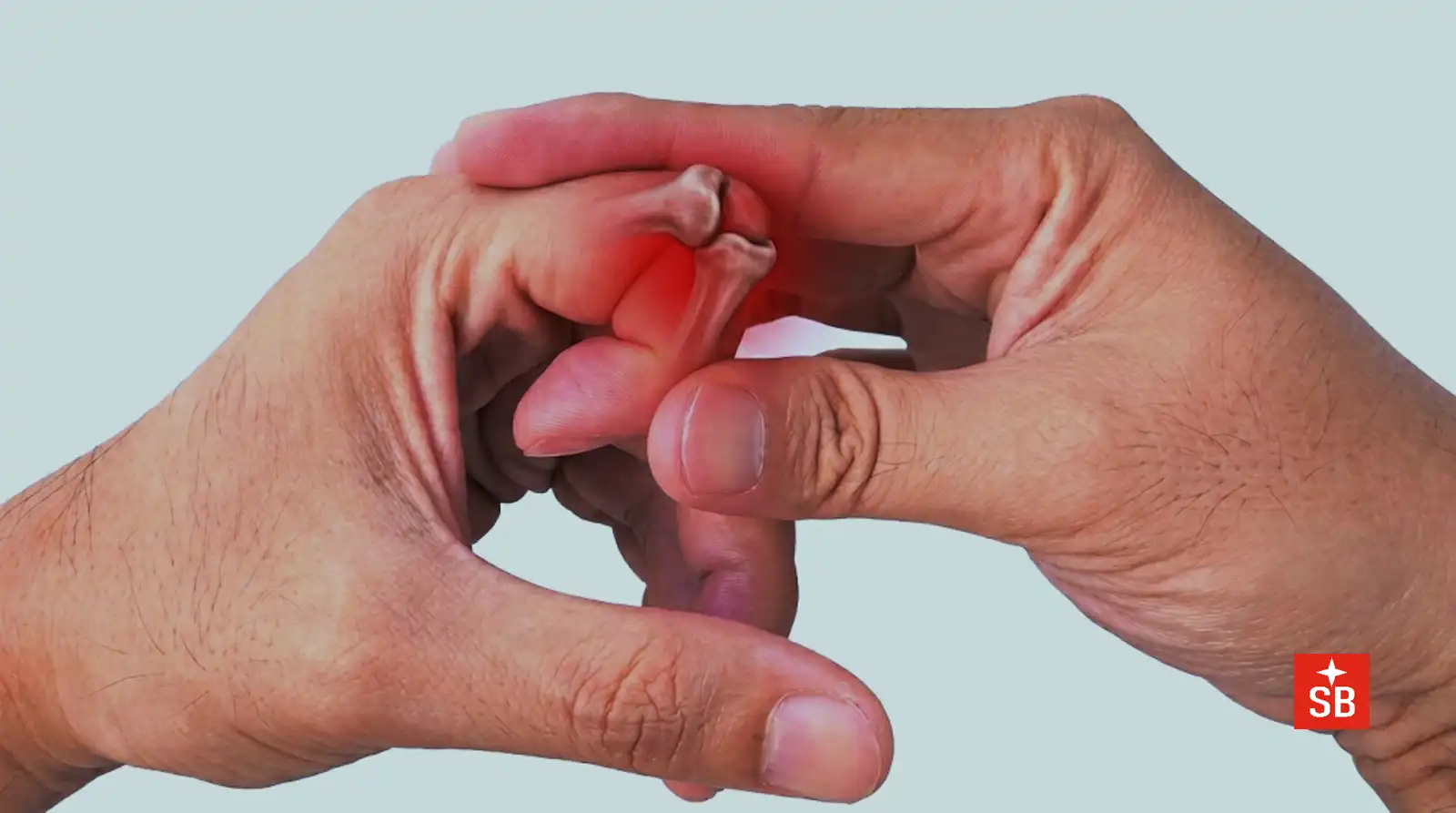
When your brain is stressed or bored, your hands feel stiff, or you just want to look like a cool movie action hero, you pop your knuckles either for instant, satisfying relief or completely on autopilot, you sit there, gripping your fingers and squeezing them until crack. That sudden, stark pop deeply satisfying to you, yet utterly maddening to those around you is not the grim sound of your bones fracturing, snapping, or grinding against one another in the dark.What is the true, hidden alchemy behind that sharp acoustic shockwave? Does this compulsive habit doom your hands to a future of ruin, or is it merely a harmless compulsion? Let us pierce the veil of anatomy to explore the startling science of what happens beneath your skin, unravel the long-term consequences of the act, and finally separate the enduring myths from the cold, hard facts.
What’s Actually Happening Inside the Joint- Your finger joints specifically the metacarpophalangeal joints are surrounded by a capsule filled with synovial fluid a thick, egg white like lubricant that reduces friction and cushions the bones. This fluid contains dissolved gases, mainly carbon dioxide, along with nitrogen and oxygen. When you pull, bend, or stretch a finger hard enough to “crack” it, you rapidly increase the space between the joint surfaces. This sudden expansion drops the pressure inside the joint. The lower pressure causes the dissolved gases to come out of solution and form a bubble or cavity in a process called cavitation.
The distinctive popping sound is produced by the rapid dynamics of that bubble. Scientific consensus has shifted over the decades, but the leading explanation supported by mathematical modeling is that the bubble’s partial collapse or rapid size fluctuation generates the acoustic wave we hear. A full collapse isn’t even required the bubble can shrink sharply and still create the characteristic pop while leaving a smaller gas pocket behind. This also explains the familiar refractory period: you usually can’t crack the same knuckle again for about 15–20 minutes. The gases need time to redissolve into the synovial fluid before another bubble can form.

The Long-Running Scientific Debate: Researchers have studied knuckle cracking for more than 70 years. Early work in the 1940s and a 1971 study pointed to bubble collapse. Then a 2015 real time MRI study suggested the sound occurred at the moment the cavity formed, not when it collapsed. In 2018, engineers published a mathematical model in Scientific Reports that matched the volume and frequency of real knuckle crack recordings and supported partial bubble collapse as the source of the sound. The debate isn’t fully settled, but the cavitation explanation remains the strongest.
Does Cracking Your Knuckles Cause Arthritis? This is one of the most persistent myths. Multiple studies and medical reviews have found no link between habitual knuckle cracking and osteoarthritis or other joint damage. The pressures involved are well within the range the joint can handle. While excessive force could theoretically irritate soft tissues, ordinary cracking is considered harmless for most people. Some individuals simply can’t crack their knuckles at all likely due to differences in joint geometry or synovial fluid properties.
Why the Sound Feels So Satisfying- Beyond the physics, many people report a sense of relief or increased mobility after cracking. This may come from the temporary change in joint pressure, the stretching of the capsule and surrounding ligaments, or simply the sensory feedback of the pop itself. Whatever the reason, the sound is a miniature demonstration of fluid dynamics happening right inside your hand. The next time you hear that familiar crack whether from your own fingers or someone else’s you’ll know it’s not bone against bone. It’s a tiny, high speed event in the synovial fluid: pressure dropping, a gas bubble forming and fluctuating, and sound waves racing outward.