
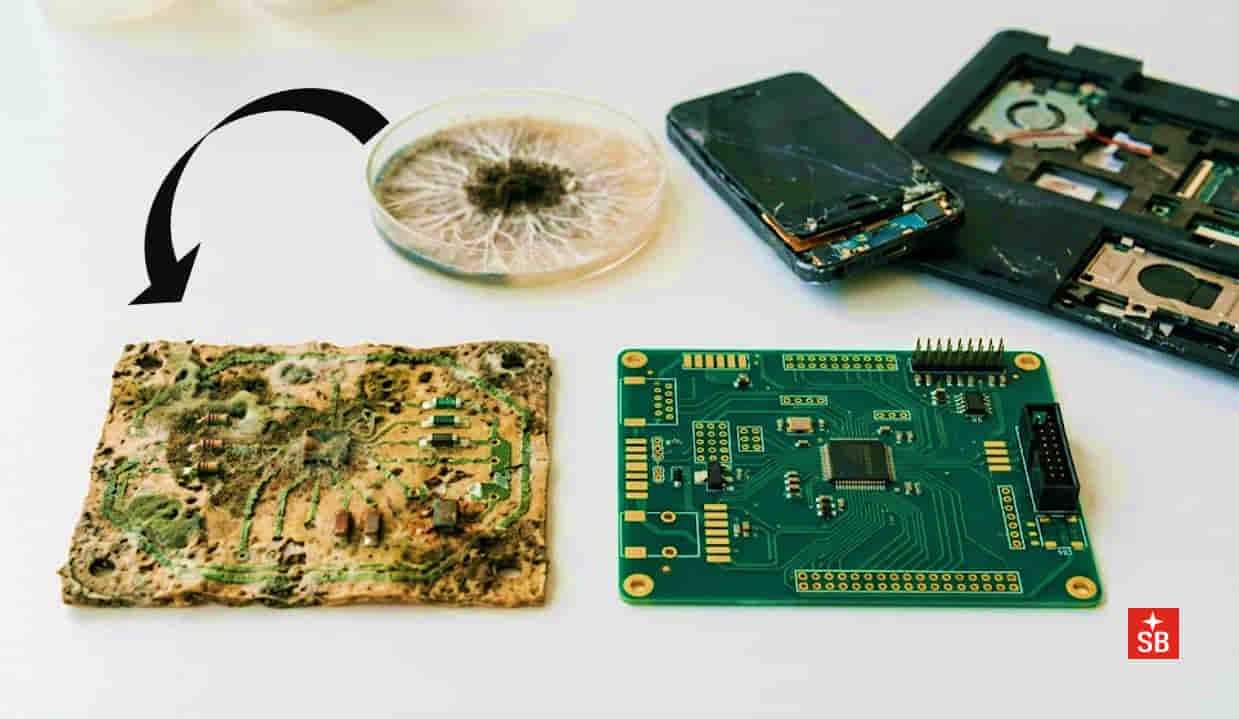
Every year, the world throws away millions of old phones, broken toys, damaged computers, and outdated electronic gadgets. Together, they form a mountain of electronic waste that grows bigger every day. By 2030, this pile is expected to reach about 82 million metric tons, almost like stacking nearly 8,000 Eiffel Towers made entirely of discarded electronics. Hidden inside this mountain is one of the toughest pieces to recycle, the printed circuit board, or PCB. It is the brain of every electronic device, but once it dies, it usually remains buried in landfills for hundreds of years. Nature seems to sigh, “Why create forever from something used for only a few years?” As the proverb says, “Waste not, want not.”
Now comes an unexpected hero, Aspergillus niger, commonly known as black mold. Most people know it as a fungus, but industries know it as a hardworking factory that produces large amounts of citric acid used in foods, drinks, and medicines. After fermentation, this fungus leaves behind a thread-like network called mycelium, which is usually treated as industrial waste. Researchers at TU Bergakademie Freiberg in Germany looked at this leftover material differently. They said, “Why throw it away when it can build the future?” Sometimes, one person’s waste truly becomes another person’s treasure.
“Nature often hides the best inventions in the most unexpected places.”
The scientists collected this spent fungal biomass and packed it into molds shaped like printed circuit boards. Instead of using energy hungry machines or high temperature ovens, they simply allowed the material to dry naturally in air. As it dried, the tiny fungal threads locked together like millions of tiny hands holding each other, forming a strong plate that looked and felt similar to a normal circuit board. This new material was named AnimatPCB. It proves that even a humble fungus can wear the crown of innovation.
Once the fungal board became firm, researchers manufactured it almost like a traditional PCB. They printed electrical pathways, etched the required patterns, and soldered electronic components onto its surface. The result was a working electronic circuit board made largely from biological waste. This approach belongs to the growing field of sustainable materials science, where renewable biological resources replace petroleum based products without sacrificing useful performance.
The environmental benefits are equally exciting. A complete life cycle analysis showed that AnimatPCB can reduce carbon dioxide emissions by as much as 56 percent compared with conventional printed circuit boards. Even more importantly, when its useful life ends, the board does not become a stubborn guest occupying landfills for centuries. Instead, it can break down in water, allowing useful electronic components to be recovered and reused. It is almost as if the board gently says, “My job is finished, now let me return to nature.”
Of course, this fungal board is not yet ready to replace the high performance circuit boards inside powerful gaming computers or advanced smartphones. Its electrical properties still need improvement, and researchers are working to make it more resistant to moisture so it can satisfy industrial standards such as IPC A 600. In scientific terms, the material still requires optimisation before large scale commercial adoption.
Even with these limitations, AnimatPCB already shows great promise for low frequency electronic devices such as environmental sensors, educational kits, electronic toys, and simple wearable devices. These products do not require extremely high electrical performance, making fungal circuit boards a practical and environmentally friendly alternative. Every small success in this field is another step toward reducing the world’s growing electronic waste problem.
This remarkable discovery reminds us that the future of technology may not always come from shining laboratories filled with expensive machines. Sometimes, it quietly grows inside a fermentation tank, hidden among threads of an ordinary fungus. Nature has always been the world’s greatest engineer. We only needed to learn how to listen. As the old saying wisely reminds us, “Great oaks from little acorns grow.” Today, even black mold is teaching humanity that tomorrow’s technology can be cleaner, greener, and kinder to our planet.
Source: Nina Oehlsen, Sebastian B. Wachsmann, Dominik Fauser, Florian Glauche, Sabine Laschat, Franz Selbmann, Holger Steeb, Pál Árki, Simon Glöser-Chahoud, Linus Stegbauer. From biotechnological residues to biodegradable printed circuit boards: Aspergillus niger mycelium as a structural support material. Cleaner Materials. (2026). https://doi.org/10.1016/j.clema.2026.100416


