
European summers have, for many centuries, been characterised by warm afternoons, cool evenings, and a climate that enabled people to enjoy outdoor cafés, take strolls along historic streets, and sleep comfortably with the windows open. In most of central and western Europe, a typical summer has daytime temperatures ranging between 22°C and 30°C, with temperatures only rarely rising above 35°C.
However, in the summer of 2026, these rules are being rewritten.
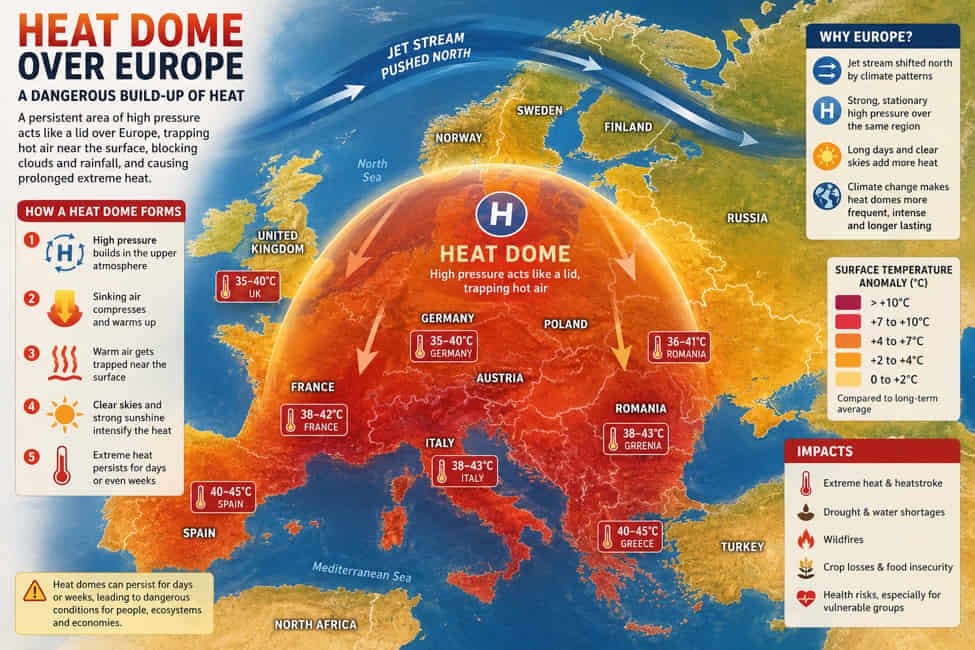
A huge Heat Dome has settled over southern and central Europe, trapping scorching air beneath an atmospheric “lid,” with temperatures rising above 40°C in Spain, Portugal, Italy, Greece, the Balkans, and parts of France. Meteorologists caution that this is not just another hot period. It is the fourth major heatwave of the season, a very rare sequence that has turned large areas of the continent into a massive natural furnace.
So, what exactly is a Heat Dome?
Picture placing a glass bowl over a burning candle so that the hot air cannot escape and keeps accumulating beneath the bowl. A Heat Dome functions in a very similar way.
A vigorous and persistent high-pressure system compresses the air beneath it. As this air descends, it becomes increasingly hotter because it is compressed. At the same time, the high-pressure system prevents cooler weather systems from the Atlantic from reaching the region, so clouds and rainfall cannot provide any relief. The longer the dome remains in place, the more heat builds up in both the air and the ground, creating a dangerous feedback loop in which each day becomes hotter than the one before.
Why is Europe experiencing such intense heat?
One major reason lies just off its coast.
The Mediterranean Sea is much warmer than usual and acts as a huge reservoir of heat. Rather than cooling the nearby land, it releases warm, moist air during both the day and the night. This causes nighttime temperatures to remain unusually high, preventing people, buildings, and infrastructure from cooling down. Scientists say that this “warm-night effect” greatly increases health risks because the human body never gets a chance to recover from the heat of the day.
Why is 40°C more dangerous in Europe?
In Europe, 40°C is very different from 40°C in deserts or in parts of India and the Middle East.
European houses were built to keep heat inside during long, cold winters. Thick insulation, airtight buildings, and the limited availability of air conditioning become disadvantages during prolonged heatwaves. In many apartments, temperatures remain dangerously high throughout the night, turning bedrooms into hot zones. Public transport systems, railways, roads, and even the power grid were originally designed for cooler climates and are now being placed under increasing strain by prolonged periods of extreme heat.
In short, Europe is experiencing tropical temperatures while its infrastructure was designed for a temperate climate.
A landscape ready to ignite
Continuous sunshine, low humidity, and dry vegetation have turned forests into fuel ready to catch fire. In both France and Spain, firefighters are still battling massive wildfires that have forced the evacuation of tens of thousands of people, destroyed homes, and produced enormous smoke plumes visible from space. In some cases, the fires have even created their own weather patterns, generating strong convection and lightning that can ignite new fires kilometres away.
How long will it last?
Forecast models suggest that the Heat Dome is likely to persist into early August, even if its exact position shifts around the Mediterranean basin. In areas where daytime temperatures drop only slightly, the heat stored in both the land and the sea will keep conditions well above seasonal averages for several days afterward.
More than just another hot summer
Europe has experienced famous heatwaves in the past, including those in 2003, 2022, and 2023. However, the situation in 2026 is different because of the extraordinary duration of the heatwaves. Rather than consisting of a single isolated event, several heatwaves have followed one another in quick succession, leaving little opportunity for ecosystems, infrastructure, or people to recover. This creates a cumulative burden on agriculture, public health, water resources, and emergency services.
While the invisible atmospheric lid continues to trap heat over the continent, Europe is learning an uncomfortable lesson: the greatest risk lies not in a single intensely hot day but in a climate capable of turning an entire season into an endurance ordeal. The Heat Dome is no longer just a meteorological oddity. It has become a powerful symbol of how a warming world is changing the character of summers, testing cities designed for a different era, and compelling millions to reconsider what “normal” weather really means.


