
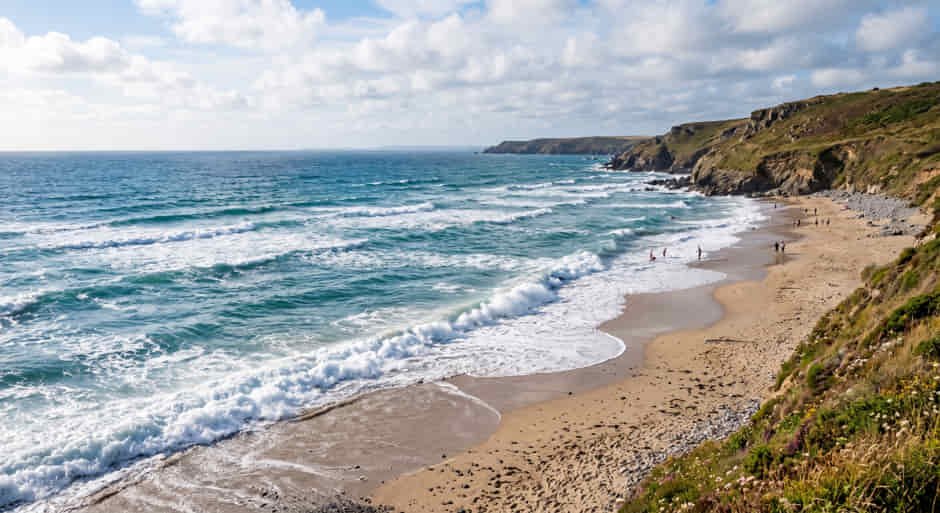
Stand on a beach for a few minutes, and nature quietly performs one of its oldest magic tricks. Far out in the sea, the waves wear a calm blue coat, rising and falling like gentle breathing. But as they race towards the shore, they suddenly leap, tumble, and burst into bright white foam. It almost feels as if the waves are putting on a grand farewell performance before meeting the land. If water is just water, why does this happen only near the beach? And why don’t rivers, made of the very same water, perform this foamy dance? As the old proverb says, “Still waters run deep,” but near the shore, the sea refuses to stay still.
The secret lies beneath the surface, where the eye cannot easily see. In the deep ocean, waves have plenty of space below them. Although the waves seem to travel across the sea, most of the water does not move forward with them. Instead, each water particle moves in tiny circular paths, much like spectators doing the “wave” in a cricket stadium. The energy travels onward, while the water mostly stays in its own place. Scientists call these orbital motions, and they allow waves to carry energy across thousands of kilometres without transporting large amounts of water.
“The ocean whispers in blue but applauds the shore in white“
Everything changes when the wave reaches shallow water. The seabed begins to act like an invisible hand gently holding back the bottom of the wave. The lower part slows because it rubs against the ocean floor through friction, while the upper part continues moving faster. It is like a runner whose feet suddenly get stuck in soft sand while the rest of the body keeps moving forward. Soon the wave becomes taller and steeper until it can no longer balance itself. The crest finally falls forward with a dramatic splash. One could almost hear the wave say, “I have carried this energy long enough, now it’s time to let go.”
The brilliant white colour is another fascinating piece of science. When the wave crashes, it traps countless tiny air bubbles inside the water. Each bubble behaves like a tiny mirror, scattering sunlight in every direction. This process is known as light scattering. Unlike the deep blue sea, where light passes through water, the foam reflects almost every colour of visible light equally, making it appear white to our eyes. It is much like crushed ice or fresh snow, both of which look white even though ice itself is transparent. Nature paints the sea white not with colour, but with light.
Rivers tell a very different story. They are flowing currents rather than giant wind-powered energy highways. Most rivers are narrow, shallow, and protected from the strong winds that build huge ocean waves. Any ripples that form usually lose their energy before growing into towering breakers. Of course, rivers can also wear a white crown, but only when fast-moving water crashes over rocks, waterfalls, or rapids. There, the tumbling water traps air bubbles, producing white water through the same scattering of light. In other words, the ocean creates white foam because waves break, while rivers create it because flowing water collides with obstacles. Same science, different stage.
From an oceanographic perspective, breaking waves are controlled by the interaction between wind energy, gravity, water depth, and seabed topography. As waves enter shallow water, a process called wave shoaling reduces their speed while increasing their height and steepness. When the wave height becomes too large compared with the water depth, the crest becomes unstable and collapses, producing surf and entraining air bubbles. These bubbles scatter incoming sunlight through multiple reflections, giving sea foam its characteristic white appearance. This process represents a beautiful partnership between fluid dynamics, optics, and coastal geology.
The next time you stand on a beach, remember that every white wave is more than splashing water. It is the sea writing its final signature before touching the shore. What looks like simple foam is actually a masterpiece created by wind, gravity, light, and the hidden shape of the ocean floor. Nature reminds us once again that even the most familiar sights often hide extraordinary science beneath the surface.


