
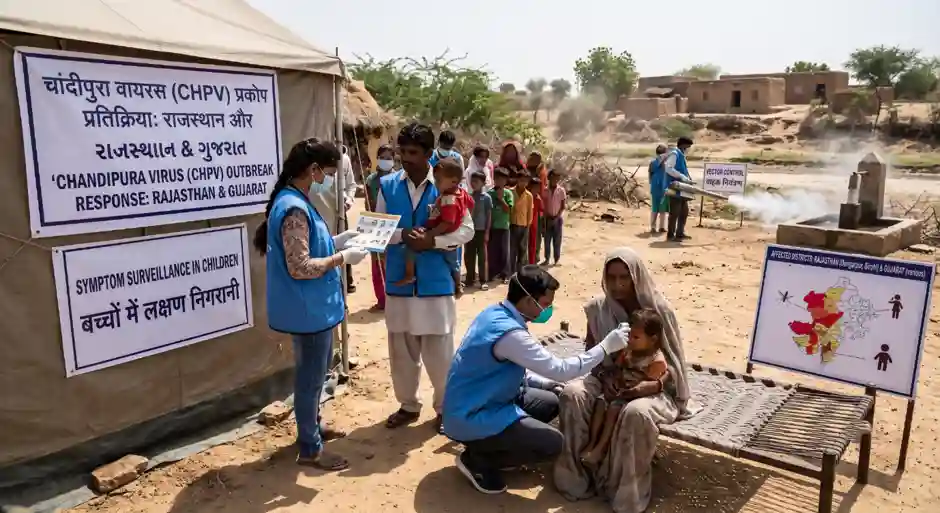
The recent Chandipura virus outbreak in Gujarat and Rajasthan has raised concerns across the country, particularly after several children were reported to have died from the infection. Unlike viruses such as COVID-19 or influenza, Chandipura virus is relatively unfamiliar to most people. So, what exactly is this virus, and why does it seem to affect children much more severely than adults?
In simple words, Chandipura virus is a tiny biological intruder that can turn a seemingly ordinary fever into a medical emergency. It may begin quietly, but its effects can become a storm inside the body. This is why awareness is the first line of defence. As the saying goes, “A stitch in time saves nine.”
The Chandipura virus belongs to the Rhabdoviridae family and is primarily spread through the bite of infected sandflies, although some mosquitoes and ticks are also being investigated as possible carriers. Unlike the common cold or COVID-19, it does not spread from person to person. Instead, the infection begins when an infected insect introduces the virus into the bloodstream during a bite.
In other words, the insect acts like a tiny delivery vehicle, carrying the virus from one host to another. This is known as vector-borne transmission, a scientific term that simply means an infection is carried by another living organism, such as an insect. The bite may be small, but the biological consequences can be anything but small.
What makes Chandipura virus particularly dangerous is the speed at which it can reach the brain. After entering the body, the virus can invade the central nervous system, causing acute encephalitis, or inflammation of the brain. The brain is the body’s control centre, responsible for everything from movement and breathing to memory and consciousness. When the virus inflames this delicate tissue, symptoms can worsen within hours. A child may initially develop fever, vomiting, headache, or weakness, but these can rapidly progress to seizures, confusion, loss of consciousness, and, in severe cases, death if medical care is delayed.
The brain can be compared to the body’s command room, coordinating many functions at once. When inflammation disrupts this command centre, the body’s normal communication network can become severely disturbed. In medical language, acute encephalitis means sudden inflammation of brain tissue, but behind this jargon lies a very serious problem. The danger is not merely the fever, but the virus’s ability to interfere with the nervous system at remarkable speed.
This rapid progression is one reason Chandipura virus has earned a particularly worrying reputation. It can be a race against time, where every hour may matter. The phrase “time is of the essence” is not just an idiom here, it reflects the importance of recognising severe symptoms quickly.
Children are especially vulnerable because their immune systems and nervous systems are still developing, making it harder for their bodies to control the infection before it reaches the brain. At present, there is no specific antiviral treatment or vaccine for Chandipura virus. Doctors therefore focus on supportive care by managing fever, controlling seizures, maintaining hydration, and closely monitoring brain function while the immune system fights the infection.
Supportive care does not mean doing nothing. It means keeping the body’s vital systems stable while its natural defences fight the infection. Doctors may have to act like a maintenance crew during a storm, carefully supporting essential functions while the underlying problem is being tackled. Every measure, from controlling seizures to maintaining hydration, can become an important piece of the treatment puzzle.
The current outbreak is a reminder that not every dangerous virus becomes a global pandemic. Some remain confined to specific regions but can still pose a serious public health threat. As researchers continue working toward better treatments and vaccines, the most effective protection remains early medical attention for symptoms and reducing exposure to insect bites, especially among children living in affected areas.
This is the irony of infectious diseases: a virus does not need to circle the globe to cause serious harm. A local outbreak can still leave a deep mark on families and communities. Prevention, awareness, and timely medical care therefore remain powerful tools. In public health, an ounce of prevention is often worth a pound of cure.


