
Nature has given our body many amazing repair mechanisms. A cut on the skin slowly fades away. A broken bone joins together again. Even the liver has the power to rebuild itself. But our teeth have always seemed to say, “Once I lose my shield, I cannot get it back.” For years, dentists have repaired damaged teeth with fillings, but what if the tooth could rebuild its own armour? Scientists have now developed a fluoride free gel that may help damaged tooth enamel grow back. It sounds like science fiction, but it is becoming scientific reality. As the proverb says, “Where there is a will, there is a way.”
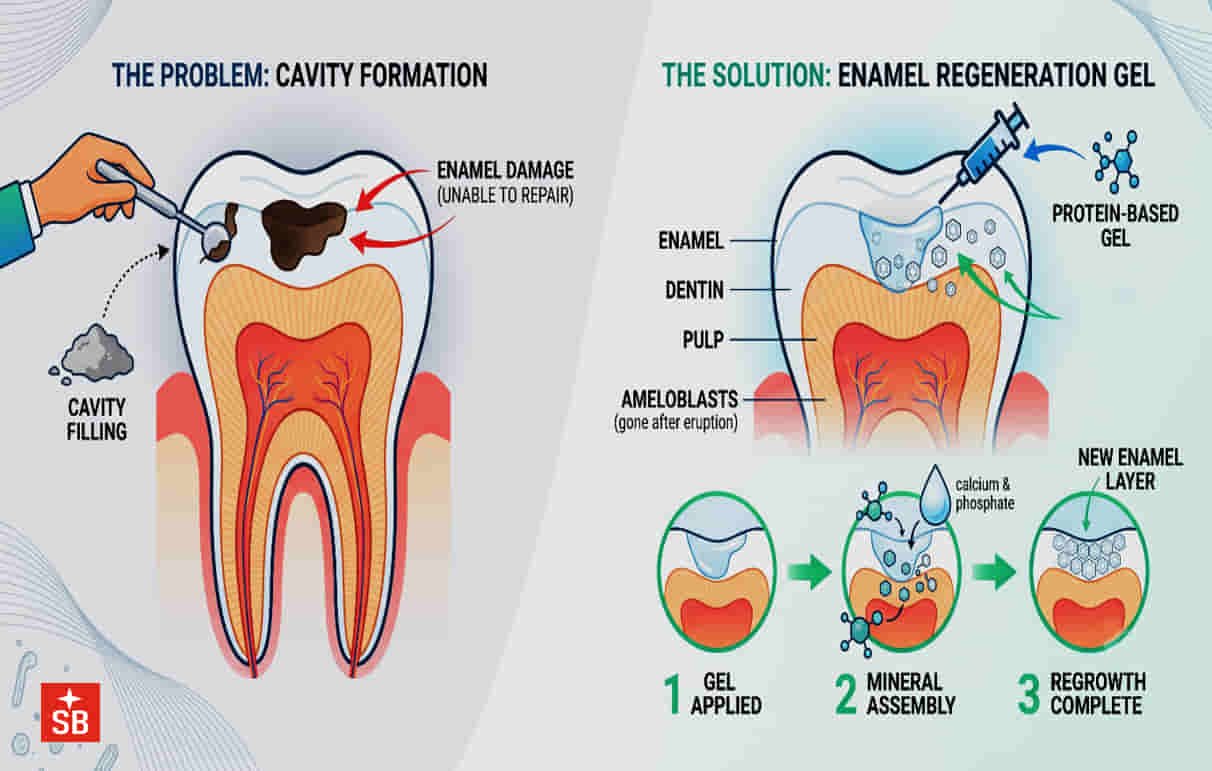
Tooth enamel is the hardest substance in the human body. It is like a strong helmet protecting a soldier on the battlefield. Every day it fights against acids, sugar, bacteria, and constant chewing. Yet even the strongest shield can crack after countless battles. Unlike skin or bone, enamel has no living cells. Once it is damaged, the body cannot naturally repair it. That is why dentists usually remove the damaged part and place a filling. The tooth survives, but its original shield is never truly restored.
Scientists wanted to solve this long standing problem by learning from nature itself. During infancy, special cells called ameloblasts build enamel with the help of proteins. These proteins carefully arrange calcium and phosphate minerals into tiny crystals, creating one of the strongest materials found in the human body. After the tooth appears in the mouth, these remarkable cells quietly disappear forever. It is like skilled builders leaving the construction site after finishing a beautiful building. Without the builders, no new enamel can normally be made.
The newly developed protein based gel follows nature’s own blueprint. Instead of simply making enamel stronger like fluoride, the gel behaves like a patient architect. It gently enters tiny cracks and weak areas inside the enamel and forms a microscopic scaffold. The gel almost whispers, “Come here, minerals, let us rebuild this wall together.” Calcium and phosphate, naturally present in saliva, gather around this scaffold and slowly arrange themselves into new enamel like crystals. Piece by piece, crystal by crystal, the damaged surface begins to regain its strength.
Laboratory studies on human teeth have produced encouraging results. The newly formed mineral layer did not merely sit on the surface like fresh paint on an old wall. Instead, it blended smoothly with the existing enamel, creating a strong connection. This seamless integration is important because it may provide better strength and durability than simple surface coatings. Scientists believe this approach could preserve the natural structure of the tooth instead of replacing damaged areas with artificial materials.
If future clinical trials confirm these findings, the benefits could be remarkable. Early tooth decay, enamel erosion caused by acidic drinks and foods, and tooth sensitivity may one day be treated before serious damage develops. Dentists may be able to repair the tooth’s own protective layer rather than drilling away healthy tissue. In many cases, fewer fillings could mean healthier teeth for a longer time. As the saying goes, “Prevention is better than cure,” and this discovery may take prevention to an entirely new level.
The science behind this breakthrough combines protein engineering, biomineralization, and regenerative dentistry. Biomineralization is the natural process through which living organisms produce mineral structures such as bones and teeth. By designing proteins that imitate those used during early enamel formation, researchers have created conditions that encourage calcium phosphate crystals to grow in an organised pattern. Rather than forcing nature to change, they are working with nature’s own instruction manual. Sometimes the best teacher is nature itself.
This discovery also reminds us that science often grows by asking simple questions. What once seemed impossible is now becoming possible because researchers chose to think differently. Years ago, regrowing enamel sounded like chasing a rainbow. Today, it is a serious area of scientific research. Although the gel still requires further clinical testing before becoming a routine dental treatment, the early findings offer genuine hope for millions of people around the world.
A simple quote captures the spirit of this discovery, “Nature writes the best designs, science learns to read them.” The future of dentistry may not only be about filling cavities, it may be about helping teeth heal themselves, one tiny crystal at a time.
Sources:
Hasan et al., (2025). Biomimetic supramolecular protein matrix restores structure and properties of human dental enamel. Nature Communications, 16(1), Article 64982.


