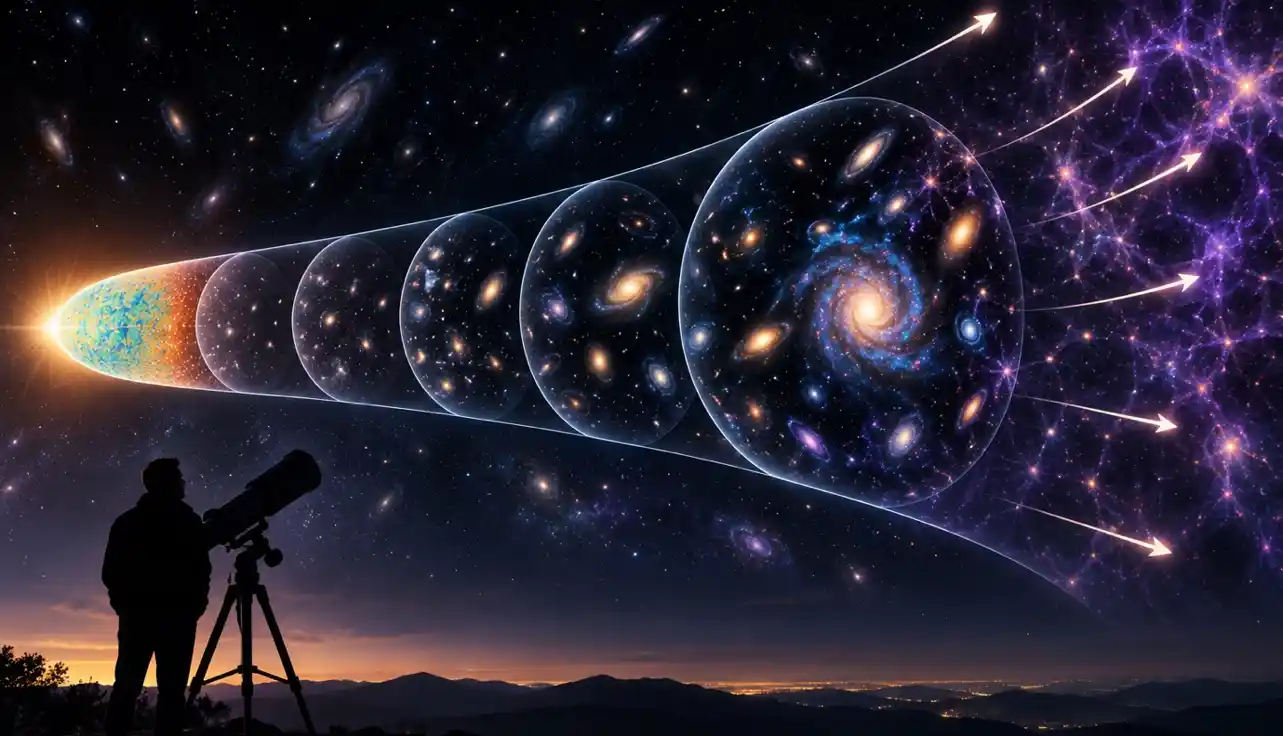
The universe is expanding and that expansion is accelerating. For more than two decades, scientists have explained this acceleration using dark energy, a mysterious component thought to make up roughly 70% of the cosmos. The simplest explanation is that dark energy is a constant property of space itself. But new observations are raising an intriguing possibility: dark energy may not be constant after all.
One of the strongest hints comes from the Dark Energy Spectroscopic Instrument (DESI), an experiment designed to create an enormous three-dimensional map of the universe. By measuring the positions and distances of millions of galaxies and quasars, DESI allows scientists to reconstruct how the universe expanded over billions of years.
In 2025, DESI researchers analyzed observations of nearly 15 million galaxies and quasars collected during the first three years of the survey. When these measurements were combined with observations of the cosmic microwave background, supernovae and weak gravitational lensing, the data showed a preference for models in which dark energy changes over time. Depending on which datasets were combined, the statistical significance ranged from 2.8 to 4.2 sigma interesting evidence, but below the 5-sigma threshold traditionally required for a discovery in particle physics and cosmology.
The idea becomes even more interesting when observations of exploding stars are considered. Type Ia supernovae act as cosmic distance markers, allowing researchers to compare how rapidly the universe expanded at different points in its history. Independent analyses have also found hints consistent with evolving dark energy, although the strength of the evidence depends partly on how the supernova data are analyzed. A 2026 Nature Astronomy assessment highlighted how systematic effects in supernova measurements can change the apparent strength of the evidence.
There is also a reason for caution. In July 2026, a new DESI analysis using the Lyman-alpha forest patterns produced when hydrogen gas absorbs light from distant quasars showed results that were more consistent with the standard cosmological model than earlier measurements. DESI researchers noted that this could mean the current hints of evolving dark energy may weaken, or that a more complicated model may ultimately be needed.
DESI completed its original five-year mapping program in April 2026, collecting measurements of more than 47 million galaxies and quasars. Researchers expect the first major dark-energy results from the complete dataset in 2027.
If future observations confirm that dark energy changes with time, scientists may need to rethink the standard model of cosmology. If the signal disappears as measurements improve, it will demonstrate another important lesson of science: extraordinary ideas require extraordinarily strong evidence.
For now, the question remains open but the universe may be giving cosmologists one of their most interesting puzzles yet.
Sources:
https://www.nature.com/articles/s41550-026-02880-z
https://newscenter.lbl.gov/2025/03/19/new-desi-results-strengthen-hints-that-dark-energy-may-evolve/