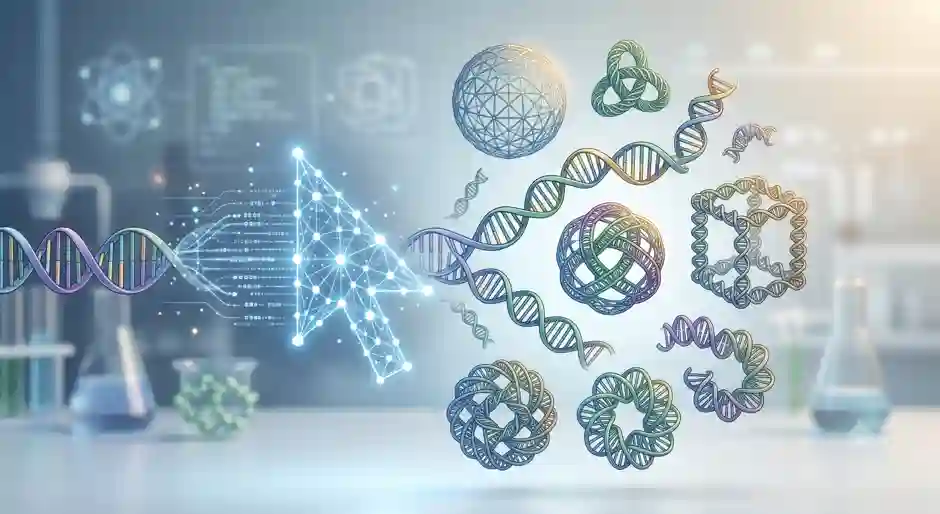
DNA is best known as the molecule that stores the genetic information of living organisms. But scientists have increasingly learned to use DNA as a construction material, creating tiny structures through a technique known as DNA origami. Now, generative artificial intelligence is opening a new chapter in this field by helping researchers design complex DNA nanostructures that would be difficult to create manually.
In May 2026, researchers reported a generative AI framework called Generative SNUPI, which uses a diffusion-based model to design DNA origami structures from user-defined shapes. Instead of requiring scientists to manually determine how thousands of DNA strands should be arranged, the system can translate a target geometry into a physically plausible molecular design and determine how the DNA strands should be routed.
The researchers generated more than 100 candidate structures and experimentally tested selected designs. The resulting structures successfully folded into their intended forms and demonstrated properties including reconfigurable mechanical behavior and modular assembly. The system was also able to explore unusual geometries, including curved structures, three-dimensional wireframes and knot-like designs.
This development could significantly expand the possibilities of DNA nanotechnology. Precisely engineered DNA structures could eventually be used in drug delivery, biosensing, molecular robotics, nanomachines and advanced materials. DNA nanotechnology is already being investigated for applications ranging from therapeutic systems to molecular computation.
However, AI-designed DNA structures are not yet ready for widespread medical or industrial use. Scientists still need to address challenges such as structural stability, manufacturing, biological compatibility and degradation inside the body. Recent research is exploring computational and chemical strategies to improve the stability of DNA origami under biological conditions.
The significance of this research goes beyond simply making DNA shapes. It demonstrates a shift toward AI-assisted molecular engineering, where researchers can describe what they want at a higher level and allow algorithms to explore possible molecular designs. As generative AI becomes more capable of working with biological systems, the boundary between computer science, engineering and molecular biology may become increasingly blurred.
The future of nanotechnology may therefore involve not just scientists designing molecules—but AI systems designing the molecules that scientists can build and test.
Sources:
https://www.sciencedirect.com/science/article/pii/S2773045X2600035X?