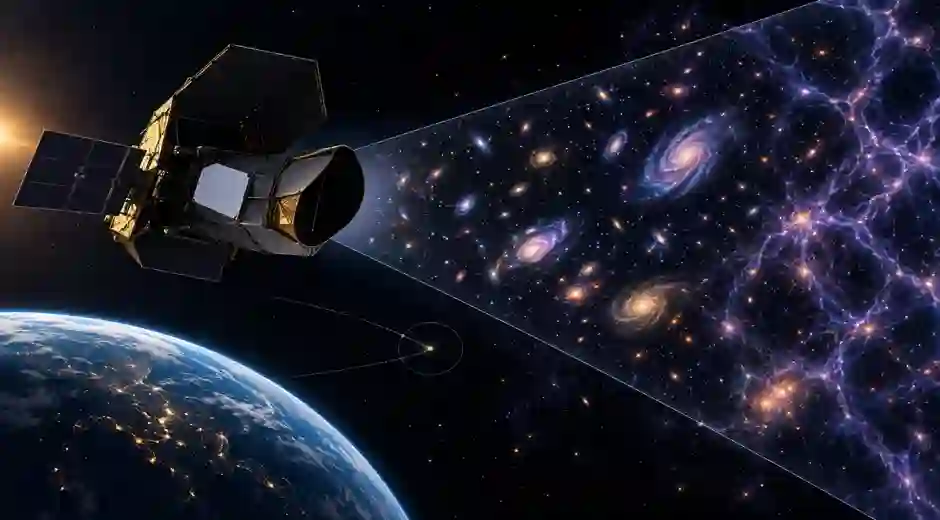
What is causing the universe to expand faster and faster? Scientists have spent decades trying to answer this question, and one of NASA’s newest space observatories could provide some of the most important clues yet. The Nancy Grace Roman Space Telescope, launched on August 30, 2026, is designed to investigate dark energy, dark matter, distant galaxies and planets beyond our Solar System.
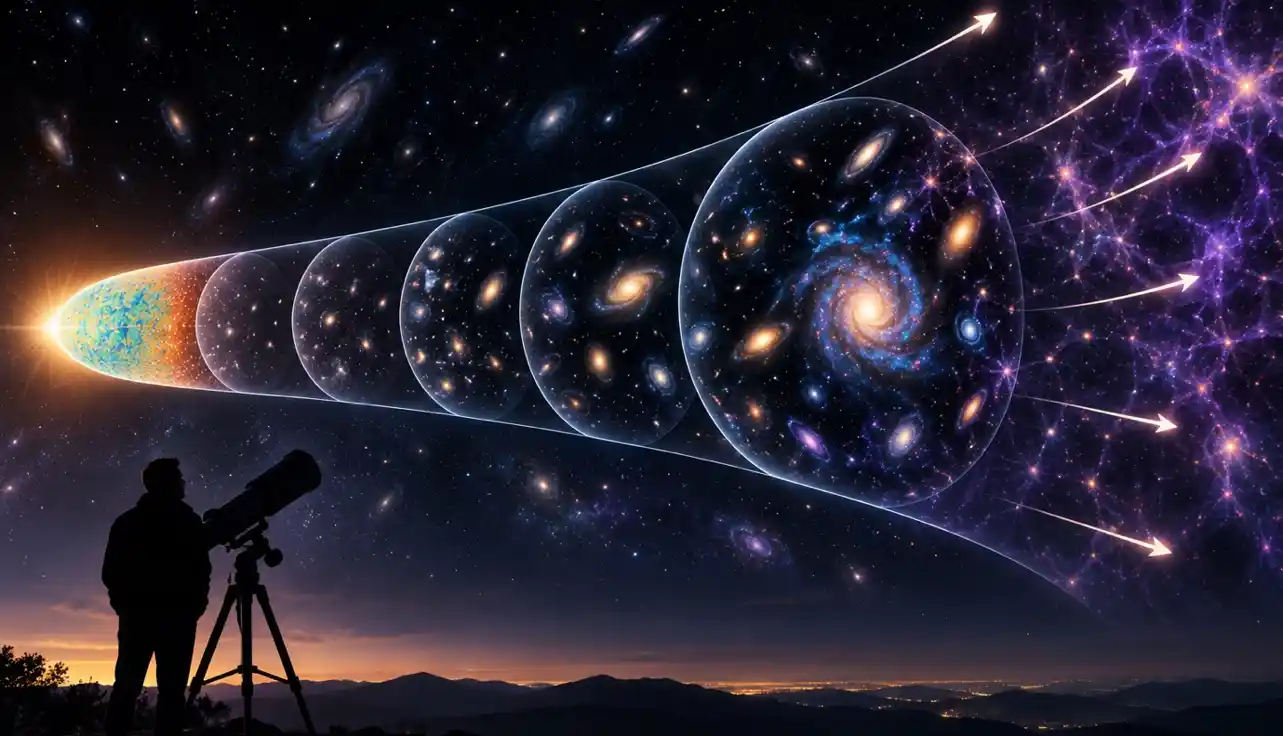
Dark energy is one of the biggest mysteries in modern cosmology. Scientists estimate that it accounts for roughly 68% of the universe, yet its true nature remains unknown. It is associated with the accelerated expansion of the universe the observation that galaxies are moving apart at an increasingly rapid rate. Recent observations have even raised the possibility that dark energy could change over cosmic time, although scientists stress that more evidence is needed.
Roman is designed to investigate this mystery by surveying enormous regions of the sky with exceptional precision. Its Wide Field Instrument combines sharp infrared vision with a field of view at least 100 times larger than Hubble’s. This means Roman can observe huge numbers of galaxies in relatively short periods, creating an enormous dataset for cosmologists to study.
One of Roman’s key approaches will be measuring baryon acoustic oscillations, ancient patterns left behind by sound waves in the early universe. Scientists will also study thousands of Type Ia supernovae, which can act as cosmic distance markers, and use weak gravitational lensing to measure how matter is distributed and how gravity has shaped the cosmic web. Together, these techniques can reveal how the universe expanded and how its structure evolved over billions of years.
Roman will also work alongside other major observatories, including the Vera C. Rubin Observatory and the European Space Agency’s Euclid mission. Combining their observations could provide a much clearer picture of cosmic expansion than any single telescope could achieve.
The telescope is now beginning its journey toward the second Sun–Earth Lagrange point, or L2, roughly one million miles from Earth. NASA expects the commissioning process to take about three months, with the first science images expected in early 2027.
Roman may ultimately tell us whether dark energy is a constant feature of the universe or something that changes with time. Either answer could reshape our understanding of the cosmos and perhaps reveal that our current model of the universe is incomplete.
Sources
https://science.nasa.gov/mission/roman-space-telescope/?
https://www.nasa.gov/missions/roman-space-telescope/core-survey-by-nasas-roman-mission-will-unveil-universes-dark-side/?